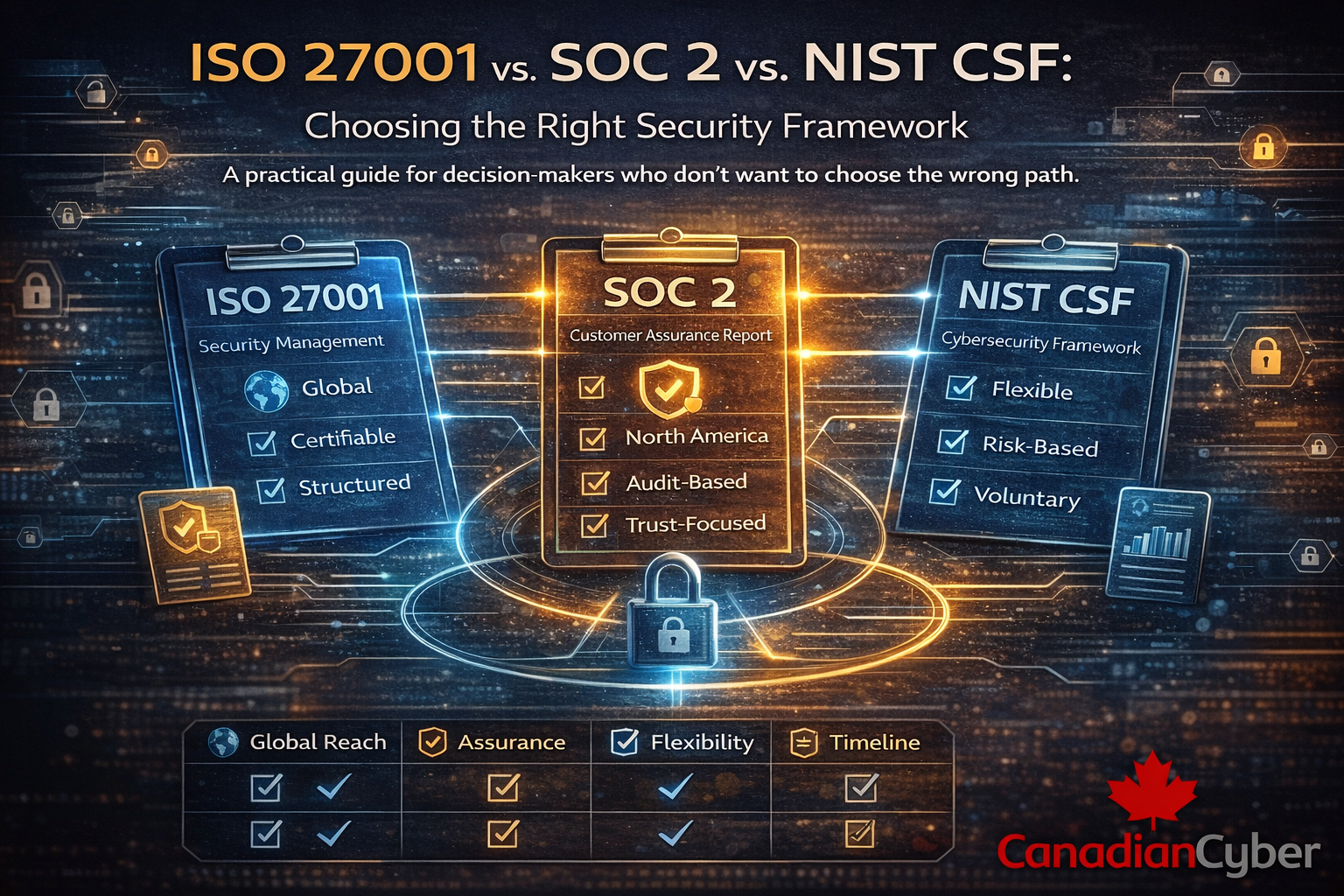
ISO 27001 vs. SOC 2 vs. NIST CSF: Choosing the Right Security Framework
A practical guide for decision-makers who don’t want to choose the wrong path especially in Canada and North America.
If you search for cybersecurity frameworks, you’ll quickly run into three names:
ISO 27001, SOC 2, and NIST CSF.
They’re often mentioned together and often confused. They are not interchangeable.
Why This Question Comes Up So Often
Most organizations don’t wake up wanting a framework. They’re pushed into the decision by:
- Customer security questionnaires and procurement requirements
- Regulatory pressure or privacy obligations
- Board or investor questions
- A recent incident or near-miss
Core idea: The right choice depends on what you’re trying to prove and to whom.
Are you proving governance, control effectiveness, or security maturity?
What ISO 27001, SOC 2, and NIST CSF Have in Common
All three frameworks aim to:
- Reduce cyber risk and protect sensitive information
- Improve security governance and accountability
- Create repeatable security practices (not one-off heroics)
Where they differ is how they achieve this and who they’re designed to satisfy.
ISO 27001: The Global Security Management Standard
ISO/IEC 27001 is an internationally recognized standard for building an Information Security Management System (ISMS). It focuses on risk management, governance, accountability, and continuous improvement.
Key characteristics
- Certifiable by accredited certification bodies
- Globally recognized and widely accepted
- Structured and management-system driven
ISO 27001 answers:
“Do you manage information security in a structured, risk-based way?”
Often preferred by global organizations, regulated industries, enterprises, public sector, and Canadian companies with international clients.
SOC 2: Customer-Driven Assurance for Service Providers
SOC 2 is a third-party attestation report commonly requested by customers — especially in North America.
It evaluates controls against the Trust Services Criteria (e.g., Security, Availability, Confidentiality, Processing Integrity, Privacy).
Key characteristics
- Report (not a certification)
- Issued by CPA firms
- Highly customer and procurement focused
- Evidence-driven (proof matters)
SOC 2 answers:
“Can you prove your controls are operating effectively right now?”
Common for SaaS companies, cloud service providers, and technology vendors selling into Canadian or U.S. enterprise markets.
NIST CSF: A Flexible Cybersecurity Blueprint
The NIST Cybersecurity Framework (CSF) is a voluntary framework developed by NIST.
It provides a structured way to assess and improve cybersecurity maturity using core functions: Identify, Protect, Detect, Respond, Recover.
Key characteristics
- Not certifiable
- Highly flexible and risk-based
- Strong depth for program building and technical planning
NIST CSF answers:
“How mature is our security posture and where should we improve next?”
Widely used by critical infrastructure, public sector, and organizations building internal security programs before committing to formal audits.
ISO 27001 vs SOC 2 vs NIST CSF (At a Glance)
Not sure which framework will unblock sales or reduce risk fastest?
Canadian Cyber can assess your market requirements, maturity, and timeline then build a framework roadmap that avoids duplicate work.
Which Framework Should You Choose?
Use these decision rules as a practical starting point.
Choose ISO 27001 if:
- You need global credibility or international client trust
- You want a formal, certifiable ISMS
- You operate in regulated or sensitive industries
- You want long-term governance (not a point-in-time win)
Choose SOC 2 if:
- Customers explicitly demand a SOC 2 report
- You sell SaaS, cloud services, or managed technology services
- Sales is blocked without a customer-facing assurance report
- You need evidence that controls operate effectively (now)
Choose NIST CSF if:
- You want flexibility and a maturity-driven approach
- You’re building or improving your internal security program
- You’re not ready for a formal certification or attestation yet
- You need a strong technical blueprint tied to risk
Do Some Organizations Use More Than One?
Yes, and increasingly so. A common sequencing strategy:
- NIST CSF to build internal maturity and priorities
- ISO 27001 to formalize governance and get a recognized certification
- SOC 2 to satisfy customer assurance and procurement requirements
Important: These frameworks are not competitors. They complement each other when planned correctly.
The goal is right fit + right sequencing.
Which Security Framework Is Right for You? (Decision Flow)
Use this simple flow to narrow down the right framework based on reality not buzzwords.
- Are customers, partners, or procurement teams explicitly asking for a report or certificate?
Yes → Go to #2 · No → Go to #4 - Are you a SaaS, cloud, or technology service provider selling mainly in Canada or the U.S.?
Yes → SOC 2 is likely required · No → Go to #3 - Do you operate globally or work with regulators, government, or international clients?
Yes → ISO 27001 is a better fit · No → SOC 2 may still be sufficient - Are you primarily trying to improve internal security maturity (not satisfy external audits yet)?
Yes → NIST CSF is a strong starting point · No → Go to #5 - Do you want a formal, internationally recognized certification?
Yes → ISO 27001 · No → NIST CSF or SOC 2 (Type I) depending on goals - Are you planning to scale, raise funding, or sell to large enterprises within 12–24 months?
Yes → Consider an ISO 27001 + SOC 2 roadmap (phased) · No → Choose one aligned to current needs
Common Framework Paths We See in Practice
A Fictional Example: Framework Confusion
A tech company rushed into SOC 2 because a client asked for it. They passed but struggled to maintain controls.
Later, another client asked for ISO 27001, and they realized they had evidence… but not governance.
With the right roadmap, they could have avoided rework.
The Role of a vCISO in Framework Selection
Framework selection is not a technical decision. It’s a business and risk decision.
A vCISO helps organizations:
- Understand client, procurement, and regulatory expectations
- Choose the right framework first (and sequence the rest)
- Avoid duplication and “audit fatigue”
- Build a phased roadmap aligned to growth
- Keep governance and control ownership clear
How Canadian Cyber Helps You Choose the Right Path
We don’t push frameworks. We help you pick what fits your goals then implement it in a way that actually scales.
🔹 Framework Selection & Strategy
- ISO 27001 vs SOC 2 vs NIST CSF fit analysis
- Client and market alignment
- Roadmap planning (phased approach)
🔹 vCISO Services
- Ongoing security leadership
- Governance, reporting, and ownership
- Framework alignment and maintenance
🔹 Implementation & Audit Support
- ISO 27001 certification readiness and support
- SOC 2 readiness, evidence, and audit support
- NIST-based maturity assessments and roadmaps
Not sure which framework is right for you?
We’ll help you choose the right path (and the right sequencing) based on your clients, risk profile, and growth plans.
Book a Free Consultation
Explore ISO 27001, SOC 2 & vCISO Services
Stay Connected With Canadian Cyber
Follow Canadian Cyber for insights on ISO 27001, SOC 2, vCISO leadership, and practical security governance.