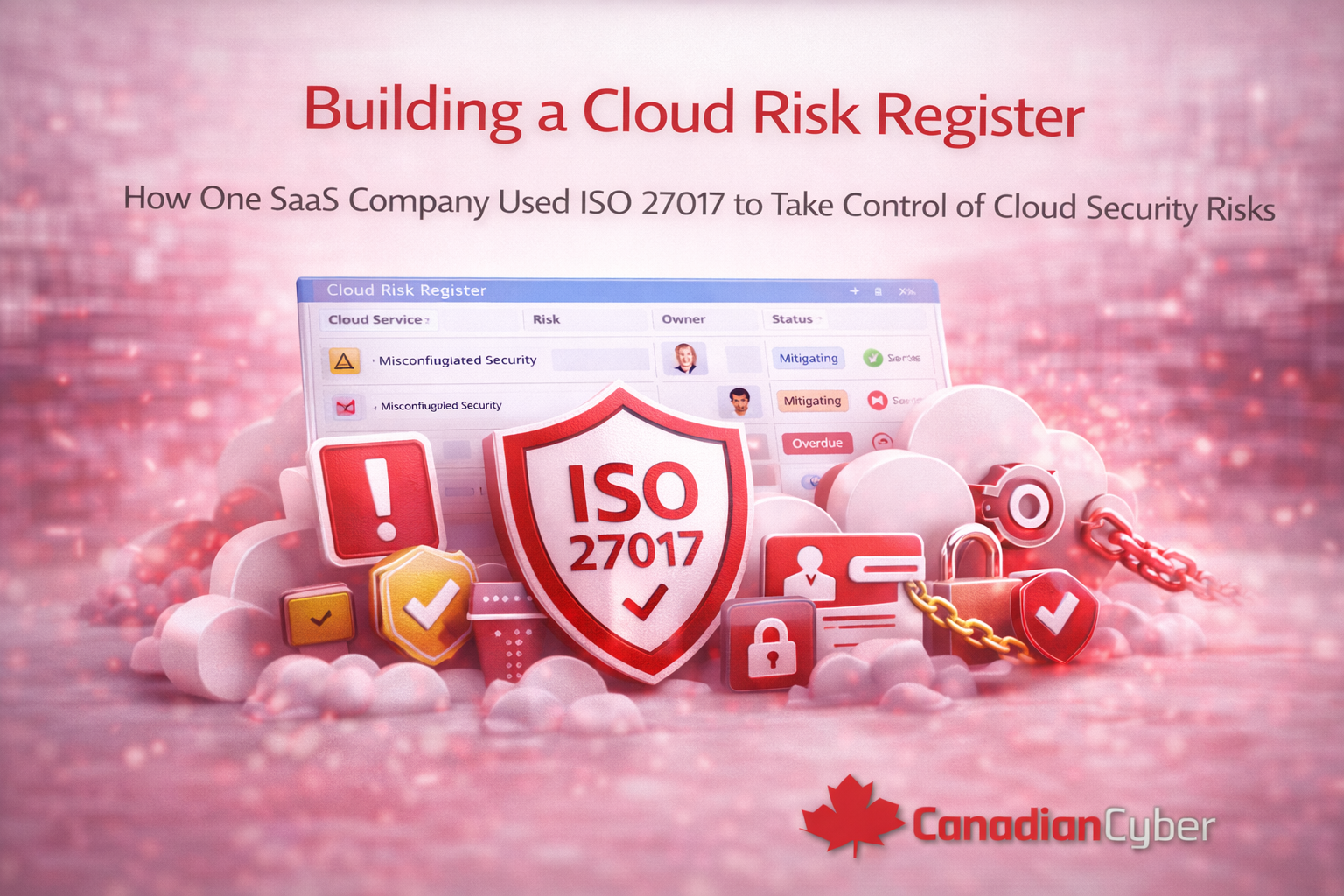
Building a Cloud Risk Register: How One SaaS Company Used ISO 27017 to Take Control of Cloud Security Risks
Note:
The company and scenario in this article are fictitious and created for educational purposes only.
Any resemblance to real organizations is coincidental.
The audit didn’t fail.
But it didn’t feel good either.
The SaaS company let’s call them BrightLayer had modern cloud security tools,
strong engineers, and clean infrastructure-as-code.
Yet during a customer security review, one question kept coming back:
“How do you track and manage cloud-specific risks?”
They had answers.
They just didn’t have a single place to prove them.
That moment triggered a shift from reactive cloud security to structured,
ISO 27017-aligned risk management.
Want a cloud risk register your buyers will actually trust?
Centralize risks, map them to ISO 27017 controls, assign owners, and automate reviews inside Microsoft 365.
Best for SaaS teams scaling fast, selling to enterprise, or preparing for ISO 27001/27017 audits.
Why cloud risks are different (and harder to track)
BrightLayer was already ISO 27001-aligned.
But cloud environments introduce risks that traditional registers often miss:
- Shared responsibility gaps (cloud provider vs customer vs you)
- Misconfigured services that drift after deployments
- Over-privileged access that grows quietly over time
- Dependency risk (vendors, sub-processors, APIs)
- Change velocity that outpaces manual reviews
Their risk register wasn’t wrong.
It was just too generic to drive cloud decisions.
The turning point: building a cloud-focused risk register
BrightLayer didn’t start from scratch.
They extended their ISMS using ISO 27017—the cloud security standard that builds on ISO 27001.
The goal was simple:
make cloud risks visible, owned, and manageable.
Step 1: define the cloud scope clearly
The first mistake many SaaS companies make is being vague.
BrightLayer defined scope in plain language:
Compute, storage, identity, logging, CI/CD.
Systems touching customer data and secrets.
Who owns which components and controls.
This avoided a common failure:
“Everything is a cloud risk, so nothing is.”
Step 2: identify cloud-specific risks (not generic ones)
Using ISO 27017 as a guide, BrightLayer categorized risks into three buckets that matched how cloud actually fails.
Shared responsibility gaps
- Provider secures infrastructure, but you secure configuration
- Logging “enabled” but not verified or reviewed
- Security ownership unclear between teams
Misconfigurations & drift
- Storage with overly broad access
- Security settings drifting after deployments
- Encryption defaults misunderstood
Vendor & dependency risks
- Reliance on third-party SaaS, APIs, and sub-processors
- Limited incident notification paths
- Weak visibility into vendor changes
The lesson was clear:
cloud security is rarely just “your cloud.”
Step 3: structure each risk so it can be managed
BrightLayer didn’t create a list.
They created a system.
Each entry included:
- Risk description (written like a real failure scenario)
- Affected cloud service (AWS/Azure/GCP component, SaaS dependency)
- ISO 27017 control mapping (so auditors can follow the logic)
- Likelihood & impact (consistent scoring)
- Risk owner (a person, not a team name)
- Mitigation actions (specific, testable)
- Review frequency (cloud moves fast)
Quick snapshot: before vs after
| Before | After |
|---|---|
| One generic risk register | Cloud-specific risk register |
| Cloud risks mixed with everything | ISO 27017 mapping for traceability |
| Reviews missed | Scheduled reviews + reminders |
| Ownership unclear | Named owners and tracked actions |
Step 4: automate risk tracking (the real game changer)
BrightLayer tried maintaining it manually.
It didn’t scale.
Automation changed everything.
With a structured approach inside Microsoft 365, they:
- Centralized the cloud risk register in one place
- Assigned owners and due dates consistently
- Scheduled recurring reviews (no “remembering” required)
- Tracked mitigation progress with live status
- Built an audit trail without extra work
Struggling to track cloud risks as your SaaS scales?
Build an ISO 27017-aligned cloud risk register with ownership, evidence, and automated reviews.
Step 5: use the register during real events
The real test came during a configuration incident.
Instead of panic:
- The risk was already documented
- Controls were already mapped
- Ownership was already clear
- Mitigation steps were already tracked
Later, auditors called this out as a sign of
mature cloud security governance.
Why ISO 27017 made the difference
ISO 27017 helped BrightLayer:
- Focus specifically on cloud risks (not generic ones)
- Clarify shared responsibility boundaries
- Align risk decisions with how cloud actually operates
It turned abstract cloud concerns into actionable, owned risks.
How Canadian Cyber supports cloud risk registers
- Design ISO 27017-aligned risk register structures
- Map risks to cloud services and control evidence
- Automate ownership, reviews, and reminders inside Microsoft 365
- Track mitigation over time so audits feel predictable
No generic templates.
No theory-only frameworks.
Just practical cloud security governance.
The bigger lesson
BrightLayer didn’t become more secure overnight.
But they became more aware.
And awareness when structured and automated reduces real risk.
Final thought
Cloud security doesn’t fail because teams ignore risk.
It fails because risks are:
- Invisible
- Unowned
- Untracked
An ISO 27017-aligned cloud risk register fixes that.
Make cloud risk visible. Manage it continuously.
Stay Connected With Canadian Cyber
Follow us for practical insights on cloud security, ISO standards, and SaaS risk management: