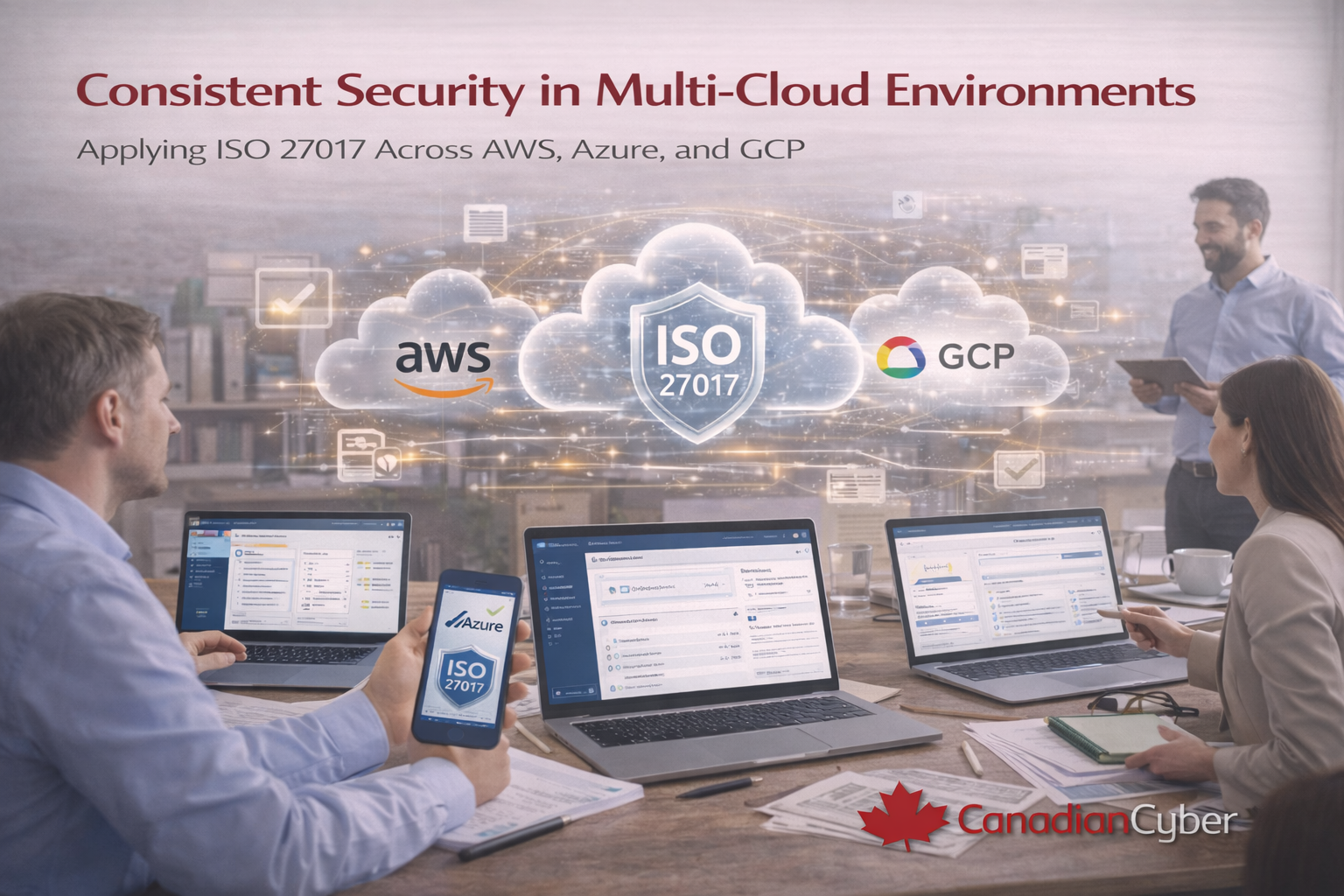
Consistent Security in Multi-Cloud Environments
Applying ISO 27017 Across AWS, Azure, and GCP
Multi-cloud is no longer a niche strategy. It’s the reality for modern organizations.
The flexibility is powerful but the security risk is real.
ISO 27017 helps you keep controls consistent across providers.
One workload in AWS. Another in Azure. A data pipeline in GCP.
Different consoles. Different defaults. Different teams.
The Multi-Cloud Security Problem No One Talks About
Most breaches in cloud environments don’t happen because companies ignore security.
They happen because security becomes inconsistent.
- Controls drift
- Permissions expand quietly
- Logging varies by platform
- Responsibility gets blurred
ISO 27017 exists to bring structure to multi-cloud security so outcomes stay consistent even when tooling differs.
What ISO 27017 Brings to Multi-Cloud Security
ISO 27017 extends ISO 27001 with cloud-specific guidance that applies regardless of provider. It focuses on:
- Shared responsibility clarity
- Secure configuration management
- Identity and access control
- Continuous monitoring
- Clear accountability
The goal isn’t identical tooling it’s consistent control outcomes.
| ISO 27017 Control Outcome |
AWS Example |
Azure Example |
GCP Example |
| Least privilege access |
IAM roles + SCPs |
Entra ID RBAC + PIM |
IAM roles + org policies |
| Misconfig drift control |
AWS Config |
Azure Policy |
Org Policies |
| Central visibility |
CloudTrail + CloudWatch |
Activity Logs + Monitor |
Cloud Audit Logs |
| Audit evidence |
Exports + screenshots |
Exports + reports |
Exports + reports |
Step 1: One Cloud Security Model, Not Three
The first mistake in multi-cloud security is treating each provider in isolation.
ISO 27017 pushes you toward a single operating model:
- A unified cloud security policy
- Clear ownership across platforms
- Standardized control expectations
Key idea:
AWS, Azure, and GCP may look different but your security intent should not.
Step 2: Identity and Access Controls Across Clouds
Identity is the most critical control. ISO 27017 emphasizes:
- Least-privilege access
- Role-based permissions
- MFA for privileged accounts
- Regular access reviews
How this looks in practice:
- AWS IAM with strict role boundaries
- Azure AD / Entra ID with conditional access
- GCP IAM with scoped service accounts
Different tools. Same control objective.
Step 3: Configuration Management That Prevents Drift
Cloud misconfigurations are a major cause of cloud incidents.
ISO 27017 expects secure baselines, change tracking, and regular reviews.
| Drift Control Need |
What “Good” Looks Like |
Multi-Cloud Example Tools |
| Baseline configs |
Approved standards for networks, storage, IAM, logging |
AWS Config / Azure Policy / GCP Org Policies |
| Change tracking |
Who changed what, when, and why |
Audit logs + ticket linkage |
| Regular reviews |
Scheduled review cadence + documented outcomes |
ISMS workflows + reminders |
Step 4: Unified Logging and Monitoring
Security without visibility doesn’t scale. ISO 27017 requires centralized logging, alerting, and retention for audit and investigation.
A practical multi-cloud pattern:
- Collect logs in native tools for depth
- Centralize summaries for oversight
- Store audit evidence in a single ISMS repository
Step 5: Clarifying Shared Responsibility Everywhere
A common audit failure is assuming cloud providers “handle security.”
ISO 27017 forces clarity across all providers:
- What AWS secures vs what you secure
- What Azure handles vs what remains yours
- Where GCP responsibilities end
Important:
This clarity must be documented and audited.
Step 6: Managing Multi-Cloud Evidence for Audits
Auditors don’t want screenshots scattered across tools. They want consistent evidence, clear ownership, and traceability to controls.
Canadian Cyber’s ISMS SharePoint Platform centralizes:
- Cloud policies
- Configuration evidence
- Access reviews
- Audit logs
One portal. One source of truth.
Want consistent controls across AWS, Azure, and GCP without extra chaos?
We’ll map ISO 27017 to your multi-cloud environment and set up evidence that’s always ready for audits.
Why Multi-Cloud Without ISO 27017 Is a Risk Multiplier
Without a common framework:
- Security maturity varies by team
- Audits become painful
- Incidents spread faster
- Accountability weakens
ISO 27017 provides a common language for security teams even when platforms differ.
How Canadian Cyber Helps Organizations Secure Multi-Cloud Environments
Canadian Cyber supports multi-cloud security end-to-end:
| Workstream |
What You Get |
Outcome |
| ISO 27017 assessments |
Gap review across AWS/Azure/GCP |
Clear priorities, less drift |
| Control mapping |
Unified control outcomes across providers |
Consistent governance |
| ISMS SharePoint deployment |
Evidence, ownership, workflows |
Audit-ready proof |
| vCISO oversight |
Ongoing cloud governance and readiness |
Security stays consistent as you scale |
Final Takeaway
Multi-cloud doesn’t have to mean multi-risk. With ISO 27017, security becomes repeatable, controls stay consistent, audits get easier, and trust increases.
One framework. Any cloud. Real security.
Get consistent multi-cloud governance and audit-ready evidence without slowing delivery.
Stay Connected With Canadian Cyber
Follow us for practical insights on cloud security, ISO 27017, and multi-cloud governance: