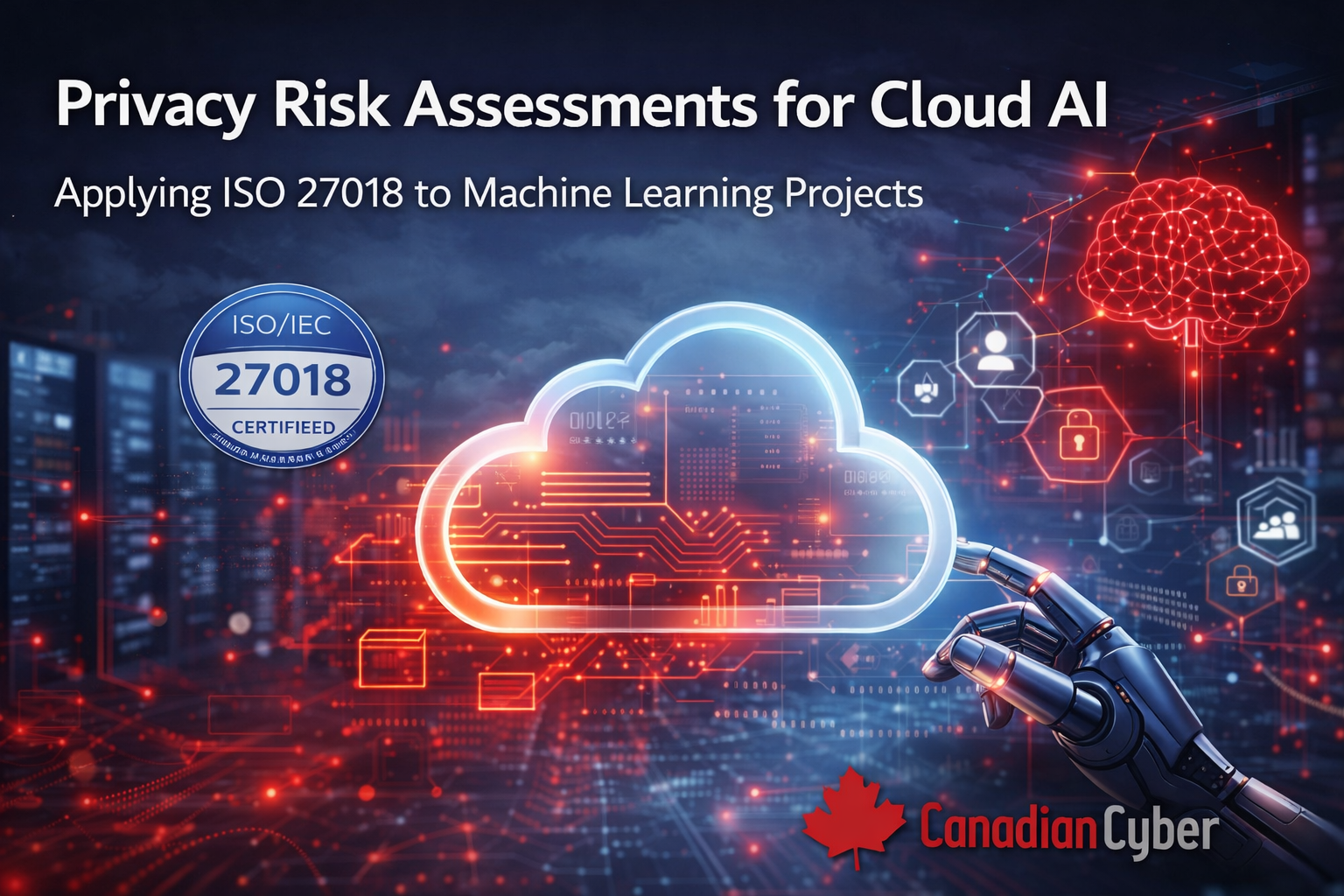
Privacy Risk Assessments for Cloud AI
Applying ISO 27018 to Machine Learning Projects
AI systems learn fast.
Regulators don’t.
But expectations around privacy and accountability are rising quickly.
Cloud-hosted AI models now process massive volumes of personal data.
That makes privacy risk assessments essential, not optional.
Simple rule: if your model touches personal data, your privacy assessment should be as real as your deployment plan.
Why privacy risk assessments matter in cloud AI
AI changes how data is used.
Models don’t just store information.
They infer, predict, and generate new insights.
That introduces new privacy risks, including:
- Re-identification of “anonymized” data
- Unauthorized data sharing between cloud services
- Excessive access by data scientists or engineers
- Retention of personal data longer than intended
Privacy risk assessments help surface these issues before deployment.
This is where ISO 27018 plays a critical role.
ISO 27018: privacy by design for the cloud
ISO 27018 extends ISO 27001 for personal data (PII) in cloud environments.
It focuses on practical safeguards that are provable during audits and reviews.
ISO 27018 emphasizes:
- Limiting use of personal data
- Ensuring transparency and consent
- Controlling access to PII
- Supporting data deletion and return
- Breach notification and accountability
For AI projects, this framework helps embed privacy by design.
Not as a slogan, but as a repeatable process.
Quick snapshot: privacy risk assessments for cloud AI
| When | Before deploying AI models using personal data |
| Framework | ISO 27018 (with ISO 27017 cloud controls) |
| Goal | Identify and mitigate privacy risks early |
| Outcome | Compliant, trustworthy AI systems |
A step-by-step approach that works for real ML projects
Step 1: identify where PII lives in AI projects
Privacy assessments start with visibility.
In cloud AI systems, PII may exist in places teams forget to include.
Common locations include:
- Training datasets
- Feature stores
- Logs and monitoring data
- Model outputs
- Backup and testing environments
ISO 27018 expects you to know where personal data flows.
Unknown data paths are privacy risks.
Step 2: assess privacy risks unique to AI
AI introduces risks traditional systems don’t.
Your assessment should ask: could the model expose personal data, even indirectly?
- Models unintentionally memorizing personal data
- Re-identification of pseudonymized datasets
- Inference of sensitive attributes
- Data reuse beyond original consent
Step 3: map ISO 27018 controls to AI risks
ISO 27018 provides practical mitigations.
In AI projects, the goal is to turn “privacy” into controls you can prove.
| AI risk | ISO 27018-style mitigation |
|---|---|
| Data used beyond consent | Define permitted use, ensure consent alignment, document purpose limits |
| Unauthorized access to training data | Least privilege, role-based access, approvals for access, periodic reviews |
| PII exposure in transit or storage | Encryption in transit/at rest, key management, secure storage configuration |
| PII in model outputs | Output filtering, logging, monitoring, and guardrails for sensitive data |
| Data retained too long | Retention rules, deletion testing, and proof of return/deletion capability |
Building AI models that use personal data?
Apply ISO 27018 to your ML pipeline and reduce privacy risk before regulators ask.
Step 4: document decisions and accountability
Regulators don’t just look at outcomes. They look at process.
Good documentation shows you were deliberate and accountable.
Your assessment should record:
- Identified risks
- Mitigation decisions
- Residual risk acceptance
- Ownership and review cycles
Step 5: align with Canadian privacy expectations
In Canada, organizations are expected to show diligence.
Even when laws lag behind technology, accountability expectations are real.
A practical approach includes:
- Assessing privacy impacts before deployment
- Applying safeguards proportionate to risk
- Demonstrating transparency in data use
Using ISO 27018 as a framework helps show good-faith compliance and consistent privacy governance.
Not sure if your AI privacy controls meet Canadian expectations?
Run a cloud AI privacy risk assessment and prepare for regulatory and customer scrutiny.
How ISO 27017 supports the privacy assessment
ISO 27017 complements ISO 27018 by securing the cloud layer.
Together, they help privacy and security work as one system.
- Cloud configurations support privacy controls
- Shared responsibility is clearly defined
- Access management is enforced consistently
- Monitoring supports incident response
Common mistakes in AI privacy assessments
| Mistake | Fix |
|---|---|
| AI pipelines excluded from scope | Include feature stores, logs, outputs, and testing environments |
| Over-reliance on anonymization | Assess re-identification and inference risk; apply layered controls |
| No access reviews for data science teams | Set least privilege, approvals, and periodic access recertification |
| No testing of deletion or retention | Test deletion/return workflows and keep evidence of results |
How Canadian Cyber supports cloud AI privacy
We help organizations apply ISO 27018 in a practical way.
Our focus is clarity—not complexity.
- Privacy risk assessments for AI projects
- Mapping ISO 27018 controls to ML pipelines
- Alignment with Canadian privacy expectations
- Ongoing compliance and audit readiness
Final thought: AI innovation doesn’t excuse privacy shortcuts.
Privacy risk assessments grounded in ISO 27018 help you build AI systems that are powerful and trustworthy.
Apply ISO 27018 to your cloud AI projects
Reduce privacy risk early and show a clear, defensible process when customers or regulators ask.
Stay connected with Canadian Cyber
Follow us for practical insights on cloud security, AI compliance, and privacy frameworks: