After the Storm: Lessons Learned from Cyber Incidents
Why the real value of an incident comes after systems are restored.
When a cyber incident ends, most organizations feel one thing above all else: relief.
Systems are back online. Customers can log in again. Emails stop flying at midnight. And then, almost instinctively, teams want to move on.
That instinct is understandable but it’s also risky. Because the most important phase of incident response begins after the crisis ends.
Bottom line: Recovery gets you back online.
Lessons learned keeps you from repeating the same incident again.
Why “Lessons Learned” Is the Most Overlooked Phase of Incident Response
Cyber incident response is often described as a lifecycle:
- Preparation
- Detection
- Containment
- Eradication
- Recovery
- Lessons Learned
The final phase is frequently rushed or skipped. Yet post-incident analysis is critical to strengthening future defenses and response capability. Organizations that pause, reflect, and improve are far less likely to repeat the same mistakes.
In short: Incidents that aren’t analyzed tend to happen again.
A Common Pattern: “We’re Just Glad It’s Over”
This example is fictional but reflects real-world behaviour.
After a ransomware incident, a company restored systems successfully. Leadership thanked the team. Operations resumed. The incident was declared “closed.”
Six months later, a similar attack occurred.
Why it repeated:
- The root cause was never fully identified
- Gaps in response weren’t addressed
- Training wasn’t updated
- Controls weren’t strengthened
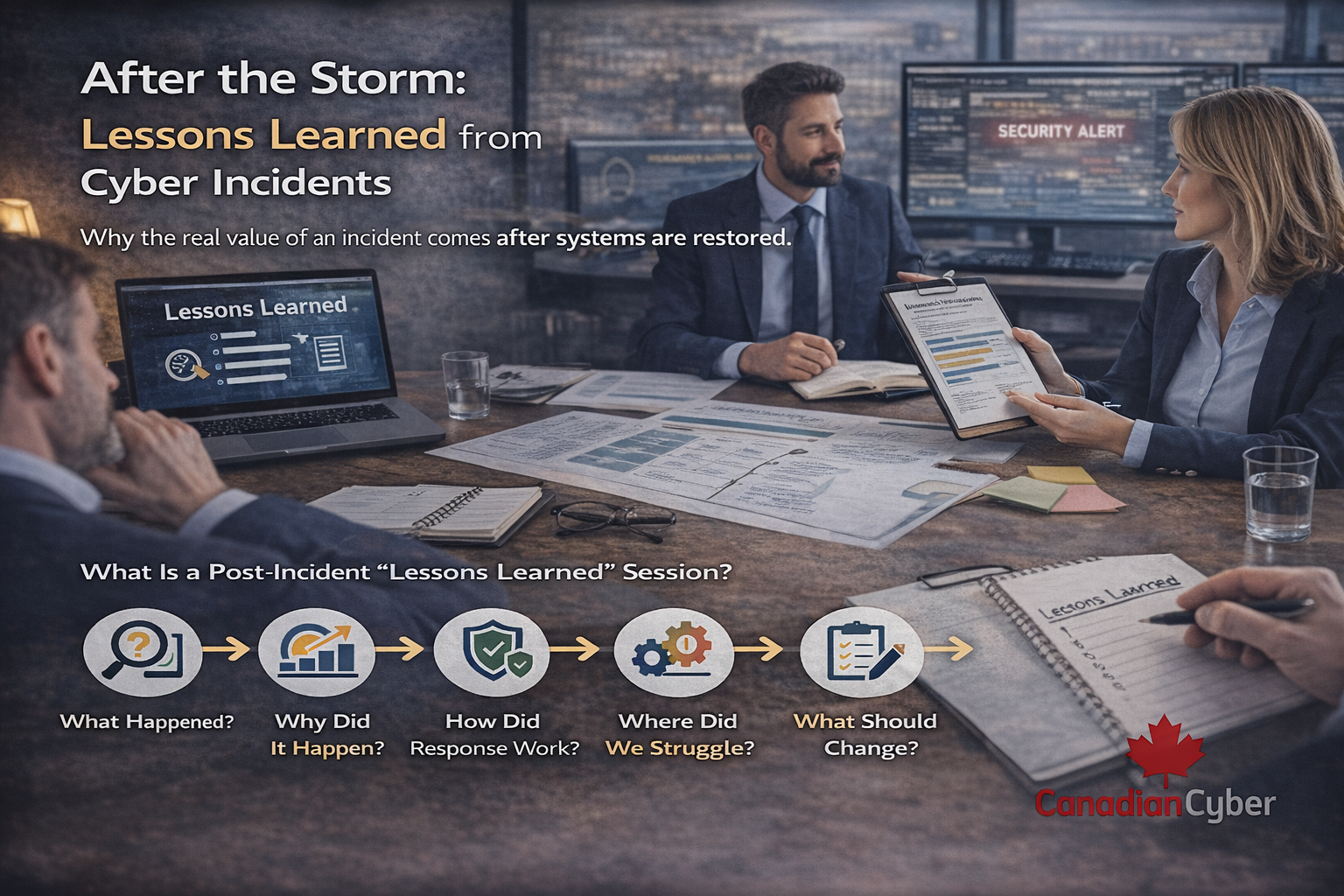
What Is a Post-Incident “Lessons Learned” Session?
A lessons learned session is a structured review held after containment and recovery, when emotions have settled and facts are clearer.
What it is (and what it isn’t)
- Not blame the goal is learning and improvement
- Not optional it’s part of mature incident response
- A structured debrief what happened, why, and what changes next
When Should Lessons Learned Take Place?
Timing matters. Best practice is to hold the session:
| Timing Guidance | Why It Matters |
|---|---|
| Once systems are stable | You’ll have clearer facts and fewer moving parts. |
| While details are fresh | People remember timelines, decisions, and friction points. |
| Within 1–2 weeks post-incident | Avoids rushed analysis while preventing memory loss. |
Tip: Waiting too long leads to forgotten details. Rushing too soon leads to incomplete insight.
Key Questions Every Lessons Learned Session Should Ask
A productive post-incident review follows a clear structure. Use the questions below as your playbook.
1) What Happened ,Really?
Start with facts, not assumptions. Document:
- Timeline of events
- How the incident was detected
- Which systems and data were affected
- When key decisions were made
2) Why Did It Happen?
This is the most important question. Look beyond symptoms and identify root causes, such as:
- Unpatched systems
- Weak access controls
- Human error or phishing
- Vendor or third-party exposure
- Gaps in monitoring
3) How Well Did the Response Work?
Evaluate response effectiveness honestly:
- Were roles clear?
- Was the incident response plan followed?
- Were decisions delayed or rushed?
- Was communication effective?
4) Where Did We Struggle?
Common friction points include:
- Confusing escalation paths
- Missing contact information
- Poor coordination between teams
- Incomplete documentation
- Unclear leadership authority
5) What Should Change Now?
End with action. Define:
- Control improvements
- Plan updates
- Training needs
- Process changes
- Ownership and timelines
What “Good” Output Looks Like
A lessons learned session should produce clear outcomes that can be tracked, not just meeting notes.
| Deliverable | Examples |
|---|---|
| Incident timeline | Detection time, escalation time, containment actions, recovery milestones |
| Root cause summary | Misconfiguration, missing MFA, phishing path, unpatched system, vendor exposure |
| Control improvements | Access hardening, logging uplift, backup testing, endpoint tuning |
| Plan updates | Contact lists, escalation steps, comms templates, decision authority clarifications |
| Action register | Owner, due date, priority, status, evidence of completion |
✅ Want a structured incident retrospective (with actions, owners, and timelines)?
Canadian Cyber helps teams run calm, objective post-incident reviews that turn disruption into measurable improvements.
👉 Explore Incident Response & Retrospective Services
👉 Book a Free Consultation
Why This Phase Drives Continuous Improvement
Post-incident analysis is the engine of continuous security improvement. Organizations that conduct structured lessons learned:
- Reduce repeat incidents
- Improve response speed
- Strengthen controls
- Build institutional knowledge
- Increase leadership confidence
A Fictional Turning Point: From Recovery to Resilience
One organization held a cross-functional lessons learned session involving:
- IT and security
- Legal and privacy
- Leadership
- Communications
They documented gaps, updated plans, and ran a tabletop exercise two months later.
The next incident wasn’t prevented but it was handled faster, calmer, and with less impact.
That’s the difference learning makes.
The Leadership Role in Post-Incident Learning
Lessons learned only work when leadership supports them. Executives must:
- Encourage honest discussion
- Avoid blame culture
- Support improvement investments
- Hold teams accountable for follow-up
How a vCISO Strengthens the Lessons Learned Process
A Virtual CISO (vCISO) helps turn incidents into improvement by:
- Facilitating structured post-incident reviews
- Identifying root causes objectively
- Aligning lessons learned with risk strategy
- Updating incident response plans
- Improving governance and controls
How Canadian Cyber Helps After the Incident
At Canadian Cyber, incident response doesn’t end when systems come back online.
Incident Response Retrospectives
- Run structured lessons learned sessions
- Identify gaps and root causes
- Document findings clearly
Plan & Control Improvement
- Incident response plan updates
- Control enhancements
- Training and awareness improvements
vCISO-Led Continuous Improvement
- Guide post-incident strategy
- Report lessons learned to leadership
- Integrate findings into broader security programs
The Incident Is Over — The Learning Shouldn’t Be
Cyber incidents are disruptive, but they are also valuable learning moments.
Organizations that pause, reflect, and improve emerge stronger.
Those that rush past the lessons repeat the experience.
The storm may pass but resilience is built afterward.
Ready to Turn Incidents into Improvement?
If your organization wants to strengthen its response and prevent repeat incidents, we can help.
Stay Connected With Canadian Cyber
Follow Canadian Cyber for practical guidance on incident response, resilience, and cybersecurity leadership: