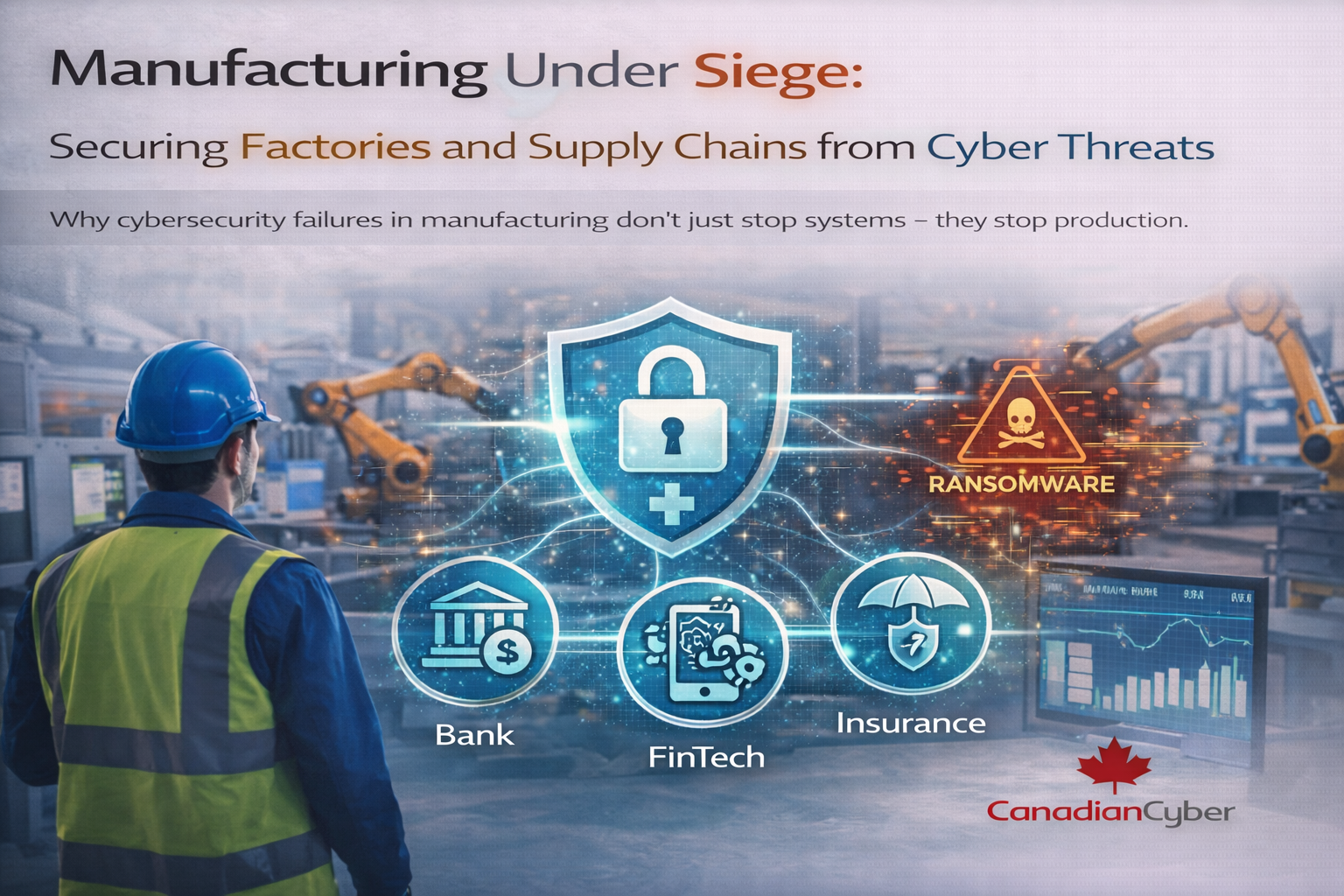
Manufacturing Under Siege: Securing Factories and Supply Chains from Cyber Threats
Why cybersecurity failures in manufacturing don’t just stop systems they stop production.
Manufacturing floors were once isolated from the internet. Today, they are connected, automated, and data-driven.
That transformation has unlocked efficiency and scale but it has also made manufacturing one of the most targeted sectors.
When attackers hit a factory, they don’t just steal data. They interrupt operations.
Bottom line: In manufacturing, cyber incidents create physical disruption. Downtime becomes leverage and leverage becomes lost output, delayed shipments, and reputational damage.
Why Manufacturing Is Now a Top Cyber Target
Manufacturing environments offer attackers something most industries don’t: a direct path to physical disruption and financial pressure.
Many factories also rely on legacy systems and complex supplier relationships, which expands the attack surface.
- Physical disruption: attackers can affect machines and production lines.
- Financial leverage: every hour of downtime costs money quickly.
- Complex supply chains: partners and suppliers increase exposure.
- Legacy systems: patching is difficult, and outages are not tolerated.
A single successful attack can shut down production lines, delay shipments, and impact downstream partners.
That’s why manufacturing delivers maximum pressure for attackers.
The Unique Cyber Risks Facing Manufacturers
1) Operational Technology (OT) Exposure
Manufacturing relies on OT systems such as industrial control systems (ICS), PLCs, SCADA environments, robotics, and automation platforms.
- Many OT systems were not designed with cybersecurity in mind.
- Outdated operating systems are common.
- Downtime for patching is often not acceptable.
This combination creates attractive targets and long-lived vulnerabilities.
2) Production Stoppages as Leverage
In manufacturing, downtime equals loss. Attackers know that stopping production can force fast decisions.
- Ransomware groups target production scheduling systems and MES platforms.
- ICS environments can be disrupted to halt operations.
- The goal is often “stop the line,” not only steal data.
3) Supply Chain and Third-Party Risk
Manufacturers depend on suppliers, logistics providers, contractors, and connected partners.
- A breach at one supplier can cascade through the chain.
- Shared access and integrations increase exposure.
- Vendor changes can introduce new, hidden risk.
Supply chain attacks turn one weak link into a systemic failure.
Why Traditional IT Security Isn’t Enough
Manufacturing environments blur the line between IT systems (email, ERP, cloud) and OT systems (machines, sensors, controllers).
Traditional IT security tools often don’t understand OT protocols, can’t be deployed safely on ICS environments, and may miss lateral movement.
Manufacturing security requires coordination, not silos.
The strongest programs align IT, OT, engineering, and operations under one risk strategy.
Key Practices to Secure Factories and Supply Chains
The goal is not to “bolt on” controls. It’s to reduce real operational risk while keeping production stable.
1) Segment IT and OT Networks
Segmentation is one of the most effective controls in manufacturing. It limits how far attackers can move.
- Separate IT and OT networks into zones.
- Restrict communication paths between zones.
- Monitor and log traffic across boundaries.
2) Build Asset Visibility Across OT and IT
You cannot protect what you don’t know exists. Visibility is the foundation of risk management.
- Maintain an accurate asset inventory (OT and IT).
- Identify critical systems and production dependencies.
- Classify systems by impact to safety and uptime.
3) Use Realistic Patch Management
OT systems can’t always be patched like laptops. Manufacturers need a risk-based approach.
- Prioritize patches based on operational risk.
- Test updates carefully before deployment.
- Use compensating controls when patching isn’t possible.
4) Plan Incident Response for Production
Manufacturing incident response must protect safety first and restore production cleanly.
Your plan should answer: who shuts down what, and when?
- Include OT teams, engineering, and operations leadership.
- Define escalation paths and decision-makers.
- Run tabletop exercises that reflect real factory scenarios.
5) Strengthen Supply Chain Risk Governance
Supply chain security is business resilience. Manufacturers should treat vendors as part of the risk surface.
- Identify critical suppliers and connected partners.
- Define security expectations and access requirements.
- Review data sharing and monitor changes over time.
Why Cybersecurity Is Now an Operations Issue
In manufacturing, cyber incidents delay production, impact customers, disrupt revenue, and damage trust.
This is no longer just an IT concern. It’s an operations and leadership issue.
The Role of vCISO Services in Manufacturing Security
Many manufacturers lack dedicated security leadership and OT-aware governance. A Virtual CISO (vCISO) helps by:
- Aligning IT and OT security strategy
- Prioritizing risks based on production impact
- Supporting ISO 27001 and SOC readiness
- Reporting cyber risk to leadership in plain language
Why it works: vCISOs add strategic oversight without adding full-time headcount which fits how most manufacturers operate.
A Fictional Example: Preventing a Factory Shutdown
(This example is fictional but reflects real-world patterns.)
A manufacturer invested heavily in automation. IT systems were monitored, and OT systems were assumed safe.
After engaging a vCISO, networks were segmented, OT assets were documented, and incident response plans were tested.
When ransomware hit a supplier, lateral movement was blocked. Production continued and shipments stayed on schedule.
How Canadian Cyber Supports Manufacturers
At Canadian Cyber, we understand that manufacturing security must balance availability, safety, and resilience.
We help manufacturers stay secure without stopping production.
Our support for manufacturing
| Service | What it helps you achieve |
|---|---|
| vCISO Services | IT/OT risk alignment, executive reporting, and security roadmaps |
| ISO 27001 & Compliance Support | Practical ISMS implementation, audit readiness, and continuous improvement |
| Incident & Resilience Planning | OT-aware incident response, tabletop exercises, and recovery planning |
Cybersecurity Is Now Part of Manufacturing Continuity
Modern manufacturing depends on uptime. Cybersecurity failures stop machines not just servers.
Organizations that treat cyber risk as an operational risk are better prepared to compete, deliver, and grow.
Ready to Secure Your Manufacturing Operations?
Let’s reduce downtime risk, strengthen IT/OT governance, and secure your supply chain without disrupting production.
Stay Connected With Canadian Cyber
Follow Canadian Cyber for ISO 27001, SOC 2, and industry-specific cybersecurity insights: