email-svg
Get in touch
info@canadiancyber.ca

Choose the Right Cybersecurity Framework

This guide explains the key differences between NIST and ISO 27001, when to use each framework, and how organizations successfully combine both.
Main Hero Image

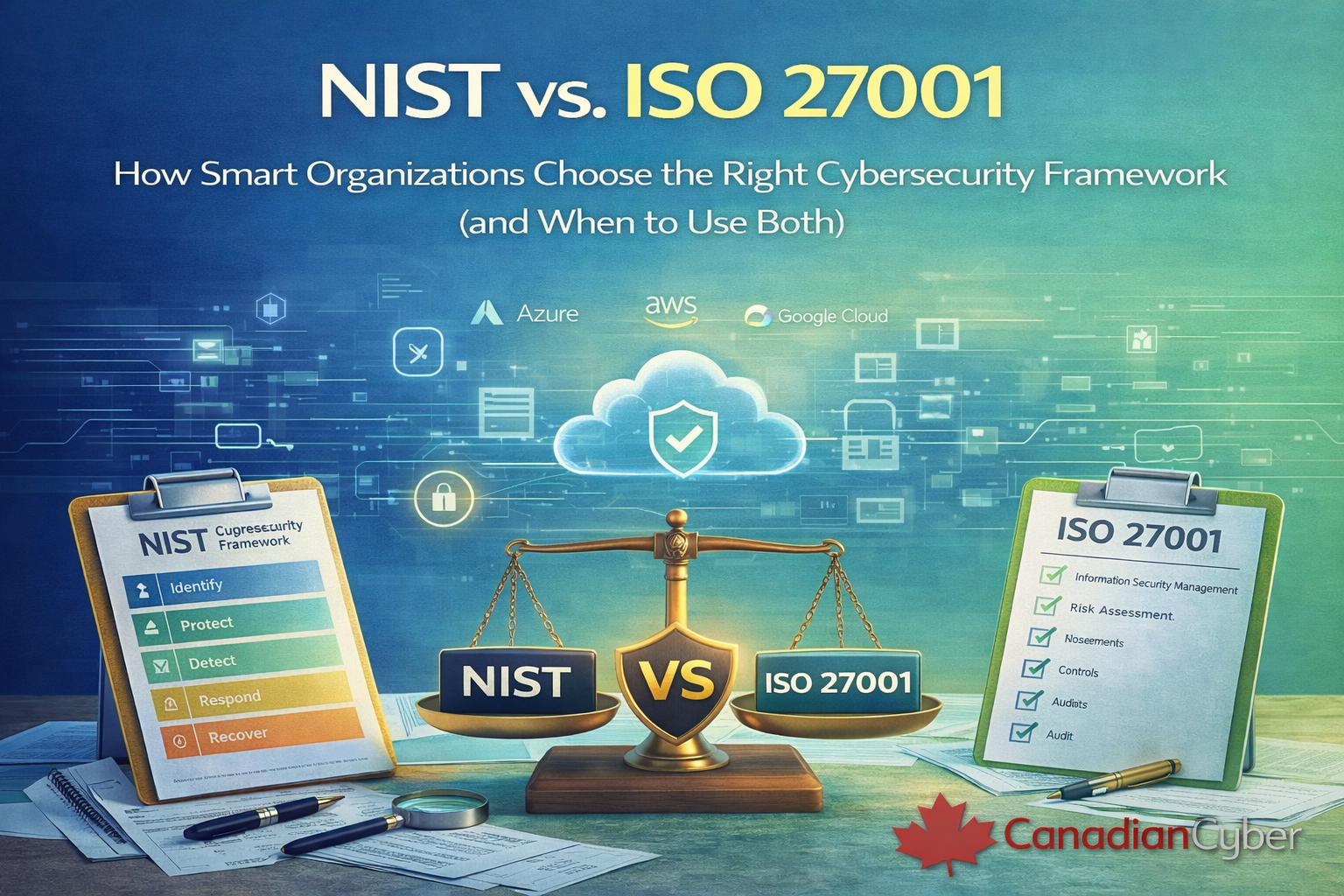
NIST vs. ISO 27001

How Smart Organizations Choose the Right Cybersecurity Framework (and When to Use Both)

The real decision is rarely “NIST or ISO.” It’s why you need a framework and who you need to prove it to.

Every security leader hits this crossroads.

  • A board asks: “Should we follow NIST or ISO 27001?”
  • A customer asks: “Are you ISO certified?”
  • An auditor asks: “What framework do you use to manage risk?”

This blog breaks down NIST vs. ISO 27001 not in theory, but in how real organizations use them.

The Real Question Isn’t NIST or ISO

It’s why and for what purpose.

NIST and ISO 27001 are often compared as competitors. They’re not. They solve different problems.
Understanding that difference is what separates mature security programs from reactive ones.

Category NIST CSF ISO 27001
Primary purpose Risk & maturity guidance Certifiable security management system (ISMS)
External proof No certification “badge” Independent certification available
Best for Prioritization and roadmap Procurement trust and auditability
Common outcome Clarity on what to fix next Repeatable governance and proof of control operation

NIST Cybersecurity Framework: The Risk Conversation Starter

The NIST Cybersecurity Framework (CSF) is a guidance-based framework. It helps organizations identify cyber risks, assess current maturity, and improve controls over time.

NIST CSF core functions

Identify • Protect • Detect • Respond • Recover

Where NIST shines

  • Risk management discussions with leadership
  • Internal maturity assessments
  • Technical roadmap planning
  • Organizations early in their security journey

Where NIST falls short

  • No formal certification
  • Limited value in procurement reviews
  • Harder to “prove” externally

NIST helps you understand your risk. It doesn’t give you a badge to show customers.

ISO 27001: The Trust and Certification Framework

ISO 27001 is a certifiable international standard. It requires an Information Security Management System (ISMS), defined ownership and accountability, and evidence-based audits.

Where ISO 27001 excels

  • Customer and enterprise trust
  • Vendor due diligence
  • Regulatory alignment
  • Repeatable, auditable security programs

Where ISO 27001 can feel heavy

  • Requires structure and documentation
  • Needs ongoing maintenance
  • Not just a technical exercise

Key difference:
NIST helps you think about security. ISO 27001 helps you prove security.

When Canadian Organizations Use NIST First

Many Canadian companies start with NIST when they want clarity without pressure:

  • They are pre-certification
  • They want a low-pressure risk assessment
  • Security maturity varies across teams

When ISO 27001 Becomes Non-Negotiable

ISO 27001 becomes essential when security shifts from internal improvement to external credibility:

  • Selling to enterprise or government
  • Responding to security questionnaires
  • Preparing for SOC 2 or privacy audits
  • Needing formal assurance

The Smart Approach: NIST + ISO 27001 Together

The most effective security programs don’t choose sides. They use both:

What you’re trying to do Use NIST for Use ISO 27001 for
Decide priorities Assess maturity, find gaps Formalize governance & ownership
Make changes stick Roadmap and control goals ISMS processes, audits, evidence
Prove trust to customers Support risk narrative Certification + repeatable proof

Simple way to remember it:
NIST informs what to fix. ISO 27001 defines how it’s governed and proven.

Need clarity before you invest time and budget?

Get a practical recommendation based on your buyers, timelines, and current maturity.

Where Canadian Cyber Fits In

Canadian Cyber helps organizations:

  • Perform NIST-based risk assessments
  • Translate findings into an ISO 27001-aligned ISMS
  • Implement controls efficiently using our ISMS SharePoint Platform
  • Maintain governance through vCISO services

A Common Canadian Scenario

A SaaS company starts with NIST to understand risks. Then enterprise clients ask for ISO 27001.

  • We map NIST findings into ISO 27001 controls
  • Build an ISMS that supports certification
  • Centralize everything in SharePoint

No wasted effort. No duplicated work. Just a clean path from risk clarity to trust proof.

Final Thought: Frameworks Don’t Secure Companies Decisions Do

Choosing NIST or ISO 27001 isn’t about compliance fashion. It’s about who you sell to, how you manage risk, and what proof your stakeholders expect. The right strategy reduces friction, accelerates trust, and scales with growth.

Choose clarity over confusion.

Whether you need NIST, ISO 27001, or both build a framework strategy that supports revenue, audits, and real risk reduction.

Stay Connected With Canadian Cyber

Follow us for practical insights on cybersecurity frameworks, ISO 27001, NIST, and security leadership:

Related Post