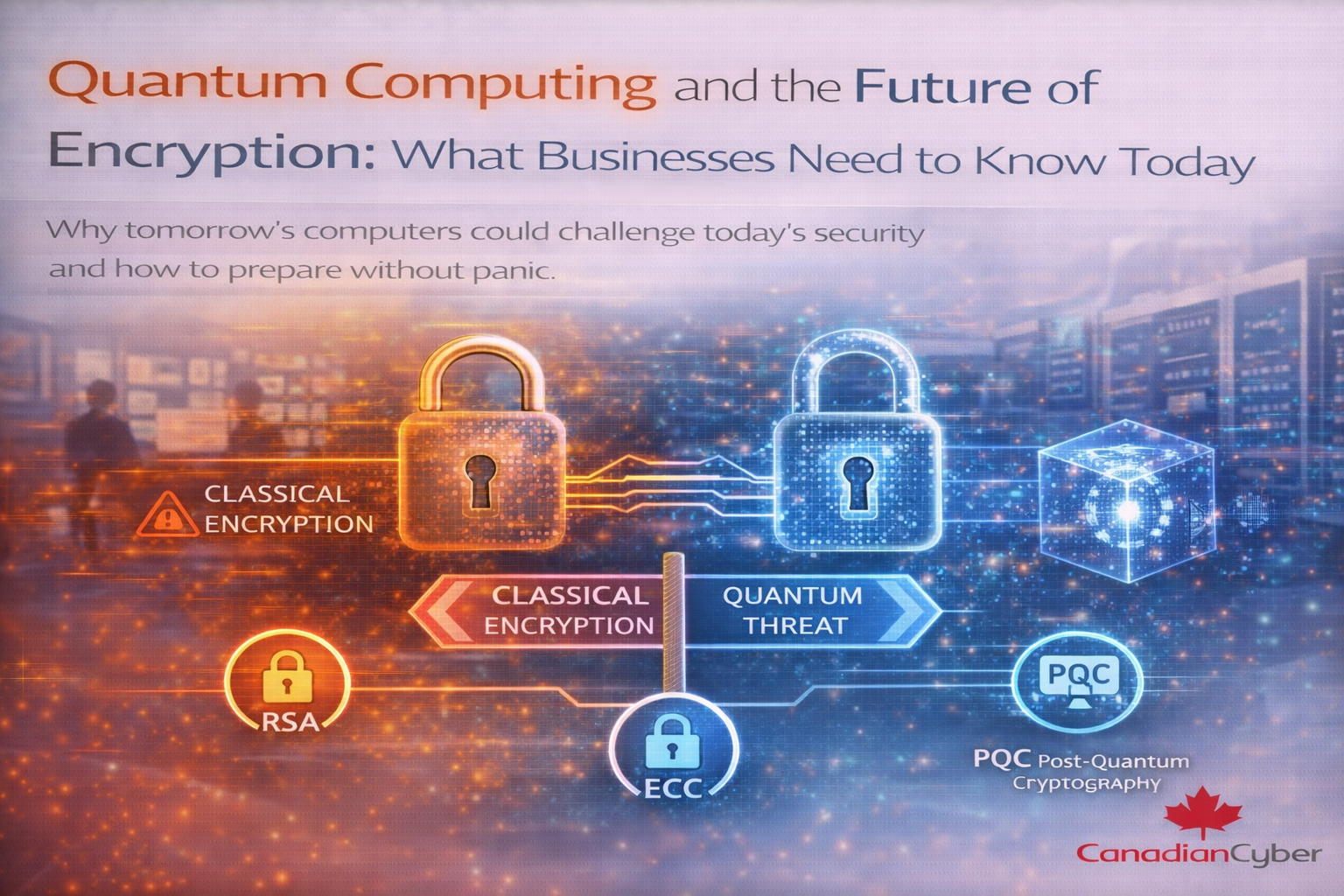
Quantum Computing and the Future of Encryption: What Businesses Need to Know Today
Why tomorrow’s computers could challenge today’s security and how to prepare without panic.
Encryption is the foundation of digital trust.
It protects customer data, financial transactions, intellectual property, and critical infrastructure.
For decades, modern encryption has been considered safe but quantum computing is changing that assumption.
While large-scale quantum attacks are not imminent, the shift they represent is real.
Organizations that prepare early will be far better positioned than those that wait.
What Is Quantum Computing (In Simple Terms)?
Traditional computers process information in bits: 0 or 1.
Quantum computers use qubits, which can exist in multiple states at once.
This allows quantum systems to solve certain problems dramatically faster and perform complex calculations that are impractical today.
From a cybersecurity perspective, this matters because some encryption relies on math problems that quantum computers could eventually solve much faster.
Why Quantum Computing Matters for Encryption
Many widely used encryption algorithms depend on the difficulty of solving certain mathematical problems like factoring extremely large numbers.
Important: This does not mean encryption is broken today.
It means the long-term security model is changing and planning needs to start now.
Quantum impact: what changes (and what doesn’t)
| Area | Why it matters |
|---|---|
| Public-key encryption | Some algorithms could become vulnerable if quantum systems reach sufficient scale |
| Long-lived sensitive data | Captured data today may be decrypted in the future (“harvest now, decrypt later”) |
| Governance + planning | Risk ownership and crypto agility become leadership priorities not just IT tasks |
Which Encryption Is Most at Risk?
Quantum computing primarily threatens widely used public-key algorithms such as:
- RSA
- ECC (Elliptic Curve Cryptography)
These are used heavily across modern business environments including TLS/SSL, VPNs, digital certificates, and secure email.
What about symmetric encryption? Algorithms like AES are less affected, though key sizes may require adjustment as guidance evolves.
What Is Post-Quantum Cryptography (PQC)?
Post-quantum cryptography refers to new encryption algorithms designed to resist quantum attacks while still running on traditional (classical) computers.
PQC is about future-proofing. It doesn’t require quantum computers to deploy it’s built to protect systems before quantum attacks become practical.
What Is NIST Doing About Post-Quantum Cryptography?
The U.S. National Institute of Standards and Technology (NIST) has been running a multi-year process to evaluate and standardize
post-quantum algorithms for future global adoption.
Why this matters for your organization
- It shapes vendor roadmaps and cloud provider timelines
- It influences government, finance, healthcare, and enterprise requirements
- It provides standards-based direction not hype-driven decisions
Is Quantum Computing a Risk Today or Tomorrow?
For most organizations, quantum attacks are not an immediate threat. Classical cyber risks remain far more likely today.
But one concept matters right now: “Harvest Now, Decrypt Later.”
Attackers can capture encrypted data today, store it, and decrypt it later when quantum capabilities mature.
This is especially relevant for long-lived sensitive data such as intellectual property, health records, and financial histories.
What Actions Can Businesses Take Today?
Preparation does not mean panic. It means strategic readiness.
1) Inventory Cryptographic Assets
Identify where encryption is used, which algorithms protect critical data, and which systems require long-term confidentiality.
You can’t protect what you don’t know exists.
2) Track Vendor and Cloud Roadmaps
Ask vendors about PQC plans, monitor cloud provider updates, and avoid hard-coding outdated cryptography.
3) Design Crypto-Agile Architectures
Crypto agility means algorithms can be updated without redesigning systems reducing disruption as standards evolve.
4) Follow NIST and Industry Guidance
Track NIST PQC announcements, monitor best practices, and avoid proprietary “quantum-proof” claims that aren’t standards based.
5) Include Quantum Risk in Long-Term Security Planning
Quantum readiness belongs in strategic risk discussions, long-term data protection planning, and security roadmaps.
A practical quantum readiness roadmap (without panic)
| Timeline | Focus | Example deliverables |
|---|---|---|
| Now | Visibility + governance | Crypto inventory, data retention review, risk ownership assigned |
| 6–18 months | Agility + vendor alignment | Crypto agility requirements, vendor roadmap checks, architecture updates |
| Long-term | Migration planning | PQC transition plan, implementation milestones, testing + staged rollout |
Why Governance Matters More Than Technology
Quantum risk is not just technical it’s a governance and planning issue.
Executives should ask:
• What data needs long-term protection?
• How future-ready is our encryption?
• Who owns cryptographic risk?
The Role of vCISO Services in Quantum Readiness
A Virtual CISO (vCISO) helps organizations translate emerging threats into business context and build practical long-term security roadmaps.
With vCISO guidance, organizations can:
- Establish cryptographic governance and ownership
- Build crypto agility into architecture and vendor decisions
- Align planning with ISO 27001 and NIST guidance
- Avoid reactive decisions driven by hype
A Fictional Example: Planning Ahead Without Disruption
(This example is fictional but reflects real-world patterns.)
An organization handled sensitive customer data with long retention periods. With vCISO guidance:
- Cryptographic assets were inventoried
- Vendor roadmaps were reviewed
- Crypto agility was added to future designs
No systems were rushed. No panic followed.
But the organization was prepared.
How Canadian Cyber Helps Organizations Prepare for the Future
At Canadian Cyber, we help organizations think beyond today’s threats and prepare for what’s next with practical, standards-driven security leadership.
How we support quantum readiness
| Service | What you get |
|---|---|
| vCISO Services | Emerging risk assessment, long-term strategy, executive & board reporting |
| ISO 27001 & NIST Alignment | Cryptographic governance, risk-based planning, audit-ready documentation |
| Future-Focused Programs | Standards-based decisions, sustainable security roadmaps, practical guidance |
Quantum Computing Changes the Timeline — Not the Principles
Strong security still depends on good governance, clear ownership, and risk-based decisions.
Quantum computing doesn’t eliminate these principles it reinforces them.
Ready to Build a Future-Ready Security Strategy?
Let us help you prepare for what’s next without losing focus on what matters today.
Stay Connected With Canadian Cyber
Follow Canadian Cyber for ISO 27001, SOC 2, NIST, and practical cybersecurity insights: