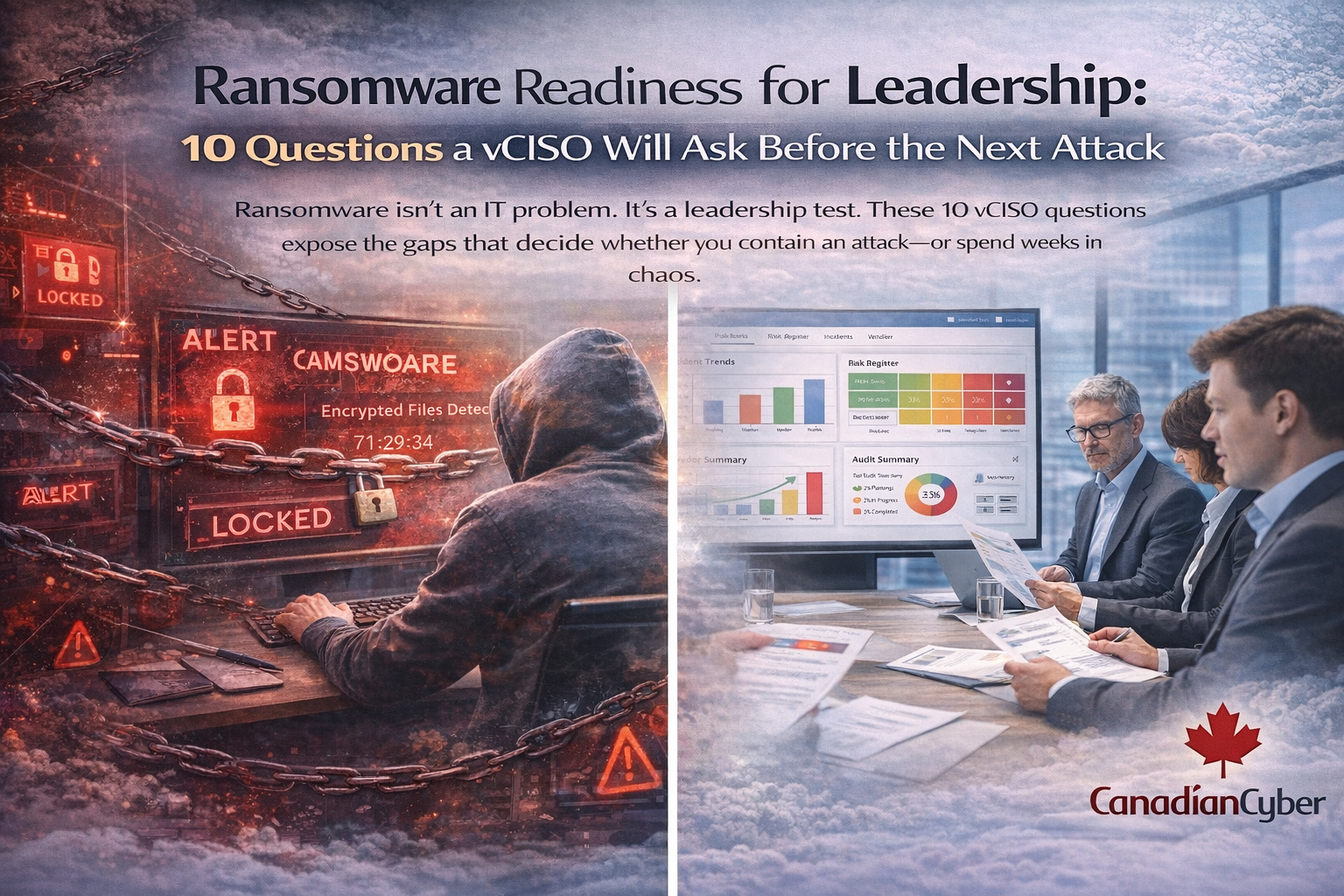
The uncomfortable truth: ransomware is already in your environment
Most ransomware incidents don’t start with “hacking.” They start with one of these:
- a stolen password
- a missed patch
- a vendor compromise
- a phishing click
- an exposed remote service
Then the real damage begins when leadership has to make decisions under pressure:
- Do we shut systems down now or keep operating?
- Do we notify customers? Regulators? Insurers?
- Can we restore—or are we negotiating?
- Who is speaking publicly? Who approves what?
What a vCISO is trying to reduce
Surprise. Not by buying more tools, but by proving you can contain, communicate, and recover.
What a vCISO is really testing
When we assess ransomware readiness, we focus on five outcomes:
- Containment: Can you stop spread quickly?
- Identity control: Can you lock down access in minutes?
- Backup reality: Can you restore cleanly and fast?
- Operational recovery: Can the business run while IT rebuilds?
- Decision-making: Can leadership make the hard calls with a plan?
If any one fails, ransomware turns into a prolonged business outage.
The 10 vCISO Questions Leaders Must Answer
1) What are our top 5 business processes and how long can each be down?
This is the starting point. If you can’t define downtime tolerance, recovery becomes guesswork.
What good looks like
- A short list of critical processes (billing, sales ops, customer support, production, logistics, payroll)
- A clear downtime limit for each (hours/days)
- Process owners who agree with those limits
Red flag: “IT will figure it out” or “We’ll restore everything.”
2) If Microsoft 365 (or your identity system) is compromised, can we lock it down in minutes?
Ransomware often begins with identity compromise. If attackers get admin-level access, they can disable protections and expand quickly.
What good looks like
- MFA everywhere (especially admins)
- Privileged access is limited, reviewed, and logged
- “Break glass” accounts exist, are protected, and monitored
- A documented emergency lockdown procedure
Red flag: Admin access is widespread or unmanaged.
3) Do we have immutable/offline backups and have we restored from them recently?
Backups are only useful if attackers cannot delete or encrypt them and if you can restore quickly.
What good looks like
- Immutable or offline backup options
- Restore testing on a schedule
- Evidence of restore times and integrity checks
Red flag: “We back up” but no recent restore test.
4) Can we list our “crown jewel” systems and data on one page?
Attackers don’t need everything. They need what hurts most.
What good looks like
- Crown jewels identified (systems + datasets)
- Owners assigned
- Dependencies mapped (what breaks if it goes down)
- Protection priorities defined
Red flag: No one can name what matters most.
5) Can we rebuild laptops and servers at scale cleanly?
Many companies pay ransom because rebuild takes too long or feels impossible.
What good looks like
- Standard “gold images” for devices
- Central device management (e.g., Intune/MDM)
- A plan to re-issue clean devices quickly
- Segmented networks to reduce re-infection
Red flag: Rebuild is manual, slow, or never practiced.
6) What are our top 3 ransomware entry points and what did we do about them this quarter?
A vCISO expects a quarterly reduction plan not a “security wishlist.”
Common entry points
- phishing + credential theft
- exposed remote access
- unpatched systems
- weak admin controls
- vendor compromise
What good looks like
- Patch SLAs and proof
- MFA coverage metrics
- External exposure checks
- Phishing trends + training improvements
Red flag: “We have tools” but no measurable reduction.
7) If encryption starts, how do we detect it quickly?
Time is everything. Early detection can turn a disaster into a contained event.
What good looks like
- Endpoint detection coverage (EDR)
- Alert triage process (who checks, how fast)
- A clear escalation chain (“who gets called at 2 a.m.”)
- Ability to isolate machines quickly
Red flag: Alerts exist, but response is slow or unclear.
8) Do we have a real incident response plan or just a PDF no one has used?
Plans don’t save you. Practice does.
What good looks like
- A simple incident plan with roles and contacts
- Legal, PR, operations, leadership included
- Tabletop exercise completed in the last 12 months
- Clear decision owners (not committees)
Red flag: No tabletop exercise or executive involvement.
9) Do we have a decision framework for ransom demands, extortion, and communications?
Modern ransomware often includes extortion: “Pay or we leak.” Leaders should not be making these decisions for the first time during the incident.
What good looks like
- A decision tree (pay / don’t pay criteria)
- Pre-identified legal counsel and breach coach (where applicable)
- Communications plan (internal + customer + public)
- Insurance notification and evidence requirements understood
Red flag: “We’ll decide when it happens.”
10) Which vendors could take us down and do we know their security posture?
Vendor compromise is a common ransomware path and can block your recovery.
What good looks like
- A list of critical vendors (IT, payroll, MSP, cloud, ERP, backups)
- Security reviews and renewal cadence
- Incident notification clauses
- Recovery dependencies understood
Red flag: No visibility into vendor security or obligations.
The fastest way to improve ransomware readiness
If these questions feel hard to answer, that’s not unusual. Most organizations don’t fail because they didn’t buy tools.
They fail because readiness is fragmented.
What a vCISO brings
- business impact first
- controls mapped to outcomes
- owners assigned
- timelines created
- evidence collected for leadership and insurers
Ransomware Readiness Review (vCISO-led)
Want a clear, board-friendly answer to “Are we ready?” We’ll run a focused readiness review.
You’ll get:
- a red/yellow/green readiness scorecard
- top risks ranked by business impact
- quick wins you can implement this month
- a 90-day ransomware hardening plan with owners and timelines
The leadership question that matters most
If systems went dark today, could you answer—without scrambling:
- what stays up first
- who decides what
- how you contain it
- how you restore
- how you communicate
If not, ransomware is a business risk you haven’t governed yet.
Get the Leadership Ransomware Scorecard
Want this in a simple format you can run in a QBR or leadership meeting?
About Canadian Cyber
Canadian Cyber helps Canadian organizations reduce ransomware risk with vCISO-led governance: identity hardening, backup assurance, incident response readiness, vendor risk controls, and board-ready reporting.
Follow Canadian Cyber
Practical cybersecurity + compliance guidance for Canadian teams: