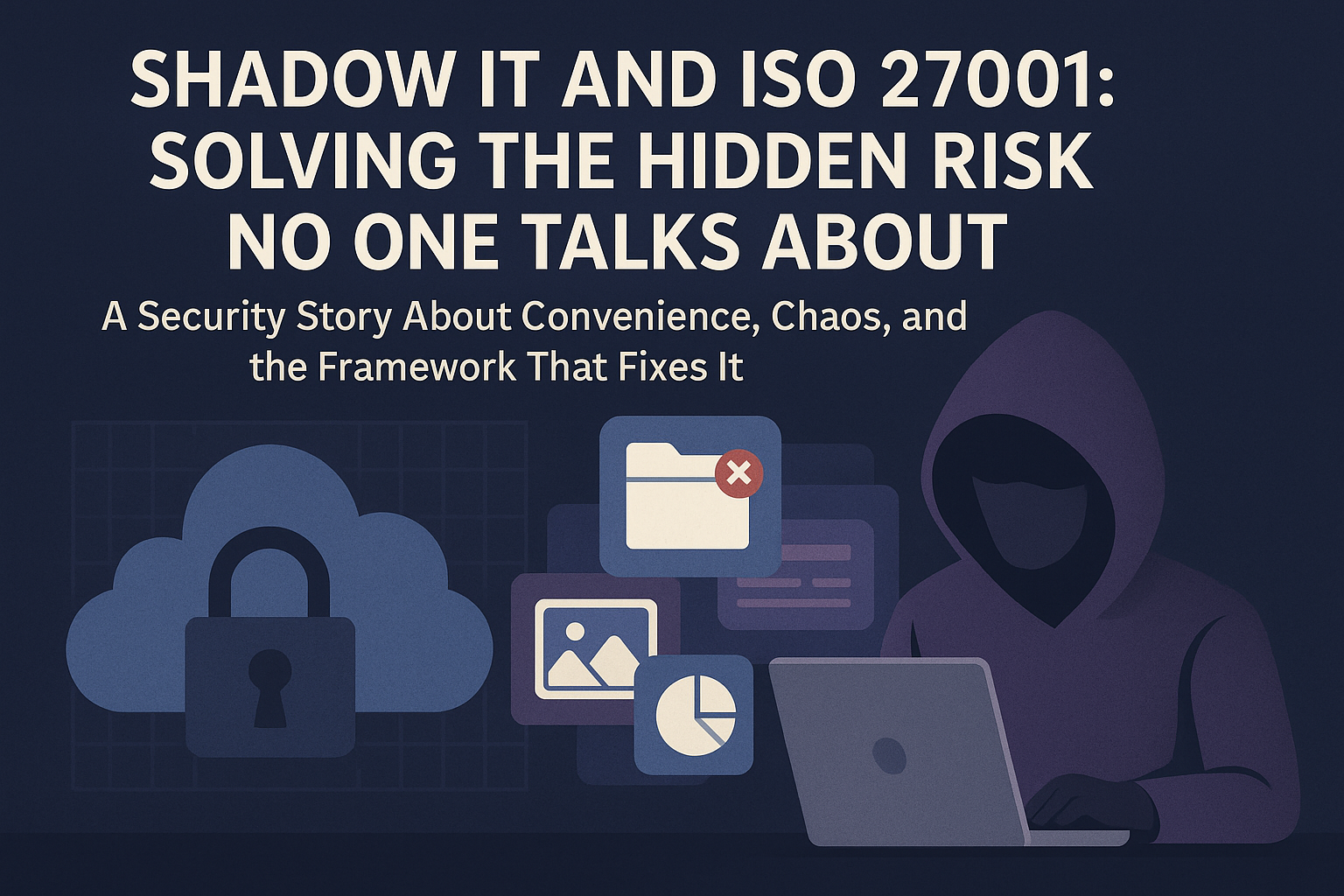
Shadow IT and ISO 27001: Solving the Hidden Risk No One Talks About
A security story about convenience, chaos, and the framework that fixes it.
Every company has a story about the day they discovered Shadow IT. Most leaders don’t even know that story is unfolding… until it’s too late.
Shadow IT lives quietly in the background the unapproved apps, the “temporary” free tools, the personal storage accounts, and the shortcuts employees adopt to make their work easier.
It feels harmless. It feels normal. It feels like innovation. But it is also one of the most underestimated cybersecurity risks in modern organizations.
Today, let’s walk through the story of one such company fictional but inspired by real patterns we see across Canada and how ISO 27001 became the hero they didn’t know they needed.
Note (Fictional Scenario for Illustration Only)
The story below is fictional but based on common Shadow IT and security patterns we see in real organizations.
The Story of BrightLeaf Consulting
(A Fictional Example for Educational Purposes)
BrightLeaf Consulting was a fast-growing HR and workforce strategy firm based in Vancouver. They were brilliant at what they did, and their client list kept growing.
But internally, things were… messy.
Their CEO, Alex, often joked:
Alex: “We’re small. We move fast. We’ll worry about security later.”
Everyone nodded and kept working.
Then came the day everything changed.
⭐ Chapter 1: “Just Use This Tool — It’s Easier.”
It began innocently.
BrightLeaf’s team struggled with their outdated file-sharing system. Uploads were slow. Clients complained.
Employees grew frustrated. So one manager, Nicole, decided to fix it herself.
Nicole: “Everyone, let’s just use this free file-sharing app for now. It’s faster. We’ll switch back later.”
No one questioned it.
No one asked IT.
No one checked the privacy settings.
Within three weeks, more than half the company was storing:
- Employee records
- Client onboarding files
- Salary spreadsheets
- Sensitive HR documents
- Contracts and agreements
…on a free consumer-grade cloud tool.
It was easy. It was fast. It felt… helpful.
Until it wasn’t.
⭐ Chapter 2: The Email That Stopped the Company Cold
On a quiet Friday morning, Alex received an email from their largest client.
Client Email:
“We found a public link containing your employee and client files. Was this intentional?”
Alex’s stomach dropped.
He rushed into the office and called his operations lead.
Alex: “What happened? How did our files get exposed?”
Operations Lead: “I… I don’t know. Let me check.”
Nicole (quietly): “It might be that file-sharing app we’ve been using. I didn’t realize links were public by default.”
Silence.
A whole company’s data… exposed by convenience.
Alex realized in that moment:
Security wasn’t a technical issue anymore. It was a cultural one.
⭐ Chapter 3: Enter ISO 27001 — The Framework That Sees the Invisible
After the chaos settled, Alex reached out to Canadian Cyber for help.
During the first conversation, the vCISO asked:
vCISO: “How many tools does your team use?”
Alex: “I’d say… maybe 12?”
vCISO: “Let’s check.”
After a full audit, the real number was 37.
- Thirty-seven apps stored data.
- Thirty-seven apps had no formal approval.
- Thirty-seven apps had unknown security and privacy settings.
This was Shadow IT in its purest form.
ISO 27001 became their roadmap a structured, tested, globally respected framework that could finally
bring order.
| Shadow IT Reality at BrightLeaf | ISO 27001 Perspective |
|---|---|
| 37 unapproved tools in daily use | Missing asset inventory and control over information systems. |
| Public links to sensitive client data | Lack of access control, classification, and secure sharing standards. |
| No process for choosing or approving tools | Absence of vendor risk management and change control. |
| Employees solving problems “their own way” | No governance or communication around secure ways of working. |
Want to Use ISO 27001 to Tame Shadow IT Not Just Write Policies?
Canadian Cyber helps organizations uncover hidden tools, structure their cloud environments, and build
ISO 27001-aligned controls that employees actually follow.
⭐ Chapter 4: ISO 27001 Reveals What No One Sees
The vCISO broke the problem into four parts all grounded in ISO 27001 requirements.
Part 1 — Identify Every Tool Employees Use
ISO 27001 requires a complete asset inventory.
For BrightLeaf, that meant:
- Listing all cloud tools in use
- Mapping who uses which application
- Reviewing what data each tool stored or processed
- Checking privacy, security, and hosting locations
For the first time, BrightLeaf knew exactly where their data lived.
Part 2 — Approve What’s Safe, Eliminate What Isn’t
Every tool was evaluated against ISO 27001-driven criteria:
- Security features (encryption, MFA, logging)
- Compliance posture and certifications
- Data location and residency
- Access management and auditability
The free file-sharing app?
Retired within 48 hours and replaced with a secure, centrally managed platform.
Part 3 — Define Clear Rules for Tools and Data
ISO 27001 brought clarity:
- No personal storage accounts for client data
- No unapproved apps for company information
- No “free tools” for sensitive documents
- A defined process to request and approve new software
- Baseline security standards for all cloud tools
Suddenly, there was structure not guesses.
Part 4 — Create a Culture Where Employees Don’t Fear Security
The vCISO explained their approach to the entire team:
vCISO: “Security isn’t here to slow you down. It’s here to protect your work, your clients, and your reputation.”
Employees learned:
- Why Shadow IT is dangerous — even with good intentions
- How data really flows through tools and clouds
- How breaches often start with one “quick shortcut”
- How to request new tools safely and quickly
- How to handle sensitive files without guesswork
BrightLeaf felt empowered not restricted.
⭐ Chapter 5: The Turning Point — 90 Days Later
After three months of ISO 27001-driven changes, things looked very different:
- ✔ All cloud tools were documented and owned
- ✔ Vendors were reviewed and approved against security criteria
- ✔ Employees stopped using personal drives for work
- ✔ A secure file-sharing platform replaced the risky one
- ✔ Shadow IT dropped by 82%
- ✔ Clients trusted BrightLeaf again
- ✔ Cyber insurance premiums went down
- ✔ Internal chaos turned into clarity and governance
Alex: “I thought ISO was just policies. But it changed how we work.”
vCISO: “ISO doesn’t fix security. People do. ISO simply shows them how.”
⭐ Chapter 6: The Real Moral of the Story
Shadow IT isn’t caused by bad employees.
It’s caused by:
- Bad or missing processes
- Slow approval cycles
- Inefficient or outdated tools
- Poor communication about expectations
- No central visibility into data and systems
- Lack of a unified security framework
ISO 27001 doesn’t punish employees. It supports them by creating:
- Approved, secure tools
- Tested and vetted vendors
- Clear guidelines on what’s okay and what isn’t
- Easy-to-follow processes instead of ad-hoc decisions
- Real security governance and visibility
Shadow IT begins to disappear when employees no longer need it to get their work done.
Shadow IT Isn’t a Technology Problem, It’s a Human One
Behind every unapproved tool is a person trying to do their job faster or better.
ISO 27001 transforms that environment by giving employees:
- The right tools
- The right training
- The right structure
- The right expectations
And it gives leaders:
- Visibility
- Control
- Confidence
- Compliance
- Predictability
That’s the real power of ISO 27001: turning invisible risk into something you can see, shape, and improve.
Ready to Uncover and Eliminate Shadow IT in Your Organization?
Canadian Cyber helps companies:
- Discover hidden Shadow IT across teams and departments
- Build ISO 27001-aligned controls and governance
- Create secure, approved-tool ecosystems that people actually use
- Train employees to adopt safer digital habits
- Build a remote-friendly, secure culture
- Prepare for ISO 27001 certification and maintain it year-round
Shadow IT becomes manageable when security becomes structured.
👉 Explore Our ISO 27001 Services
Stay Connected With Canadian Cyber
Follow Canadian Cyber for more insights on ISO 27001, Shadow IT, and practical security leadership: