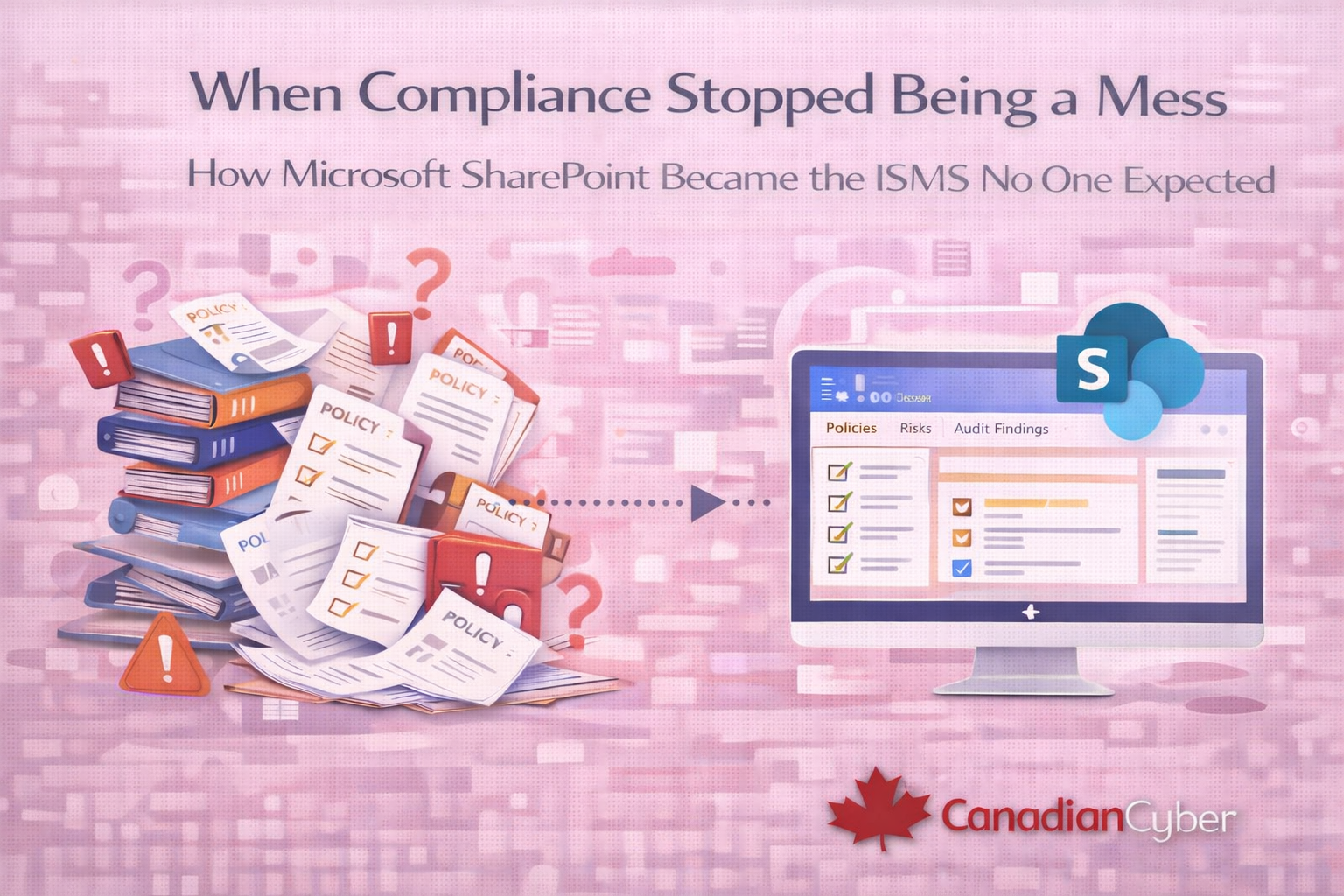
When Compliance Stopped Being a Mess
How Microsoft SharePoint Became the ISMS No One Expected
A true story pattern: scattered policies, spreadsheet risks, and evidence hunts until one SharePoint ISMS portal created one source of truth.
Read time: 5–7 minutes
Keywords: SharePoint ISMS, ISMS portal, ISO 27001 documentation, SOC 2 evidence, compliance automation, Microsoft 365 compliance
SharePoint becomes powerful when it’s designed as an ISMS not a file cabinet.
Centralize policies, risks, findings, and evidence with ownership + workflows, and the chaos disappears.
The moment everything became obvious
It started with a simple question during an internal audit prep call:
“Which version of the policy is the real one?”
Three people answered.
Three different files.
Three different folders.
That’s when the organization realized the problem wasn’t effort.
It was fragmentation.
The hidden cost of scattered compliance
Like many teams, they had “everything” somewhere:
- Policies in shared drives
- Risks in spreadsheets
- Audit findings in email threads
- Evidence buried in old folders
Nothing was technically “wrong.”
But nothing worked together so compliance felt harder than it should.
The shift: treating SharePoint as an ISMS, not storage
The breakthrough came with a mindset change.
Instead of asking:
“Where do we store this document?”
they asked:
“How should compliance actually work?”
SharePoint wasn’t treated as a file cabinet anymore.
It became the ISMS itself.
Quick snapshot: storage SharePoint vs ISMS SharePoint
One portal. One structure. One truth.
The first step was centralization.
They built a single SharePoint site dedicated to the ISMS:
- One entry point
- One navigation
- One structure
- No more guessing where things lived
Compliance finally had a home.
Policies that stayed current (without chasing people)
Policies moved into structured document libraries.
Each policy had:
- Version history
- Clear ownership
- Approval workflows
- Review dates
Result:
People reviewed policies when prompted without friction.
Risk registers that finally made sense
Spreadsheets were replaced with SharePoint Lists.
Risks became:
- Searchable
- Filterable
- Assigned to owners
- Tracked through mitigation
Result:
Risk management felt alive not archived.
Audit findings that didn’t disappear
Findings used to vanish after closing meetings.
Now they lived in structured lists each with:
- An owner
- A due date
- A status
- Follow-up notes and evidence
Result:
Auditors could see progress instantly no explanations required.
Permissions without the headaches
Not everyone needed access to everything.
SharePoint permissions ensured:
- Sensitive data stayed protected
- Teams only saw what mattered to them
- External auditors had controlled access
Security and transparency finally coexisted.
The real win: a single source of truth
The most important change wasn’t technical.
It was psychological.
When someone asked, “Where’s the latest policy?”
there was only one answer:
“It’s in the ISMS portal.”
Still managing compliance across emails, folders, and spreadsheets?
Build a SharePoint ISMS portal that gives your team one place to work and auditors one place to verify.
Why SharePoint works so well as an ISMS
SharePoint already offers the fundamentals a living ISMS needs:
- Version control and approvals
- Access management
- Workflow automation (Power Automate)
- Native Microsoft 365 integration
When structured intentionally, it becomes a living ISMS not just storage.
How Canadian Cyber makes it work
Canadian Cyber helps organizations:
- Design SharePoint as an ISMS platform (not a dumping ground)
- Structure libraries, Lists, workflows, and permissions
- Align the portal with ISO 27001 and SOC 2 expectations
- Reduce evidence chasing and audit-week stress
Result:
Compliance that feels organized, calm, and predictable.
Final thought
Compliance doesn’t fail because teams don’t care.
It fails because systems aren’t designed for how people actually work.
When SharePoint becomes your ISMS not just a place to dump files everything changes.
One portal. One truth. Zero confusion.
Turn SharePoint into a real ISMS your team will actually use built for audits, built for daily work.
Stay Connected With Canadian Cyber
Follow us for modern insights on ISMS design, compliance automation, and Microsoft 365 security: