Get in touch
info@canadiancyber.ca


Rafia Rizwan

April 3, 2026
Trying to decide between SharePoint and a GRC platform? Learn which works best for ISO 27001 and SOC 2 based on your company’s size, complexity, and audit needs.
Mid-Market Software • SharePoint ISMS • GRC Platform • Compliance Strategy
Mid-market software companies often hit the same point in their compliance journey. ISO 27001 and SOC 2 are active priorities, or at least getting close. Customer security reviews keep coming. Evidence grows every month. Control owners are multiplying. And eventually someone asks a simple but loaded question:
Do we need a GRC platform, or can SharePoint handle this?
The wrong answer is to assume a dedicated GRC platform is always more mature. The other wrong answer is to assume SharePoint is always enough. The right answer comes from your scope, your workflow load, your audit pressure, and your real bottleneck.
This decision is not only about software. It is about the kind of operating model you want to support.
Scope complexity is one of the clearest decision points. A company with one main SaaS product, one main environment, and a clear evidence cadence is in a very different position from a company with multiple products, multiple entities, or overlapping regions.
| If this sounds like you | SharePoint often fits | GRC often fits |
|---|---|---|
| Single product SaaS or a few tightly related products | Yes | Maybe later |
| Clear environments and understandable data flows | Yes | Not necessary yet |
| Multiple products, multiple regions, or subsidiaries | Possible, but harder | Often better |
| Many overlapping frameworks and customer overlays | Can strain quickly | Usually stronger fit |
Some teams say they need automation when what they actually need is structure. Others really do need automated attestations, reminders, and escalations because they have too many owners and too many review cycles to manage manually.
For SOC 2 Type II and ISO 27001 surveillance cycles, evidence over time matters more than pretty dashboards. If your team can consistently produce access reviews, log review sign-offs, restore test records, vendor review evidence, and change samples, SharePoint can work very well.
If the main challenge is not storage but getting many teams to complete controls on time, then a GRC platform starts to offer more value.
This is often the deciding factor.
SharePoint is often the fastest win. You likely already use Microsoft 365, and you can immediately standardize evidence packs, tag evidence by period and control, build overdue and approval views, and create an auditor view.
A GRC tool may help more, especially if you have many owners, many attestations, many vendor reviews, and complicated exception workflows.
Founders usually care about speed, adoption, and total cost more than feature lists. That is why time-to-value matters so much here.
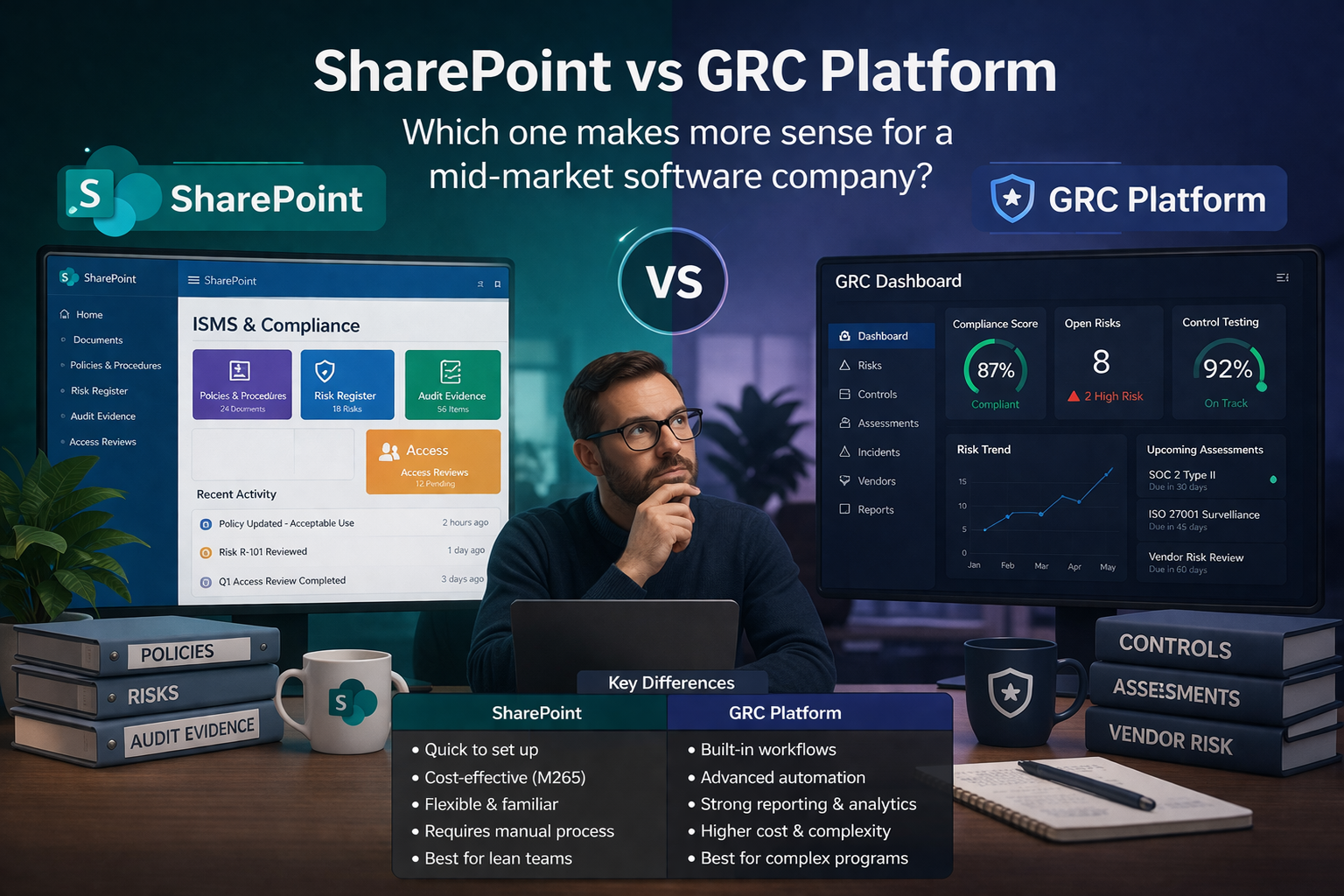
| Factor | SharePoint ISMS | GRC Platform |
|---|---|---|
| Implementation speed | Often weeks | Often months or longer |
| Incremental cost | Low if you already use Microsoft 365 | Higher licensing and rollout cost |
| Flexibility | High, but requires design discipline | High within the tool’s structure |
| Workflow automation | Basic to moderate | Usually stronger |
| Risk of underuse | Lower if the team already lives in Microsoft 365 | Higher if governance is weak and the tool is bought too early |
Many companies underestimate this last point. Teams often underuse GRC tools because they buy features before they have a clear operating model.
This is the shortest useful version of the decision.
For many mid-market software companies, the most practical answer is not to choose the biggest platform first. It is to choose the fastest path to clean governance and visible proof.
That usually looks like a phased path.
This path avoids buying a GRC platform too early. It also gives you a much cleaner migration later, because your governance model is already mature when the tooling expands.
SharePoint and GRC platforms can both support strong compliance programs. The question is not which one is more impressive. The question is which one creates the fastest, least painful path to stable governance, clean evidence, and audit confidence for your actual stage.
If your company mainly needs evidence discipline, auditor views, management review readiness, and a clean operating cadence, SharePoint is often the better first move. If your company is dealing with large-scale workflow complexity, many owners, many frameworks, and deeper reporting needs, a GRC platform starts to make more sense.
For many mid-market software teams, the best answer is phased maturity: stabilize in SharePoint first, then move to GRC when complexity truly demands it.