

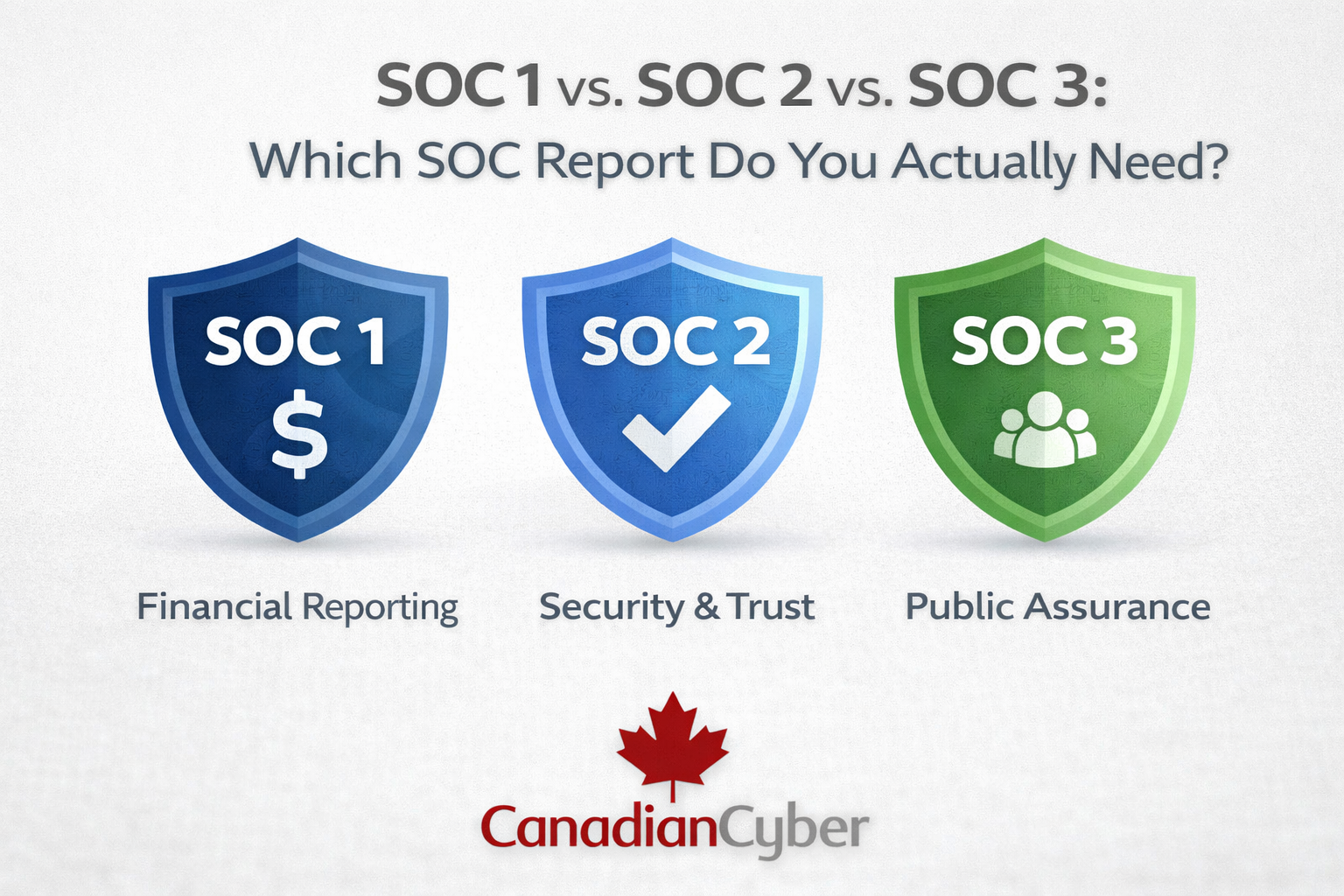
SOC 1 vs. SOC 2 vs. SOC 3: Which SOC Report Do You Actually Need?
A practical guide to choosing the right SOC report for your business.
SOC reports are often misunderstood. Many organizations know they need “a SOC report” but aren’t sure which one, why, or who it’s actually for. SOC 1, SOC 2, and SOC 3 are not interchangeable.
Choosing the wrong SOC report can waste time and money, delay sales, create unnecessary audit scope, and confuse customers.
This guide breaks down SOC 1 vs. SOC 2 vs. SOC 3 in plain language so you can choose the report that actually supports your business goals.
Quick Snapshot
| Report | What it’s about | Best fit |
|---|---|---|
| SOC 1 | Controls that impact customer financial reporting | Payroll, billing, finance services |
| SOC 2 | Security & trust controls for customer data and systems | SaaS, cloud, tech vendors, MSPs |
| SOC 3 | Public, high-level summary of SOC 2 | Marketing & trust signals |
What Are SOC Reports?
SOC reports are independent assurance reports issued by licensed CPA firms. They evaluate how organizations manage controls to protect data, support customer trust, and meet assurance expectations.
SOC reports are commonly requested by:
- Enterprise customers
- Procurement teams
- Auditors
- Regulators
SOC reports provide third-party validation not marketing claims.
Why There Are Different Types of SOC Reports
SOC reports exist because not all risks are the same. Some buyers care about financial reporting accuracy, while others care about security, availability, and privacy controls.
Rule of thumb: SOC 1 is for financial statement reliance.
SOC 2 is for security trust. SOC 3 is for public-facing assurance.
SOC 1: Financial Reporting Assurance
What SOC 1 is for
SOC 1 focuses on controls that impact financial reporting. It answers:
“Does this service provider affect our financial statements?”
Who needs SOC 1
- Payroll processors
- Billing platforms
- Financial service providers
- Companies supporting accounting or financial systems
Important: SOC 1 is not designed for cybersecurity assurance or marketing.
It’s primarily used by customer auditors and finance teams.
SOC 2: Security and Trust Assurance
What SOC 2 is for
SOC 2 evaluates how organizations protect customer data and systems. It answers:
“Can customers trust how we manage security, availability, and data?”
Trust Services Criteria (TSC)
- Security (required)
- Availability
- Confidentiality
- Processing Integrity
- Privacy
Who needs SOC 2:
- SaaS companies
- Cloud service providers
- Technology vendors
- Managed service providers
Reality: SOC 2 is the most commonly requested SOC report today for B2B and enterprise vendor onboarding.
SOC 2 Type I vs. Type II (Quick Note)
| Type | What it evaluates |
|---|---|
| Type I | Control design at a point in time |
| Type II | Control operation over time (often 6–12 months) |
Buyer expectation: Most enterprise customers prefer SOC 2 Type II because it proves consistency, not just intent.
SOC 3: Public Trust Summary
What SOC 3 is for
SOC 3 is a public, high-level version of SOC 2. It answers:
“Can we show we’re secure without sharing sensitive details?”
Who uses SOC 3
- Marketing teams
- Sales teams
- Public websites
- Non-technical stakeholders
Key point: SOC 3 is not a replacement for SOC 2 it complements it as a shareable trust signal.
SOC 1 vs. SOC 2 vs. SOC 3 (Simple Comparison)
| SOC Report | Primary Focus | Audience | Level of Detail | Common Use Case |
|---|---|---|---|---|
| SOC 1 | Financial reporting controls | Auditors, finance teams | High (financial) | Payroll, billing, finance services |
| SOC 2 | Security & trust controls | Customers, procurement, security | High (detailed) | SaaS, cloud, tech vendors |
| SOC 3 | Public assurance summary | Prospects, public | Low (summary) | Marketing & trust signal |
Which SOC Report Do You Actually Need?
Choose SOC 1 if:
- You impact customer financial reporting
- Your customers’ auditors rely on your controls
Choose SOC 2 if:
- You handle customer data
- You sell to enterprises
- Security questionnaires slow sales
Choose SOC 3 if:
- You already have SOC 2
- You want a public trust signal
- Sales and marketing need shareable proof
Common path: Many organizations start with SOC 2, then add SOC 3 later for public-facing trust.
A Fictional Example: Choosing the Right SOC Report
(This example is fictional but reflects real decision patterns.)
A SaaS company handling customer data pursued SOC 1 because “someone said a SOC report was required.”
Customers still asked:
- “Where’s your SOC 2?”
- “How do you protect customer data?”
- “Can we review your security controls?”
After switching to SOC 2, security reviews accelerated, procurement questions dropped, and trust increased.
The problem wasn’t compliance it was choosing the wrong report.
How SOC Reports Support Business Growth
When chosen correctly, SOC reports can:
- Reduce sales friction
- Build enterprise trust
- Support vendor onboarding
- Strengthen risk management
- Improve credibility
SOC reports are not just audits they are business enablers when used for the right purpose.
How Canadian Cyber Helps You Choose and Succeed
At Canadian Cyber, we help organizations pursue the right SOC report for the right reason and build a program that stays strong year-round.
| Service | What you get |
|---|---|
| SOC Readiness & Advisory | SOC 1 / SOC 2 / SOC 3 guidance, scope definition, control mapping |
| vCISO Services | SOC ownership, executive reporting, ongoing compliance management |
| SOC Health Checks | Gap identification, audit readiness, no-surprise assessments |
Final Thought: Not All SOC Reports Are Equal
SOC reports are powerful when used correctly. The right report builds trust, accelerates deals, and reduces risk.
The wrong one delays progress, confuses buyers, and wastes effort.
Choose wisely: Match the SOC report to the buyer’s risk question and your business model.
Need Help Choosing the Right SOC Report?
We can help you pick the right path (SOC 1 vs SOC 2 vs SOC 3), define scope, and build an audit-ready program that supports growth.
Stay Connected With Canadian Cyber
Follow Canadian Cyber for SOC 2, ISO 27001, and practical compliance insights: