Why SOC 2 scope is harder for B2B marketplaces
Most SOC 2 guidance assumes one customer, one product, one boundary.
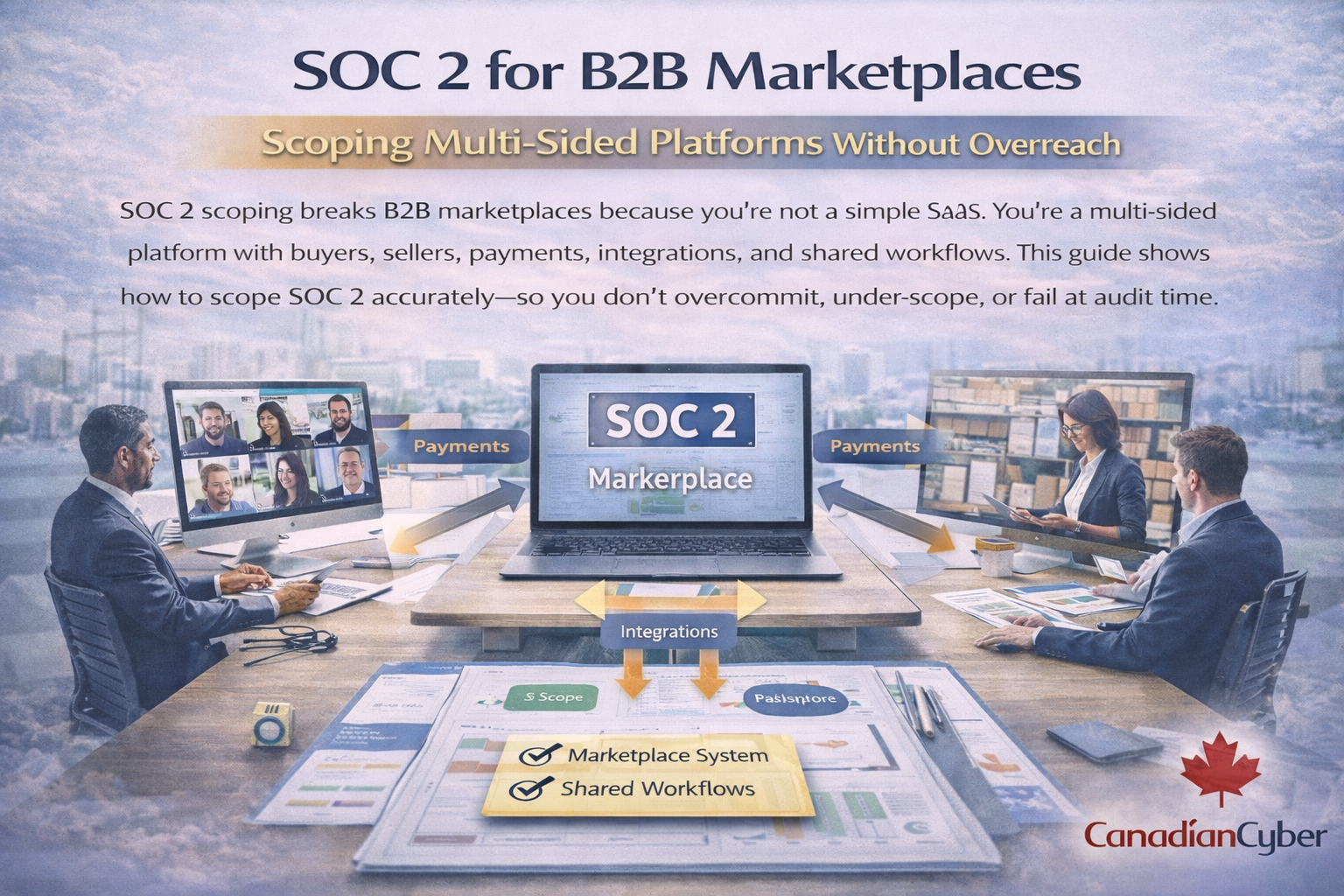
Marketplaces don’t work like that. You have:
- Multiple user populations (buyers, sellers, partners, internal ops)
- Shared workflows (matching, messaging, fulfillment, disputes)
- Third parties everywhere (payments, identity/KYC, cloud, analytics, support tools)
- Data that crosses sides (buyer-visible-to-seller, seller-visible-to-buyer, shared records)
Important
SOC 2 does not require you to control everything in the ecosystem. It requires you to define what you are responsible for and prove controls work inside that boundary.
Most SOC 2 delays for marketplaces happen because scope is vague, too broad, or missing key system boundaries.
The only SOC 2 scoping question that matters
What are you promising customers you do?
SOC 2 validates that your controls support the commitments you make about the system you operate, the services you deliver, and the trust criteria you include.
Scope is not everything you use. Scope is the system you operate that materially affects customer trust.
Start with the SOC 2 “system” definition (simple version)
Your SOC 2 system typically includes:
- The marketplace application (web app, mobile app, APIs)
- Core infrastructure (cloud hosting, network, IAM, logging)
- Supporting processes (access, change, incident response, vendor management)
- People and procedures that operate the system
It does not automatically include every seller’s environment, every buyer’s internal controls, or every third party’s internal controls unless your description pulls them in.
Marketplace scoping framework that auditors accept
Step 1: Define your “marketplace product” in one paragraph
This often becomes the heart of your System Description.
Write a plain-English description you can defend in an audit:
- Who uses it (buyers, sellers, admin teams)
- What the platform does (match, transact, message, manage orders)
- What data it stores/processes (contact info, invoices, payment tokens, docs)
- What outcomes it provides (procurement workflow, onboarding, order management)
Step 2: Decide your Trust Services Criteria (don’t overreach)
Pick criteria you can evidence within 6–12 months.
Most marketplaces start with: Security.
Optionally add:
- Availability (if downtime is material or you make uptime commitments)
- Confidentiality (sensitive commercial data, bids, contracts, proprietary docs)
- Processing Integrity (order/fees/escrow/payout logic must be correct)
- Privacy (personal data beyond basic business contact info)
Avoid overreach: Don’t include criteria you cannot support with evidence in the next 6–12 months.
Step 3: Draw boundaries using 3 layers
Auditors want boundaries that are clear and testable.
Layer A — In scope (you control)
- Marketplace app + APIs
- Cloud environment(s)
- CI/CD + change process
- Databases and storage
- Operational processes (support, onboarding, incident response)
Layer B — Carve-outs (subservice orgs)
- Payment processors
- Identity/KYC vendors
- Email/SMS providers
- Support platforms
- Analytics tools
You manage reliance with vendor controls. You don’t “own” their internal controls.
Layer C — Out of scope
- Sellers’ internal systems
- Buyers’ internal approvals
- Buyer endpoint security
- Seller warehouse systems (unless you operate them)
Describe these as user entity responsibilities.
Step 4: Choose “system-of-record” boundaries
The #1 marketplace scoping mistake is scope sprawl.
Marketplaces often have more than one source of truth (CRM, support tool, warehouse, payments dashboard, admin consoles).
Auditors will ask where the authoritative record lives for transactions, onboarding status, and access.
Best practice:
Identify 1–2 systems of record for each critical workflow:
vendor onboarding, buyer onboarding, listings/matching, orders/transactions, payouts/fees, messaging/disputes.
The 6 marketplace workflows that define scope
If you include these workflows in the product description, you must be able to evidence controls around them.
Workflow → scope question → common evidence
| Workflow |
Scope question |
Evidence examples |
| 1) Identity, roles, access |
Does RBAC enforce separation across sides? |
Role matrix, provisioning, MFA/SSO, admin reviews, privileged logs |
| 2) Tenant isolation |
What prevents cross-tenant visibility? |
Auth design, secure coding standards, test cases, suspicious access alerts |
| 3) Transactions + financial flows |
Are you claiming processing accuracy? |
Change control, reconciliation checks, payout approvals, payment incident handling |
| 4) Vendor onboarding (KYC) |
Do you store verification artifacts? |
Onboarding steps, vendor diligence, access controls, retention rules |
| 5) Messaging + file exchange |
Are files confidential? Where stored? |
Encryption, access controls, audit trails, malware scanning (if used) |
| 6) Support + admin tooling |
Can staff change access, payouts, status? |
Role restrictions, approvals, admin action logging, ticket evidence |
How to scope third parties without failing the audit
SOC 2 does not expect you to audit Stripe or AWS yourself. It expects you to manage reliance responsibly.
A clean third-party approach includes
- Vendor inventory (critical vs non-critical)
- Security due diligence (SOC reports, questionnaires, certifications)
- Contract clauses (incident notification, access, data handling)
- Ongoing reviews for critical vendors
- Documented incident escalation path
Auditor-friendly wording
“We rely on third-party subservice organizations. Controls relevant to these services are addressed through vendor management,
contractual requirements, and review of independent assurance reports where available.”
Avoiding overreach: what NOT to include in scope
Overreach kills marketplaces because it creates control obligations you can’t evidence.
- All seller operations (fulfillment, internal systems)
- Buyer internal procurement approvals
- Every analytics/marketing tool as “critical”
- Availability commitments without DR evidence
Better approach
Keep scope to what you control and can evidence.
What auditors will ask during SOC 2 scoping (script)
Use this in your internal readiness assessment.
Scoping interview script
System and boundaries
- What is the marketplace service you provide (in one paragraph)?
- Which environments are in scope (prod only vs prod + staging)?
- What components are in scope (apps, APIs, databases, admin tools)?
- What is out of scope and why?
Data and users
- What data types do you store and process?
- Which data is sensitive or confidential?
- How do buyers/sellers authenticate and get roles?
- How do you prevent cross-tenant access?
Key controls
- How do you manage changes to production?
- How do you monitor for suspicious access or anomalies?
- How do you respond to incidents, and what’s your evidence?
- How do you manage vendors you rely on?
Marketplace-specific
- How do you control admin tooling and sensitive actions?
- How do you handle payment workflows and reconciliations?
- How do you manage onboarding verification data?
The evidence pack that makes SOC 2 easier for marketplaces
If you want SOC 2 to move fast, build a scope-first evidence pack.
Core scope artifacts
- System description (model + boundaries + users)
- Architecture diagram (components + data flows)
- Data classification and data flow summary
- Vendor inventory with criticality and diligence status
Control evidence essentials
- Access controls (RBAC, admin MFA, access reviews)
- Change management (PR reviews, deploy approvals)
- Logging/monitoring (alerts, tickets, response)
- Incident response (runbook + record/tabletop)
- Vendor management (SOC reports, reviews, notes)
Scope SOC 2 correctly from day one
If you’re a B2B marketplace aiming for SOC 2, correct scoping reduces time and cost and prevents control overreach.
Canadian Cyber vCISO teams can scope your SOC 2 in 10 business days and deliver:
- an audit-ready system boundary
- trust criteria recommendation (no overreach)
- a marketplace-specific control map
- a 90-day evidence plan aligned to real workflows
FAQ: SOC 2 scoping for B2B marketplaces
Common questions
Does SOC 2 include our sellers and buyers?
Not by default. It includes your system and the controls you operate. Seller and buyer responsibilities are typically described as user entity responsibilities.
Are payment processors in scope?
Usually as a subservice organization you rely on. You manage them through vendor controls, not by auditing their internal controls yourself.
Do we need Processing Integrity?
Only if you make strong claims about transaction accuracy (fees, payouts, escrow logic). Many marketplaces start with Security (and sometimes Availability) and add Processing Integrity later.
Should we include staging environments?
Usually no, unless staging handles production data or materially affects production outcomes. Production-only scope is most common.
What’s the biggest marketplace SOC 2 risk?
Cross-tenant access failures and admin tooling misuse.
Marketplace SOC 2 Scope Pack
Want a proven scope pack built for multi-sided platforms?
Includes:
- system description template for marketplaces
- scope boundary worksheet (in-scope / carve-out / out-of-scope)
- vendor subservice register template
- “user entity responsibilities” wording
- marketplace workflow control map
Follow Canadian Cyber
Practical cybersecurity + compliance guidance for Canadian teams: