Why telemetry integrity is the real deal blocker
In smart infrastructure security reviews, buyers rarely stop at standard questions about MFA, vulnerability scanning, or admin access. They want to know whether the underlying telemetry itself is dependable enough to drive business and operational decisions.
Typical buyer fears
- spoofed devices sending fake telemetry
- tampered telemetry in transit or during processing
- cross-tenant data mixing
- silent data gaps where “missing” looks like “normal”
- uncontrolled exports at scale
- no audit trail for what happened, when, or why
Key point:
SOC 2 reviewers do not need you to promise perfect telemetry. They need you to prove controls that make telemetry reliable, attributable, and auditable over time.
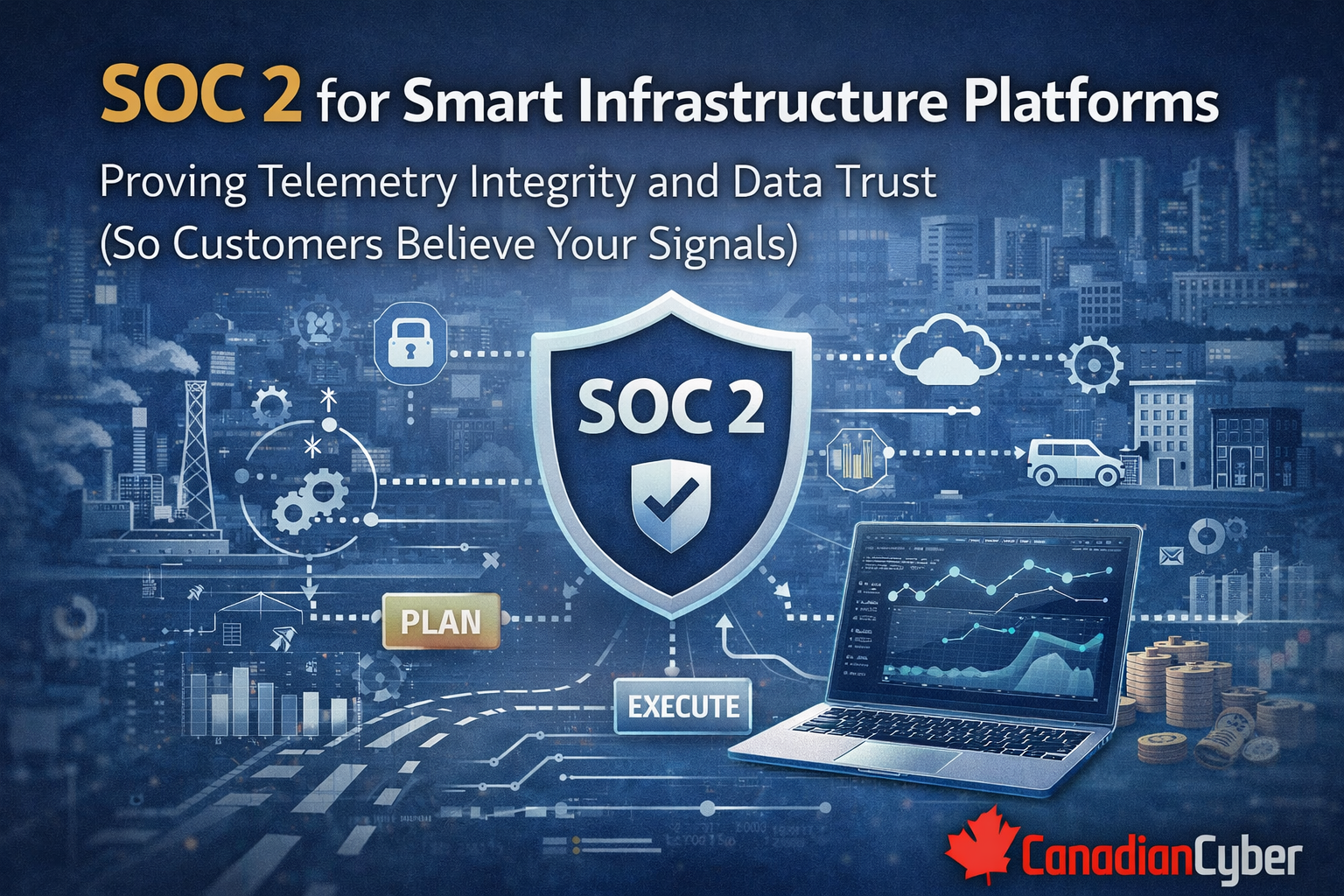
The SOC 2 lens: data trust sits across Security, Availability, and Confidentiality
Most smart infrastructure platforms start with SOC 2 Security. Many also include Availability when uptime is contract-critical, and Confidentiality when telemetry includes sensitive site, tenant, or user-related operational information.
Security
Identity, access control, logging, change management, and threat resistance.
Availability
Reliable delivery, alerting, heartbeat monitoring, and resilience when data stops flowing.
Confidentiality
Protection of tenant, site, export, and operational data from overexposure or leakage.
Important nuance:
telemetry integrity is not its own SOC 2 criterion. It is the outcome produced by multiple control domains working together.
The Telemetry Trust Model
To make telemetry trustworthy, you need evidence across five stages:
Identity
Transport
Processing
Storage & Retention
Auditability
Those five stages are what buyers are actually testing when they ask whether they can trust your telemetry.
1) Device and source identity: stop spoofing at the door
The first trust question is simple: who or what generated this telemetry? If you cannot prove source identity, the rest of the pipeline starts from a weak foundation.
Controls that matter
- unique identity per device or gateway
- certificate-based auth or strong token-based auth with rotation
- controlled provisioning workflow
- revocation or quarantine capability for compromised sources
Evidence auditors trust
- device identity model document
- provisioning workflow record
- sample revocation event and verification record
- quarterly review of provisioning and admin permissions
2) Transport integrity: encryption is table stakes, replay resistance is trust
Encryption in transit is expected. The stronger trust story comes from proving the ingestion path also resists replay, flooding, malformed payload abuse, and high-volume manipulation attempts.
| Control |
Why it matters |
Evidence |
| TLS enforced |
Protects telemetry in transit |
Ingestion endpoint config proof |
| Replay protection |
Reduces duplicate or injected event risk |
Design note, validation rules |
| Request size limits |
Prevents payload abuse |
Gateway or WAF config export |
| Rate limits per device and tenant |
Prevents flood and cost-spike abuse |
Throttling logs, policy config |
If buyers are already asking whether they can trust your telemetry, the fastest win is to tighten the controls that prove source identity, transport integrity, and tenant isolation.
3) Tenant isolation: prevent cross-site and cross-customer mixing
This is one of the biggest failure modes in shared telemetry platforms. If one customer’s telemetry can appear in another customer’s dashboards, exports, alerts, or reports, trust collapses immediately.
Controls
- tenant context enforced at ingestion and processing
- device identity bound to tenant context
- separate topics, queues, streams, or strong logical scoping
- storage segregation using prefixes, partitions, or schemas
- automated tests for cross-tenant boundaries
Evidence
- one-page multi-tenant isolation statement
- CI evidence showing isolation tests run and pass
- sample denied cross-tenant access events where available
- privileged access review evidence for platform admins and support roles
4) Processing integrity: prevent tampering and silent corruption
Telemetry pipelines usually do more than ingest and store data. They normalize, enrich, aggregate, generate alerts, and drive workflows. That means the trust problem is not only whether the data arrived. It is also whether it was transformed safely and visibly.
Controls
- immutable or tamper-evident event logging for critical telemetry records
- schema validation and required field checks
- acceptable range and sanity checks where relevant
- dead-letter queue and error handling visibility
- change control for pipeline logic
Evidence
- pipeline validation rules summary
- error handling process
- sample incident or ticket from processing failure
- PR approvals, deployment logs, and post-change validation for pipeline updates
5) Audit trails: prove who did what to telemetry and configurations
Buyers and auditors will test whether you can reconstruct a telemetry-related event from end to end. They want to know whether you can trace alerts, configuration changes, exports, and admin actions back to their source.
| What to log |
Why it matters |
| configuration changes |
thresholds, alert rules, and integrations affect trust outcomes |
| admin actions |
proves who changed security- or data-relevant settings |
| export actions |
critical for confidentiality and scale exfiltration detection |
| privileged role changes and ingestion config changes |
high-risk events that should be monitored and reviewed |
Evidence that works
- log retention settings proof
- monthly or quarterly log review sign-offs
- 2–3 alert-to-ticket-to-resolution examples
- quarterly privileged access review evidence
The data trust controls buyers ask for specifically
A) Data completeness: prove you detect missing telemetry
One of the most dangerous smart infrastructure failure modes is not bad telemetry it is missing telemetry that looks normal.
Controls and evidence
- heartbeat monitoring per device or fleet
- alerts for missing telemetry beyond threshold
- customer-visible status indicators where possible
- monitoring rule list and sample missing-data incident record
B) Time integrity: prove timestamps are reliable
If time is wrong, analysis is wrong. That affects alerting, investigations, performance analysis, and customer trust.
- timestamp normalization policy
- documented time sync assumptions
- detection for out-of-range timestamps
- sample rejected or flagged event logs
C) Export controls: stop bulk telemetry exfiltration
Telemetry can be highly sensitive even when it does not contain classic personal data. Site layouts, occupancy patterns, performance conditions, and operations metadata can all be commercially or operationally sensitive.
Controls and evidence
- role-based export permissions
- approval workflow for bulk exports, where appropriate
- rate limits on export APIs
- export audit logging and anomaly alerts
- export permission settings proof and sample export audit log
The Smart Infrastructure SOC 2 Evidence Pack
If you want SOC 2 to move faster and convert into buyer confidence, organize your evidence around telemetry trust rather than generic security screenshots.
A strong evidence pack includes
- Scope and trust statement — platform components, telemetry types, and multi-tenant boundaries
- Identity and provisioning evidence — device identity model and revocation workflow proof
- Pipeline integrity evidence — ingestion protections, validation, error handling, and pipeline change samples
- Isolation and access governance evidence — isolation statement, test evidence, privileged access review, support access controls
- Monitoring and auditability evidence — retention proof, review sign-offs, alert-to-ticket examples, missing telemetry monitoring evidence
This is what buyers actually want:
a trust story they can review quickly, not a random pile of screenshots.
Common SOC 2 gaps in smart infrastructure platforms
Common gaps
- shared device credentials
- no revocation proof
- silent telemetry drops
- assumed rather than tested tenant isolation
- uncontrolled exports
- pipeline rule changes bypass governance
- logs exist but are not reviewed
Quick fixes
- move to unique device or gateway identity
- implement quarantine workflow with logs and tickets
- add heartbeat and missing-data alerts
- document and continuously test isolation
- separate export permissions and alert on spikes
- enforce PR approvals and deployment traceability for pipeline rules
- add monthly or quarterly sign-offs with sample tickets
Practical truth:
fixing two or three of these often shortens security reviews immediately.
Next Steps
If you run a smart infrastructure platform and want SOC 2 to prove data trust, not just policy maturity, focus first on the controls buyers will challenge earliest: telemetry identity, processing integrity, tenant isolation, and auditability.
Final takeaway
Smart infrastructure platforms are not judged only on whether the application is secure. They are judged on whether the underlying telemetry can be trusted enough to drive action.
SOC 2 helps when you translate it properly: not as generic control language, but as a telemetry trust model that covers source identity, transport integrity, processing control, auditability, export governance, and missing-data detection.
In one line
Buyers do not trust signals because you say they are secure. They trust signals because you can prove how those signals stay attributable, intact, visible, and reviewable over time.
Follow Canadian Cyber
Practical cybersecurity + compliance guidance: