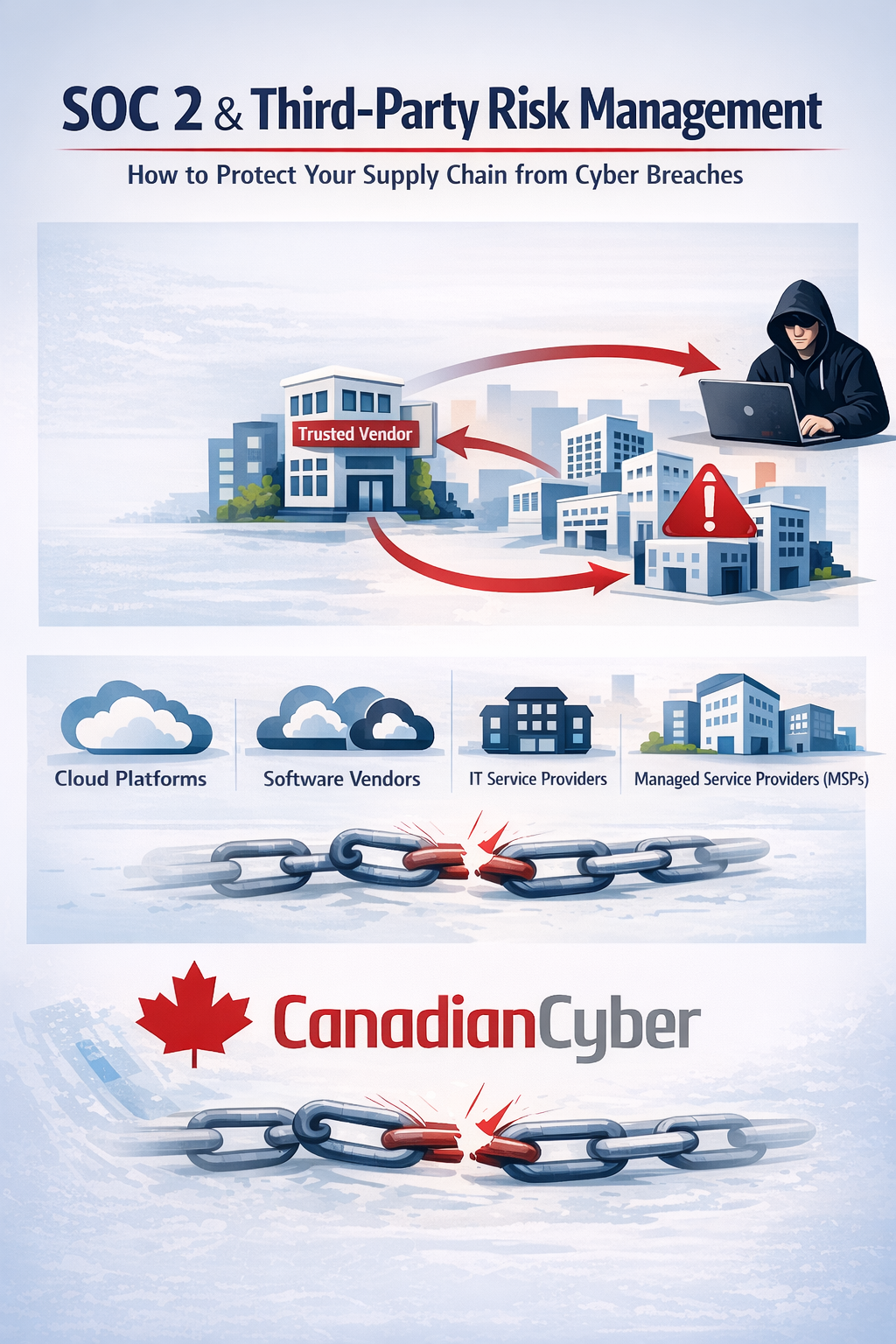
SOC 2 and Third-Party Risk Management
How to protect your supply chain from cyber breaches
The breach did not start inside the organization.
No employee clicked a phishing link.
No firewall failed.
The attacker came through a trusted vendor.
This is how modern cyber incidents unfold.
Supply chain attacks have proven that one weak link can compromise many.
SOC 2 helps organizations reduce that risk.
Why Supply Chains Are a Prime Target for Hackers
Organizations rely on third parties more than ever.
Cloud platforms.
Software vendors.
IT service providers.
Managed Service Providers (MSPs).
Each vendor adds convenience.
Each vendor also adds risk.
Attackers know that compromising one supplier can provide access to dozens or thousands of downstream customers.
Supply chains are now a primary attack vector.
What Is Third-Party Risk Management (TPRM)
Third-party risk management is the process of:
- Identifying vendors and suppliers
- Assessing their security posture
- Defining security expectations
- Monitoring access and performance
SOC 2 treats vendor risk as a core security control, not a side task.
Why SOC 2 Is Critical for Managing Vendor Risk
SOC 2 requires organizations to demonstrate that:
- Vendor access is controlled
- Sensitive data is protected
- Risks are assessed and documented
- Incidents involving vendors are managed
This applies across the Trust Services Criteria, especially Security, Confidentiality and Availability.
Vendor security must be provable.
Quick Snapshot: SOC 2 and Third-Party Risk
| Category | Details |
|---|---|
| Best for | Organizations with vendors, suppliers, or MSP relationships |
| Primary risk addressed | Supply chain and vendor-driven breaches |
| Key benefit | Auditable vendor security controls |
| Relevant to | All industries, including MSPs |
| Outcome | Reduced exposure and stronger accountability |
The Real Impact of Supply Chain Breaches
When a vendor is compromised, the effects spread fast.
Systems go offline.
Customer data is exposed.
Trust erodes.
For MSPs, the impact is amplified.
One breach can affect multiple clients at once.
SOC 2 helps reduce the “blast radius” by enforcing consistent controls.
Step-by-Step: Building Third-Party Controls with SOC 2
Step 1: Identify All Third Parties and Their Access
You cannot manage vendor risk without visibility.
SOC 2 expects organizations to:
- Maintain a vendor inventory
- Document what data vendors access
- Understand system and network connections
This includes:
• SaaS tools
• Hosting providers
• IT support partners
• Development and integration vendors
Subtle highlight: Visibility is the foundation of control.
Step 2: Vet Vendors Before Onboarding
Not all vendors pose the same risk.
SOC 2 encourages a risk-based approach to vendor vetting.
This may include:
- Security questionnaires
- Reviewing SOC 2 or ISO 27001 reports
- Assessing data handling and access practices
High-risk vendors require deeper scrutiny.
Low-risk vendors still require oversight.
Step 3: Enforce Security Requirements in Contracts
Trust alone is not enough.
Security expectations must be written into agreements.
SOC 2 supports contractual controls such as:
| Contract Control | Why It Matters |
|---|---|
| Data protection requirements | Sets expectations for handling sensitive data |
| Incident notification timelines | Reduces response time and downstream impact |
| Access limitations | Prevents overreach into systems and data |
| Security responsibility clauses | Clarifies who owns which controls and evidence |
Subtle highlight: Contracts set expectations before issues arise.
Mid-Section CTA
Not sure if your vendor contracts actually protect you?
Review your posture and find gaps early.
Step 4: Control and Monitor Third-Party Access
Vendor access should never be permanent or unrestricted.
SOC 2 emphasizes:
- Least-privilege access
- Role-based permissions
- Logging and monitoring
- Regular access reviews
Subtle highlight: For MSPs, this is especially critical across multiple client environments.
Step 5: Continuously Monitor Vendor Risk
Vendor risk does not end after onboarding.
Security posture changes over time.
SOC 2 expects ongoing monitoring, including:
- Periodic reassessments
- Incident tracking
- Performance and compliance reviews
Continuous oversight reduces long-term exposure.
How SOC 2 Supports MSPs and Multi-Client Environments
MSPs face unique challenges.
They manage shared tools.
They access multiple client systems.
They carry shared risk.
SOC 2 helps MSPs:
- Standardize vendor and client security controls
- Protect client environments
- Demonstrate security maturity
Subtle highlight: This builds trust across the supply chain.
Common Third-Party Risk Mistakes
Many organizations repeat the same errors.
- Trusting vendors without validation
- Granting excessive or permanent access
- Skipping contract security clauses
- Failing to reassess vendors
SOC 2 addresses these gaps through structure and evidence.
Build a scalable framework and align vendor security with SOC 2.
👉 Build a Third-Party Risk Framework
👉 Align Vendors With SOC 2
How Canadian Cyber Helps Manage Third-Party Risk
We help organizations take control of vendor risk.
Across industries.
Across supply chains.
Our SOC 2 services include:
- Vendor risk assessments
- Control mapping and implementation
- Contract security guidance
- Audit-ready documentation
Subtle highlight: Security that extends beyond your perimeter.
Strengthen Your Supply Chain With SOC 2
If your organization:
- Relies on vendors or MSPs
- Handles sensitive customer data
- Wants to prevent supply chain breaches
SOC 2 provides clarity and confidence.
Build vendor visibility, tighten access, and stay audit-ready with SOC 2.
👉 Start Your SOC 2 Journey Today
👉 Speak With a Cybersecurity Expert
Stay Connected With Canadian Cyber
Follow us for practical insights on compliance, risk, and cybersecurity: