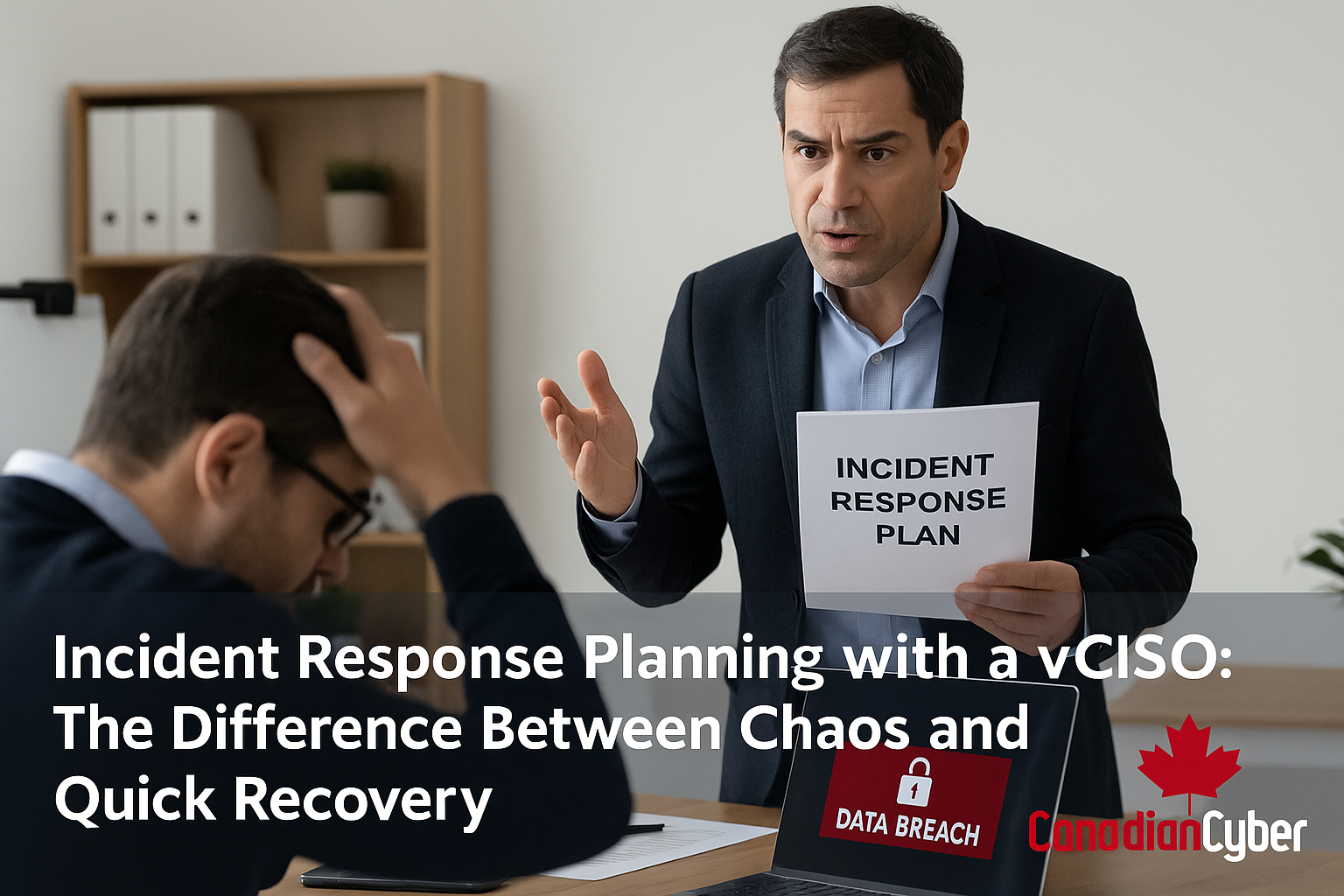
Incident Response Planning with a vCISO: The Difference Between Chaos and Quick Recovery
Why every Canadian business needs a tested plan before something goes wrong
Most organizations believe cyber incidents happen to “someone else.”
Until the day they don’t.
Across Canada, ransomware, phishing, data theft, and cloud misconfigurations are hitting SMBs faster than ever. Yet many companies still do not have an Incident Response Plan (IRP). Others have a plan they downloaded years ago that no one has ever tested.
This is where a vCISO (Virtual Chief Information Security Officer) becomes invaluable. A vCISO builds, tests, and leads incident response planning so your team already knows what to do when something goes wrong.
To show how powerful this can be, here’s a fictional (but very realistic) example based on patterns we see
across Canadian organizations every day.
A Fictional Story: The Day MapleStone Finance Faced a Ransomware Attack
Note: The story below is fictional, created for educational purposes, but reflects common real-life scenarios faced by Canadian organizations.
MapleStone Finance, a mid-sized financial advisory firm in Toronto, relied heavily on cloud applications, email communication, and client document sharing. They had good intentions but limited cybersecurity maturity.
Six months earlier, they hired a Canadian Cyber vCISO to improve their security posture, including creating an incident response plan.
During the first planning session
David (CEO): “Do we really need an incident response plan right now? We’ve never had a breach.”
Alex (vCISO): “You don’t build a fire escape during the fire. You build it when everything is calm so when the fire comes, you already know the way out.”
David reluctantly agreed. Alex created a structured IRP, conducted a tabletop exercise, assigned roles, and trained
leaders on what to do in the first 60 minutes of an incident. Everyone hoped they’d never need it.
But they did.
The Incident: Friday Morning at 9:17 AM
It started with a simple email.
A finance associate clicked a link disguised as a document from a familiar vendor. Within minutes, files became
unreadable. A message appeared on their screen:
Panic spread fast.
In the hallway
David (CEO): “Systems are locked! Someone call IT! What do we do?”
IT Lead (nervous): “We’ve never dealt with ransomware before…”
The IT team froze. They had never handled a ransomware attack on their own.
But Alex, the vCISO, had prepared them for this exact moment.
The Response: Calm Through Structure
Alex joined the call within minutes.
On the incident bridge
Alex (vCISO): “Everyone take a breath. Open your Incident Response Plan.
Step one: isolate the affected workstation.”
Because MapleStone had completed their tabletop exercise months earlier, the team already knew their roles:
- IT isolated the compromised devices
- HR notified key staff and ensured instructions were followed
- Communications paused outgoing email campaigns
- Leadership convened in a dedicated Teams channel
- The vCISO coordinated the entire response
- Backups were checked and validated
Alex guided them step by step through:
- Containment
- Eradication
- Root-cause analysis
- Communication to the vendor whose identity was spoofed
- Evidence preservation for possible legal and insurance needs
The IRP worked exactly as designed.
| Without Tested IRP | With vCISO-Led IRP |
|---|---|
| Unclear roles, everyone guessing what to do | Defined roles, rehearsed via tabletop exercises |
| Panic and conflicting instructions | Calm, single point of leadership (vCISO) |
| Uncertain backup status | Backups validated and tested ahead of time |
| High chance of paying ransom and extended downtime | No ransom paid, minimal downtime, controlled recovery |
Within 3 hours, MapleStone restored its systems using clean backups.
No ransom paid. Minimal downtime. No public disclosure required.
After the incident
David (CEO): “I never realized how fast things could fall apart.”
Alex (vCISO): “That’s why we prepare. Not for if. For when.”
Why Incident Response Planning Matters More Than Ever
Many Canadian companies assume they will detect an incident quickly. In reality:
- Ransomware can spread in minutes
- Phishing can compromise accounts instantly
- Cloud misconfigurations can silently expose data
- Vendor breaches can impact you overnight
- Insider threats often go unnoticed for weeks or months
A vCISO ensures that during an incident:
- Roles are clear
- Decisions are fast
- Damage is minimized
- Communication is controlled
- Recovery is quick
- Regulators and stakeholders are properly informed
Without a plan, companies rely on improvisation and improvisation is expensive.
What a vCISO Brings to Incident Response Planning
A vCISO helps organizations build a complete IRP that is practical, tested, role-based, evidence-driven, and compliant with regulatory and framework expectations.
Key vCISO responsibilities include:
- ✔ Creating a customized Incident Response Plan
- ✔ Leading tabletop exercises and scenario walk-throughs
- ✔ Establishing a clear communication protocol
- ✔ Ensuring backups and recovery processes are validated
- ✔ Defining roles and responsibilities across teams
- ✔ Training staff on early detection and reporting
- ✔ Guiding leadership during active incidents
- ✔ Documenting lessons learned and corrective actions
- ✔ Keeping the IRP updated as threats and infrastructure evolve
In short, a vCISO turns chaos into an organized, confident response when it matters most.
Lessons Learned from MapleStone’s (Fictional) Incident
| Lesson | What It Really Means |
|---|---|
| 1. Incidents escalate fast | Minutes matter in ransomware delays increase damage and cost. |
| 2. Training reduces panic | People who know the plan keep the business stable during chaos. |
| 3. Communication must be structured | Uncontrolled messages can worsen the incident and confuse staff. |
| 4. Backups only help if tested | Their backups worked because their vCISO insisted on validation. |
| 5. Preparation builds confidence | Leadership felt empowered, not helpless, because they had practiced. |
This fictional example mirrors the real events Canadian Cyber sees frequently across Canada.
Strong Incident Response = Lower Risk + Faster Recovery + Better Compliance
Incident response planning is now expected by:
- Clients and enterprise customers
- Cyber insurers
- Boards and senior leadership
- Privacy regulators
- Compliance frameworks like SOC 2, ISO 27001, Law 25, and PCI DSS
A vCISO provides the structure many SMBs lack. With a vCISO, you gain:
- Leadership
- Clarity
- Speed
- Experience
- Predictability
- Confidence during a crisis
Ready to Build a Real Incident Response Plan?
Canadian Cyber helps Canadian companies build, test, and maintain effective incident response programs without
needing a full-time CISO.
Stay Connected with Canadian Cyber
Follow Canadian Cyber for more real-world vCISO stories, incident response tips, and Canadian cybersecurity insights: