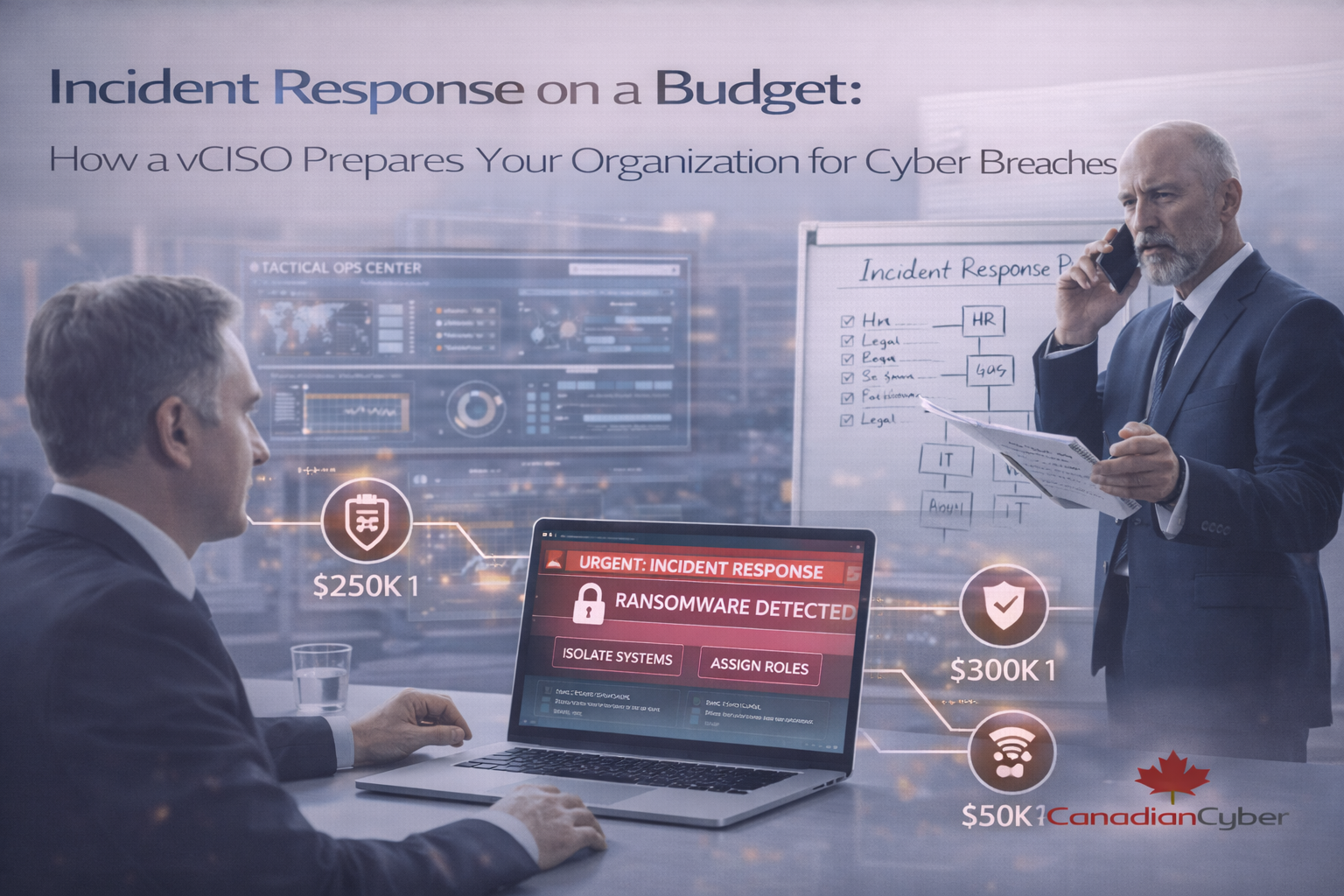
Incident Response on a Budget: How a vCISO Prepares Your Organization for Cyber Breaches
Why being “prepared enough” is often the difference between a contained incident and a business crisis.
Every organization asks the same question after a breach hits the news:
“Would we be ready if that happened to us?”
For many small and mid-sized organizations, the honest answer is uncomfortable.
Not because they don’t care about security.
But because they don’t have a full-time CISO, a 24/7 response team, or the budget of a large enterprise.
Cyber incidents are no longer rare, but full-time security leadership still is.
This is where a Virtual CISO (vCISO) becomes critical especially when budgets are tight and the margin for error is small.
Why Incident Response Fails in Most Organizations
Most incident response failures don’t happen during the attack.
They happen before it ever begins.
• No written incident response (IR) plan
• Plans that exist but are outdated
• No clear decision-makers
• Confusion between IT, legal, and leadership
• No practice under pressure
When a breach occurs, teams lose time debating what to do next instead of responding.
Time is the most expensive resource during an incident.
Incident Response Is a Leadership Problem — Not a Tool Problem
Many organizations invest in strong tools, yet still struggle during incidents.
Firewalls don’t make decisions.
EDR tools don’t coordinate leadership.
SIEM alerts don’t manage business impact.
Incident response is ultimately a governance and leadership function.
That’s exactly where a vCISO adds value.
What a vCISO Brings to Incident Response (That Tools Can’t)
A vCISO does not replace your IT team.
They prepare, guide, and lead when things go wrong — before, during, and after an incident.
✅ Clear response structure
✅ Executive decision support
✅ Tested plans and procedures
✅ Calm coordination under pressure
✅ Audit-ready documentation and evidence
How a vCISO supports every phase of incident response
| Phase | What the vCISO does | Why it matters |
|---|---|---|
| Before | Builds plans, clarifies roles, runs tabletop exercises | Prevents chaos and lost time |
| During | Coordinates response, supports leadership decisions | Faster containment and clearer communication |
| After | Leads post-incident review, improves controls, updates plans | Incidents become maturity gains |
Phase 1: Building a Practical Incident Response Plan
Most IR plans fail because they are too technical, copied from templates, or disconnected from reality.
A vCISO builds an IR plan that answers real questions:
• Who declares an incident?
• Who contacts legal or insurers?
• When does leadership get involved?
• What systems are prioritized?
The goal is clarity — not complexity.
Phase 2: Aligning Incident Response With Business Reality
Every organization has different priorities.
A hospital, a SaaS provider, and a manufacturer respond differently to incidents.
A vCISO ensures response priorities reflect business impact not guesswork.
Leadership understands trade-offs before a crisis.
Phase 3: Running Tabletop Exercises (Without Wasting Time)
Tabletop exercises are one of the most powerful and most underused security practices.
When done properly, they reveal gaps before attackers do.
✅ Realistic scenarios (ransomware, data breach, supplier compromise)
✅ Executive participation (not just IT)
✅ Clear communication testing under stress
✅ No jargon and no blame
Practicing incidents reduces response time and prevents costly mistakes.
Even one avoided misstep can justify the cost of preparation.
Want a Budget-Friendly Incident Response Plan That Actually Works?
We help organizations build clear IR plans and run executive tabletop exercises without enterprise overhead.
Phase 4: Coordinating During a Live Incident
When an incident occurs, confusion is the enemy.
A vCISO becomes the central coordinator, the translator between technical teams and executives, and the calm presence that keeps response structured and documented.
Phase 5: Managing External Pressures
During incidents, organizations often must deal with insurers, legal counsel, regulators, customers, and auditors.
A vCISO helps ensure communications are consistent, obligations are met, and evidence is preserved reducing long-term fallout.
Phase 6: Post-Incident Review and Improvement
Many organizations rush to “move on” after an incident. This is a mistake.
A vCISO leads structured post-incident reviews, root cause analysis, control improvements, and plan updates so the organization gets stronger instead of just recovering.
Why This Matters for Organizations on a Budget
Hiring a full-time CISO just for incident readiness is unrealistic for many organizations.
A vCISO provides leadership-level incident readiness with:
✅ Senior-level security leadership
✅ On-demand involvement
✅ Experience across multiple incidents
✅ No long-term employment overhead
A Fictional Example: Prepared Without a Full-Time CISO
(This example is fictional but reflects real-world patterns.)
A growing company had no CISO but they engaged a vCISO.
They had a tested plan, clear executive roles, and practiced decision-making.
When ransomware hit:
✅ Systems were isolated quickly
✅ Leadership stayed calm
✅ Legal and insurer notifications were timely
✅ The incident was contained
How a vCISO Aligns Incident Response With Compliance
Frameworks like ISO 27001, SOC 2, and NIST all expect documented response plans, evidence of testing, and improvement.
A vCISO ensures incident response supports compliance and reduces audit risk.
How Canadian Cyber Delivers Incident Readiness on a Budget
🔹 Incident Response Planning
Business-aligned IR plans • Executive-friendly language • Audit-ready documentation
🔹 Tabletop Exercises
Realistic scenarios • Leadership participation • Clear lessons learned
🔹 Live Incident Support
Coordination and guidance • Calm decision-making • Clear communication
Preparedness Is the Real Cost Saver
Most breach costs don’t come from attackers.
They come from delayed decisions, poor communication, missed obligations, and unclear authority.
Incident response is not about perfection.
It’s about detecting quickly, responding confidently, and recovering efficiently.
Ready to Strengthen Incident Response Without a Full-Time CISO?
Let us help you prepare for the day you hope never comes so it doesn’t become the day everything falls apart.
Stay Connected With Canadian Cyber
Follow Canadian Cyber for practical readiness and governance insights: