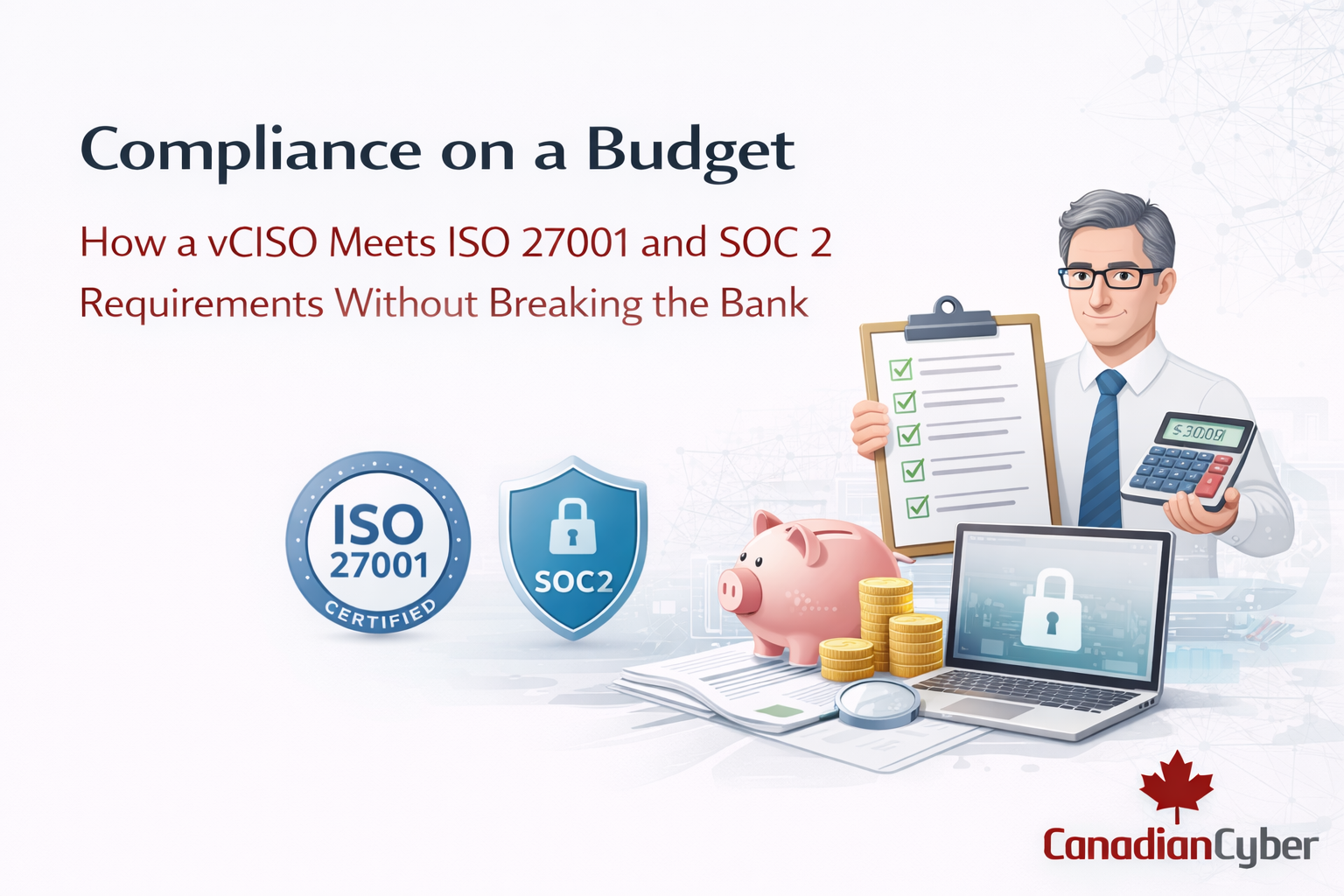
Compliance on a Budget
How a vCISO Meets ISO 27001 and SOC 2 Requirements Without Breaking the Bank
Every growing company eventually faces the same reality:
• A major client asks for ISO 27001
• An enterprise deal requires SOC 2
• Investors want proof of governance
• Regulators tighten expectations
And leadership asks:
“How do we become compliant without blowing the budget?”
Compliance does not have to be expensive.
But unmanaged compliance almost always is.
The difference is strategic leadership and that is where a Virtual CISO (vCISO) changes everything.
The Myth: Compliance Requires Massive Spending
Many SMEs assume they need:
• A full-time CISO (often $180K+ salary)
• Multiple compliance tools ($20K–$50K/year)
• Large consulting retainers
• Enterprise-scale controls for every requirement
That mindset creates:
• Over-engineering
• Tool sprawl
• Burned-out IT teams
• Bloated budgets
A vCISO approaches compliance differently.
What a vCISO Does Differently
A vCISO does not just “add controls.” They design a program that is risk-based, audit-ready, and efficient.
• Prioritize what actually matters
• Align controls to business risk
• Reuse existing tools (especially Microsoft 365)
• Reduce duplication and busywork
• Phase implementation intelligently
• Prepare you for audits with structured evidence
The goal is not maximum controls.
The goal is effective controls at the right maturity level.
Where Companies Overspend (Without Realizing It)
1) Buying Expensive GRC Tools Too Early
Many teams buy a $20K+ platform before they have done the basics:
• Define scope
• Complete a gap assessment
• Assign internal control owners
• Create a repeatable evidence approach
Often, Microsoft 365 already provides most of what you need if it is structured properly:
• SharePoint (document control + evidence libraries)
• Teams (approvals + collaboration)
• Power Automate (workflow automation)
• Entra ID (MFA, access controls, access reviews)
• Power BI (dashboards and reporting)
2) Over-Scoping the ISMS
Certifying “the whole organization” sounds impressive but it often doubles the work.
• More audit days
• More documentation
• More evidence
• More internal audit complexity
A vCISO scopes intelligently: core product, customer data systems, and high-risk functions first.
Scope expands later once the system matures.
Savings: often 20–40% in year one.
3) Implementing Controls at Enterprise Scale
Not every SME needs a full enterprise stack on day one.
ISO 27001 and SOC 2 require controls that are:
• Appropriate
• Risk-based
• Documented
• Monitored
A vCISO ensures proportional implementation mature enough to satisfy auditors, without over-engineering.
How a vCISO Builds Compliance Cost-Effectively
Step 1: Conduct a Focused Gap Assessment
• Review current controls
• Identify true gaps
• Prioritize based on risk
• Align requirements to business impact
Clarity saves money. It prevents wasted work and last-minute audit surprises.
Step 2: Reuse Existing Infrastructure
| Requirement | Expensive Approach | Smart vCISO Approach |
|---|---|---|
| Policy management | External GRC platform | SharePoint document control |
| Access reviews | Separate access review tool | Entra ID + workflow attestations |
| Task tracking | Compliance software | Planner + automated reminders |
| Evidence storage | External repository | Structured SharePoint evidence library |
| Reporting | Third-party dashboards | Power BI executive reporting |
The result: fewer subscriptions, less duplication, and simpler adoption for your team.
Step 3: Automate Recurring Controls
Manual compliance is expensive. A vCISO designs a system that runs continuously.
Automate recurring tasks like:
• Quarterly access reviews
• Annual policy reviews
• Vendor reassessments
• Training reminders and tracking
• Evidence collection alerts
Automation reduces staff hours, missed deadlines, and audit findings while improving consistency.
Step 4: Phase Compliance by Business Goals
Phase 1: Scope + documentation foundation + core controls
Phase 2: Strengthen monitoring + improve control maturity
Phase 3: Automate evidence + dashboards + continuous improvement
This approach avoids overwhelming teams and keeps progress visible to leadership.
Planning ISO 27001 or SOC 2 and worried about cost? Get a clear estimate and a smarter roadmap based on what you already own.
The Cost Comparison: Full-Time vs vCISO
| Option | Annual Cost | Strategic Impact |
|---|---|---|
| Full-time CISO | $180K–$250K+ | High, but heavy overhead |
| Security consultant (project) | $25K–$80K | Short-term only |
| vCISO (fractional leadership) | Cost-effective, scalable | Continuous oversight + roadmap |
For most SMEs under 150 employees, a vCISO is the fastest way to gain executive-level security leadership without full-time executive cost.
Real-World Example (Simplified)
50-person SaaS company
Initial instinct: hire a full-time CISO + buy a $30K platform + large consulting package
vCISO approach: scope smart + use Microsoft 365 + automate workflows + focused internal audit
Outcome:
• ~40% lower year-one cost
• Certification readiness achieved
• Enterprise deal unlocked
• Compliance embedded into operations
How Canadian Cyber Helps You Do It
Canadian Cyber provides:
• vCISO services tailored for Canadian SMEs
• ISO 27001 and SOC 2 readiness programs
• Internal audit support
• Compliance automation strategy
• SharePoint-based ISMS platform inside your Microsoft 365 tenant
We help you reduce tool sprawl, avoid over-engineering, and stay audit-ready year-round.
Want Compliance Clarity Without the Budget Guessing?
In 15 minutes, we’ll estimate your real costs, define smart scope, and outline a phased roadmap with no pressure.
Final Takeaway
Compliance doesn’t fail because companies lack money.
It fails because they lack structure and strategy.
A vCISO gives you both so you can reduce risk, win enterprise trust, and stay audit-ready without breaking the bank.
Stay Connected With Canadian Cyber
Follow us for practical compliance strategies, vCISO insights, and audit readiness guidance: