Get in touch
info@canadiancyber.ca


Rafia Rizwan

January 7, 2026
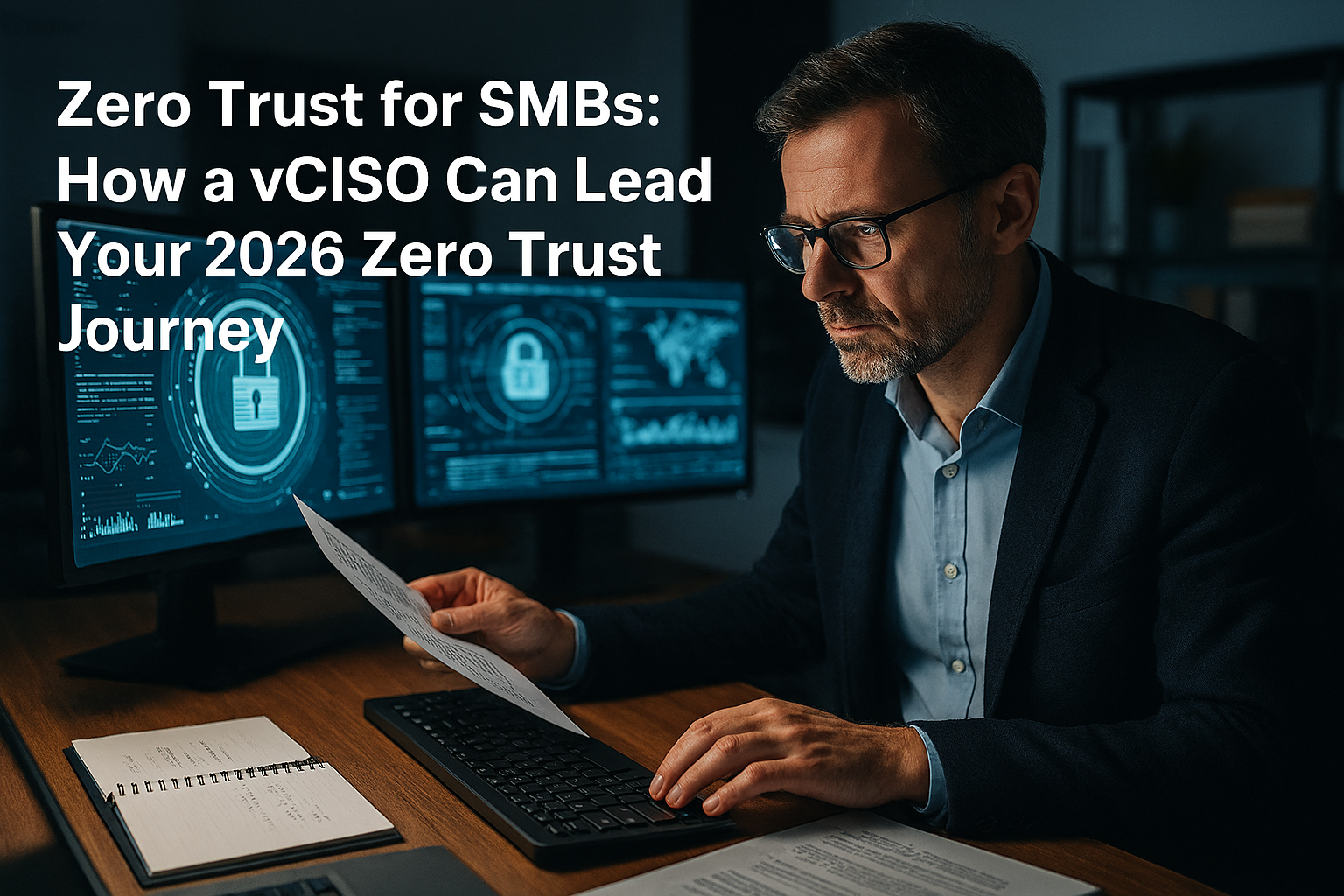
Zero Trust for SMBs: How a vCISO Can Lead Your 2026 Zero Trust Journey Audience: IT leaders and executives at SMBs and mid‑market companies. Why Zero Trust now especially for smaller organizations Zero Trust is no longer a buzzword. It’s the modern baseline for securing hybrid work, SaaS, and multi‑cloud environments: “never trust, always verify.” […]
Audience: IT leaders and executives at SMBs and mid‑market companies.
Zero Trust is no longer a buzzword. It’s the modern baseline for securing hybrid work, SaaS, and multi‑cloud environments: “never trust, always verify.” In 2025, authoritative guidance from NIST and CISA frames Zero Trust as a practical architecture (not a single product) that continuously validates identity, device posture, and context before granting per‑request access to resources.
Yet many SMBs struggle to operationalize it. Budgets are constrained; teams are lean; legacy VPN and flat networks persist. The good news: a virtual CISO (vCISO) a fractional security leader can plan and run a phased Zero Trust rollout that fits your size, tooling, and timelines, anchored in NIST SP 800‑207 concepts and the 2025 NIST SP 1800‑35 implementation guide.
NIST defines Zero Trust as a shift from perimeter-centric security to resource-centric, per‑session access governed by dynamic policy and continuous telemetry. Core components include a Policy Engine, Policy Administrator, and Policy Enforcement Points, supported by identity, endpoint, and logging systems.
CISA’s Zero Trust Maturity Model (V2.0) breaks adoption into pillars (identity, devices, networks, applications, data) and pragmatic maturity levels (traditional → initial → advanced → optimal), useful for SMB roadmapping.
It’s not a product purchase. It’s an operating model your vCISO can translate into practical steps, controls, and evidence—so auditors (and insurers) recognize progress.
Independent research underscores adoption momentum and business value: market growth, fewer incidents, faster detection, and reduced breach costs when Zero Trust is implemented. Forrester emphasizes that Zero Trust is a business amplifier: it strengthens brand trust and supports modern engagement models when implemented with microsegmentation and strong identity controls.
Microsoft’s guidance reiterates the same anchor principles—verify explicitly, use least‑privilege access, and assume breach and offers practical patterns for identity‑centric enforcement in cloud estates that SMBs commonly use.
A vCISO gives you executive security leadership without the full‑time cost. They translate Zero Trust principles into a phased, budget‑sensitive plan, coach IT and business stakeholders, and ensure audit‑ready evidence. Critically, they map your journey to recognized frameworks NIST SP 800‑207 and CISA’s ZT Maturity Model so progress is measurable and defensible.
Typical vCISO responsibilities:
What changes: Universal MFA, Conditional Access, JIT admin, entitlement clean‑up, strong service account governance.
Why it matters: NIST’s model requires per‑request authorization and continuous posture checks; Microsoft’s Zero Trust guidance centers on verify explicitly and least privilege.
What changes: From flat networks and broad VPNs to micro-segmented workloads with per‑app access policies; access decisions at PEPs.
Why it matters: Forrester and federal guidance highlight micro-segmentation as critical to halting lateral movement and limiting breaches.
What changes: Device compliance checks, hardening baselines, isolation for unmanaged endpoints, and continuous telemetry.
Why it matters: Mature Zero Trust validates device health before granting access, per CISA pillars and NIST practice builds.
What changes: Centralized logs; behavior analytics; automated response playbooks; rehearsed incident workflows.
Why it matters: Visibility and analytics are an essential Zero Trust pillar emphasized by NSA to speed detection and adaptive decisions.
CISA explicitly notes Zero Trust often requires a shift in philosophy and culture—a new habit of explicit verification and least privilege across teams. Your vCISO leads that change: executive messaging, policy clarity, and training that treats Zero Trust as everyone’s job, not only security’s.
Practical tactics:
Starting point: 800‑employee manufacturer with flat internal networks, shared admin accounts, and broad VPN access for partners.
vCISO plan: 9‑month roadmap aligned to CISA ZT maturity model: identity baseline (MFA, Conditional Access, JIT), microsegmentation of ERP/PLM workloads, ZTNA for partner access, device compliance with automated isolation, and a consolidated SIEM.
Outcomes:
Industry surveys show Zero Trust adoption accelerating across organizations of all sizes, with SMBs posting strong growth through 2030; the driver is identity‑centric architectures and ZTNA replacing legacy VPN reliance. Your vCISO prioritizes impact over spend:
Combined, these resources make Zero Trust measurable and achievable for SMBs.
Do we need to replace everything?
No. Zero Trust integrates with identity, endpoint, and network controls you already own; the vCISO aligns policy and telemetry so they work as one fabric.
Is Zero Trust just for government and large enterprise?
No. Adoption is rising among SMBs; the barriers are planning and prioritization—a vCISO accelerates both.
How fast can we see results?
Within 90 days: MFA everywhere, entitlement clean‑up, and segmentation of one crown‑jewel app reduce risk immediately.
Canadian Cyber helps SMB and mid‑market organizations build vCISO‑led Zero Trust programs aligned to NIST and CISA guidance designed for your size and tools.
We’ll assess your current posture and deliver a phased roadmap that your team can execute.
Follow us for practical Zero Trust and SMB security leadership insights: