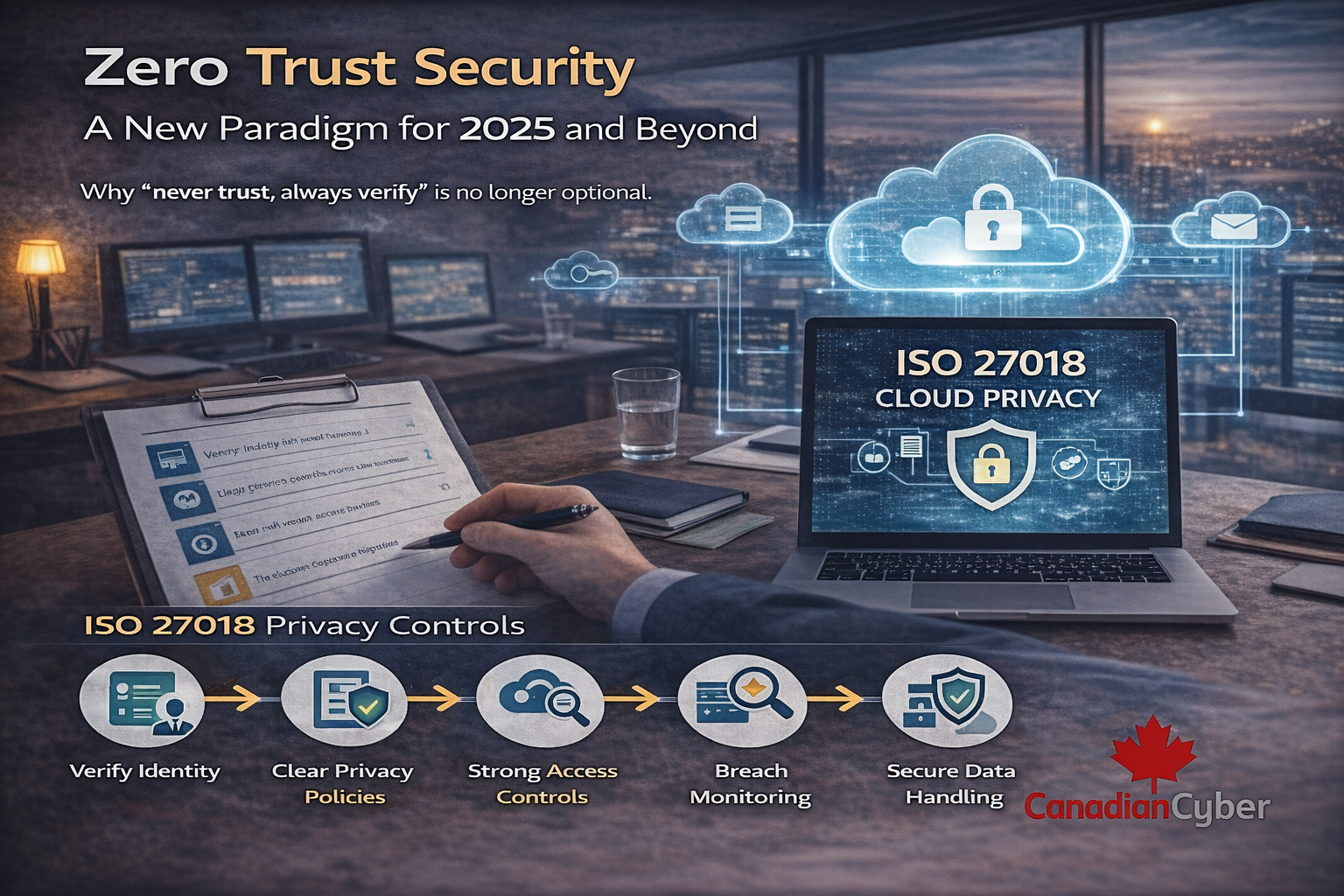
Zero Trust Security: A New Paradigm for 2025 and Beyond
Why “never trust, always verify” is no longer optional.
For years, cybersecurity was built around a simple idea:
If you’re inside the network, you’re trusted.
Firewalls protected the perimeter. VPNs granted access. Internal users moved freely. That model no longer works.
In 2025 and beyond, users work remotely, applications live in the cloud, devices connect from everywhere, and attackers often start inside the environment using stolen credentials.
This is why organizations are shifting toward a new approach: Zero Trust security.
What Is Zero Trust Security (In Plain Language)?
Zero Trust is based on one core principle:
Never trust. Always verify.
Instead of assuming trust based on location (inside vs. outside the network), Zero Trust requires continuous verification of every access request.
- Every user is verified
- Every device is validated
- Every application request is checked
- Every session is monitored
No one gets a “free pass” not even internal users.
Why the Traditional Perimeter Model Failed
The old security model assumed:
- Users worked from offices
- Systems lived on internal networks
- Threats came from outside
Today, the reality is different:
- Employees work remotely or hybrid
- Cloud services dominate
- SaaS tools replace internal apps
- Credentials are routinely stolen
The problem: once an attacker gets inside, traditional networks often allow
lateral movement with little resistance.
Zero Trust is designed to stop exactly that.
How Zero Trust Actually Works
Zero Trust is not a single product. It’s a security architecture and mindset.
At a high level, it includes:
- Strong identity verification
- Least-privilege access
- Continuous authentication and authorization
- Device posture checks
- Micro-segmentation
- Ongoing monitoring
Zero Trust rule of thumb: every access decision is treated as a new request even if it happened five minutes ago.
Traditional Perimeter vs. Zero Trust
| Security Model | How Access Works | Key Risk |
|---|---|---|
| Perimeter-based | Trust increases once inside the network/VPN | Attackers move laterally after credential theft |
| Zero Trust | Every request is verified using identity, device, and context | Reduced blast radius and tighter access boundaries |
A Fictional Example: Same Login, Very Different Outcomes
This example is fictional but reflects real-world scenarios.
An employee’s credentials are compromised through phishing.
| Traditional Network | Zero Trust Environment |
|---|---|
|
|
Same breach attempt. Completely different impact.
That’s the power of Zero Trust.
Zero Trust Is Not Just About Security
One of the biggest myths about Zero Trust is that it hurts usability. In well-designed implementations,
it can strengthen security while improving the user experience.
How Zero Trust Improves User Experience
Instead of clunky VPNs and broad network access, Zero Trust enables:
- Single Sign-On (SSO) across approved tools
- Context-aware authentication (risk-based prompts)
- Seamless access to applications without overexposing the network
- Clearer permissions and less confusion about access
Bottom line: security becomes more consistent and in many cases, less visible.
Want a practical Zero Trust roadmap (not buzzwords)?
We help organizations prioritize identity, access, and architecture changes that reduce risk without breaking workflows.
👉 Explore Zero Trust & Security Architecture Services
👉 Book a Free Consultation
Why Zero Trust Is Critical for 2025 and Beyond
Modern organizations face challenges that Zero Trust directly addresses:
- Remote and hybrid work
- Cloud-first architectures
- Bring-your-own-device (BYOD)
- Third-party access
- Sophisticated credential-based attacks
Zero Trust assumes breach is possible and designs systems to limit damage. This mindset is essential for modern threat environments.
Core Principles of Zero Trust
| Principle | What It Means in Practice |
|---|---|
| Identity is the new perimeter | Access depends on who you are and context not network location |
| Least privilege by default | Users get only what they need, nothing more |
| Continuous verification | Trust is re-evaluated constantly, not once |
| Assume breach | Design controls to contain impact when something goes wrong |
Zero Trust Is a Journey, Not a Switch
One of the biggest mistakes organizations make is trying to “buy Zero Trust.” Zero Trust is implemented incrementally, often starting with:
- Identity and access management
- MFA and SSO rollout
- Device security checks (posture and compliance)
- Application-level access controls (not broad network access)
- Segmentation and monitoring to limit lateral movement
Over time, architecture matures. This is where planning and leadership matter.
The Role of a vCISO in Zero Trust Adoption
Zero Trust touches technology, processes, and people. A Virtual CISO (vCISO) helps organizations:
- Assess current architecture and risk exposure
- Define realistic Zero Trust goals
- Prioritize steps that deliver measurable risk reduction
- Align security with business needs and user experience
- Avoid over-engineering and tool sprawl
Instead of a theoretical model, Zero Trust becomes a real, achievable strategy.
How Canadian Cyber Helps Organizations Adopt Zero Trust
At Canadian Cyber, Zero Trust is treated as a strategic security architecture not a buzzword.
Zero Trust Strategy & Architecture Advisory
- Design Zero Trust roadmaps that fit your environment
- Align Zero Trust with cloud and remote work realities
- Strengthen identity and access controls
- Reduce lateral movement risk across apps and infrastructure
vCISO-Led Security Architecture
- Guide Zero Trust adoption with executive-level oversight
- Balance security and usability for real-world operations
- Align Zero Trust with ISO 27001 and SOC 2 requirements
- Support leadership decision-making and prioritization
Zero Trust Is About Control, Not Distrust
Despite the name, Zero Trust is not about distrusting employees. It’s about:
- Protecting people
- Protecting systems
- Reducing blast radius
- Building resilience
In a world where breaches are inevitable, trust must be earned continuously.
Is Your Organization Ready for Zero Trust?
If your organization relies on cloud services, remote access, or third-party integrations, Zero Trust is not a future idea it’s a current requirement.
Ready to Explore Zero Trust the Right Way?
If you want to improve security and user experience without disrupting your business, we can help.
Stay Connected With Canadian Cyber
Follow Canadian Cyber for practical guidance on Zero Trust, security architecture, and cybersecurity governance: