vCISO Onboarding Checklist for Canadian Organizations
Your 90-Day Plan for Security Leadership That Delivers Results
A vCISO can move fast but only if onboarding is structured.
Use this 90-day checklist to get early wins, reduce risk, and align security with Canadian compliance and business goals.
Read time: 7–9 minutes
Keywords: vCISO onboarding, virtual CISO Canada, 90-day security plan, Law 25, PIPEDA, ISO 27001, SOC 2
The first 90 days decide if a vCISO becomes a trusted security leader or “another consultant.”
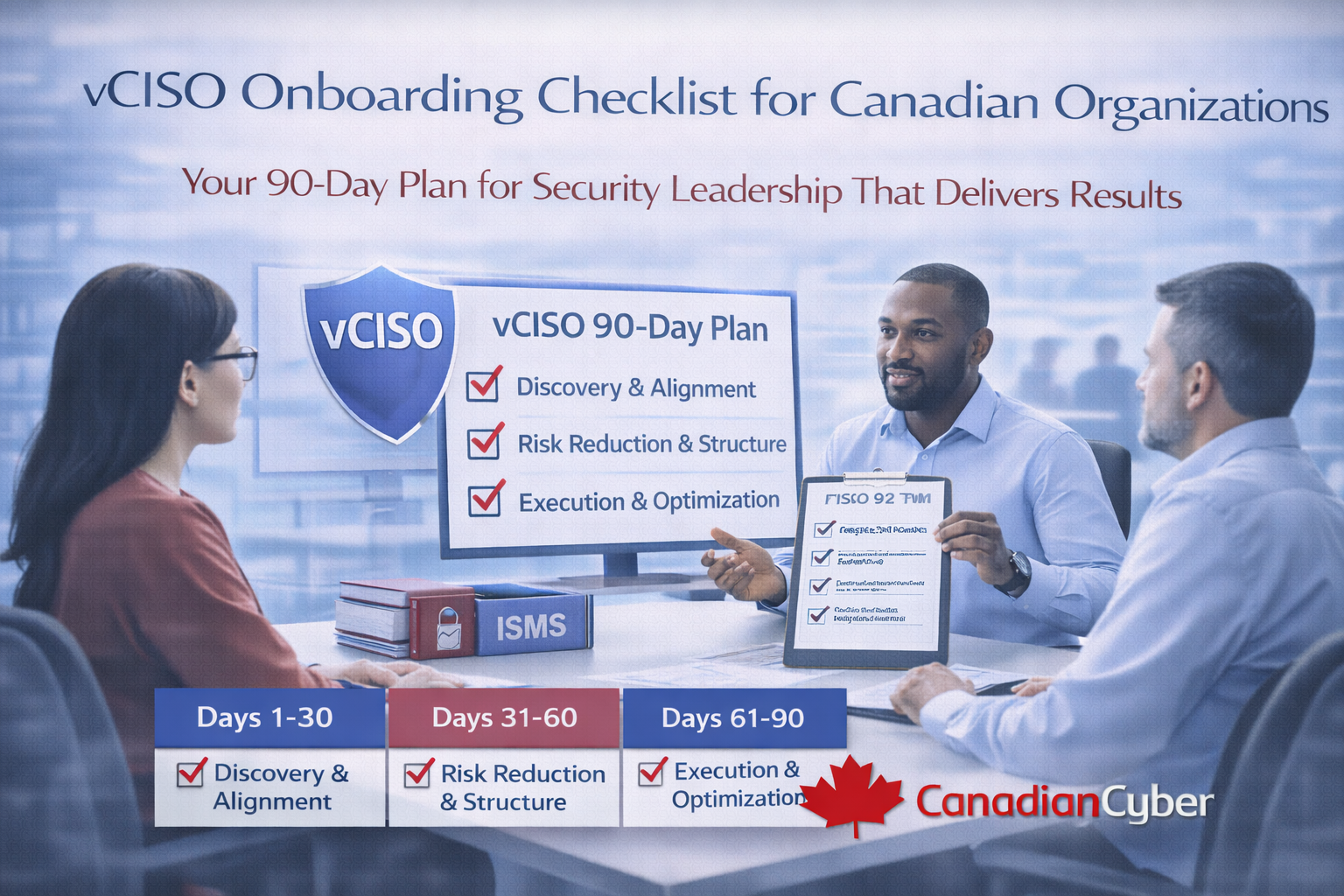
Follow the 3-phase plan: Discovery (1–30), Risk Reduction (31–60), Execution (61–90).
The decision is made. Now make it work—fast.
You don’t need a full-time CISO.
But you do need security leadership quickly.
When a Virtual CISO (vCISO) joins, teams feel relief.
Then a practical question shows up:
“How do we make this work quickly?”
Key idea:
A vCISO only delivers value when onboarding is structured.
Without a plan, priorities drift. With a plan, early wins arrive.
Why vCISO onboarding matters more than you think
A vCISO isn’t just an advisor.
They become your security leader across strategy, risk, and compliance.
- Security strategist for priorities and roadmap
- Risk translator for leadership and boards
- Compliance guide for ISO 27001 / SOC 2 / privacy
- Incident decision-maker when time matters
The 90-day vCISO onboarding framework (at a glance)
Days 1–30: discovery, access, and alignment
The first month sets the tone.
Move quickly here and everything else gets easier.
✔ Grant the right access
Give your vCISO what they need to understand your environment.
Slow access equals slow progress.
- Policies and procedures (current + drafts)
- Risk register (even if it’s messy)
- Cloud and IT architecture overview
- Past audit reports, pentests, incidents, and lessons learned
✔ Define business priorities
Security should support business.
Share what matters most so the vCISO can prioritize correctly.
- Revenue drivers and growth targets
- Customer trust requirements (questionnaires, enterprise buyers)
- Compliance needs: PIPEDA, Law 25, SOC 2, ISO 27001
- Top operational risks (outages, incidents, vendor dependency)
✔ Establish governance (so decisions don’t stall)
Clarify how decisions will be made and escalated.
This prevents confusion during incidents or audits.
- Reporting cadence (weekly working session + monthly exec update)
- Decision-making authority (what the vCISO can approve vs recommend)
- Escalation path (who gets called first, second, third)
- Key stakeholders (IT, product, legal, privacy, exec sponsor)
Want early wins in the first 30 days?
Get a structured onboarding plan, a clear security roadmap, and fast risk reduction without hiring full-time leadership.
Days 31–60: risk reduction and early wins
This is the confidence-building phase.
A good vCISO will reduce real risk not just create documents.
✔ Conduct a security & compliance gap assessment
Your vCISO should identify the highest-impact gaps and prioritize what matters.
This avoids overwhelm and stops “random security work.”
- High-risk gaps affecting customer trust
- Weak or missing controls
- Quick wins that reduce exposure fast
- What to fix now vs later
✔ Stabilize critical risks (the board cares about these)
Tip: Start with controls that prevent costly incidents and tough audit findings.
- Access management (MFA, privileged access, reviews)
- Backup and recovery (tested restores, clear RPO/RTO)
- Incident response readiness (roles, playbooks, escalation)
- Third-party risk (high-risk vendors, contracts, monitoring)
✔ Introduce ISMS structure (where momentum accelerates)
This is where many Canadian organizations see fast results.
With a SharePoint-based ISMS, the vCISO can centralize work and enforce ownership.
- Centralized policies (one source of truth)
- Risk register with owners and review cycles
- Action tracking (who owns what, by when)
- Audit-ready evidence stored continuously
Days 61–90: execution, metrics, and maturity
Now the vCISO shifts from setup to strategy.
This is where security becomes measurable and repeatable.
✔ Align security with compliance goals
Whether you are preparing for ISO 27001, SOC 2, or customer reviews, the goal is the same:
ongoing readiness, not last-minute prep.
✔ Define KPIs and reporting (so leadership can see progress)
Leadership needs simple, repeatable visibility.
Good vCISO reporting answers: “Are we safer this month than last month?”
✔ Embed security into daily operations (so it stays in place)
The best vCISOs use the tools teams already live in.
With Microsoft 365 workflows:
- Policy approvals happen in Teams
- Reminders and reviews are automated
- Evidence is captured in real time
- Security becomes routine (not “extra work”)
A common Canadian success story (what 90 days can look like)
A growing Canadian SaaS company onboarded a vCISO with no formal security program.
Within 90 days:
- Risks were mapped and prioritized
- Policies were centralized and controlled
- Audit readiness improved
- Leadership gained clarity and confidence
The difference wasn’t headcount.
It was structured onboarding.
Why Canadian Cyber’s vCISO model works
Canadian Cyber combines experienced vCISO leadership with deep knowledge of Canadian expectations and a SharePoint-based ISMS platform.
That mix speeds up onboarding and makes progress visible.
- Faster onboarding: clear plan, clear roles, quick wins
- Fewer blind spots: risk-based focus, practical controls
- Sustainable growth: governance + automation that sticks
Ready to onboard a vCISO the right way?
Onboard smart. Reduce risk faster. Build a security program that supports growth and compliance.
Final thought
A vCISO isn’t a quick fix.
They’re a strategic partner.
With the right onboarding plan, Canadian organizations can see real results in 90 days without hiring full-time security leadership.
Next step: Start strong, get quick wins, and build a program your team can maintain.
Stay Connected With Canadian Cyber
Follow us for insights on vCISO leadership, compliance, and cybersecurity strategy in Canada: