email-svg
Get in touch
info@canadiancyber.ca

SOC 2 Cost Breakdown for Canadian Startups

A practical breakdown of SOC 2 cost for startups in Canada—covering auditor fees, tooling, and prep so you can budget accurately and avoid overspending.
Main Hero Image

Budget Planning • Auditor Fees • Tooling • Internal Prep

SOC 2 Cost Breakdown for Canadian Startups

What you will actually spend on auditor fees, tooling, and prep in 2026
If you are pricing out SOC 2, you do not want vague marketing ranges. You want a realistic answer to four questions: how much it will actually cost, what drives cost, where startups overspend, and how to keep the budget predictable without making the audit harder.

The most important thing to know is that SOC 2 cost is never just the audit fee. Your real spend usually includes the CPA firm, your tooling stack, and the internal or external prep required to get controls and evidence ready.

This guide breaks those costs into the three buckets that matter most and gives you a budget table you can actually use.

The fastest way to think about SOC 2 cost

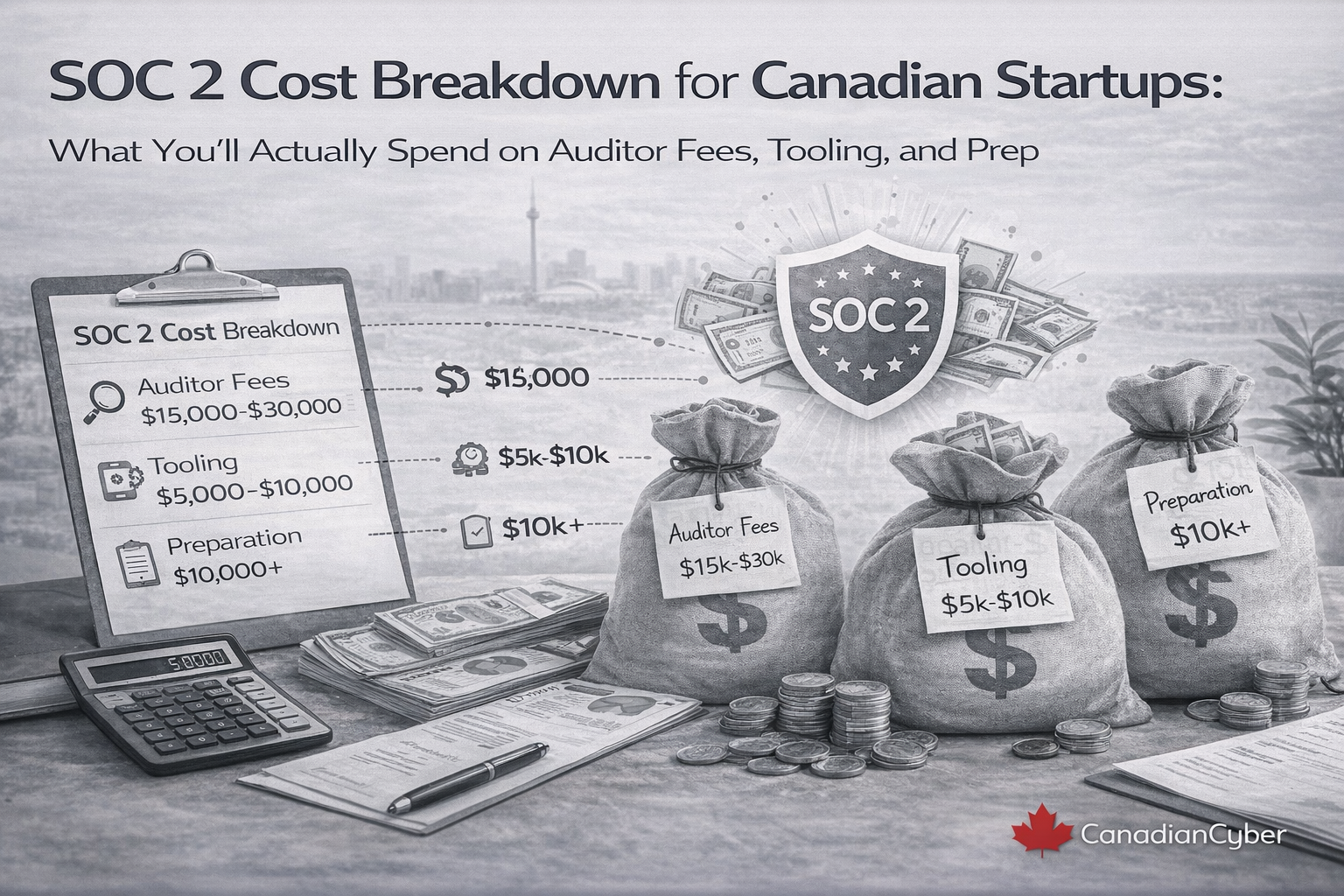
SOC 2 cost comes from three places, and most founders underestimate the third one.

1) Auditor fees
The CPA firm cost for the actual SOC 2 audit work.
2) Tooling
Security and compliance tools, monitoring, and sometimes testing support.
3) Prep
Internal time plus external help to make controls, policies, and evidence audit-ready.
Simple rule:
if you only budget for the auditor fee, SOC 2 will feel surprisingly expensive.

SOC 2 cost breakdown table in CAD

These are realistic planning ranges for Canadian startups in 2026. Use them as budgeting support, not as a formal quote.

Typical all-in totals
SOC 2 Type I: about $25,000 to $90,000 CAD
SOC 2 Type II: about $55,000 to $180,000+ CAD
Cost category Type I typical range (CAD) Type II typical range (CAD) What to know
Auditor fees $15,000 to $45,000 $30,000 to $90,000 Depends on scope, systems, period length, and audit firm
Tooling $0 to $20,000 $3,000 to $35,000 Can stay lower if your current stack is already strong
Prep, internal plus external $10,000 to $40,000 $20,000 to $80,000+ Usually the biggest variable because readiness drives everything
Total typical range $25,000 to $90,000 $55,000 to $180,000+ Wide range because scope and readiness matter more than founders expect

Type II costs more because you are paying for an operating period, more sampling, and more evidence testing over time.

What actually drives auditor fees

1) Scope size is the biggest driver

Auditor costs go up quickly when you include multiple products, messy corporate IT, several cloud environments, multiple regions, or a lot of customer-facing integrations.

Cost control move:
scope around the service customers actually buy and define system boundaries clearly.

2) Trust Services Criteria selection matters

Most startups begin with Security only. Adding Availability or Confidentiality often means more testing and more evidence collection.

Cost control move:
only add criteria when buyers actually require them.

3) Type II operating period length changes the bill

A longer operating period means more evidence and more sampling. That raises audit effort naturally.

3 months: fastest credible option
6 months: common compromise
12 months: strongest signal, highest effort
Cost control move:
if you need deal impact quickly, start with a 3-month Type II and mature later.

4) Evidence quality is the hidden fee multiplier

When evidence is scattered, unclear, or inconsistent, auditors spend more time, ask more follow-up questions, and drag the process out.

Cost control move:
use quarterly evidence packs and keep a clean auditor view in SharePoint.

Biggest budget surprise for founders
The audit bill usually is not what hurts most. The real pain comes from prep hours, evidence cleanup, and rework caused by poor scope or a messy operating model.

Tooling costs: what you actually need and what you do not

Tooling is where startups either overspend on fancy platforms they cannot operate or underspend and create evidence gaps that slow the audit.

Tooling bucket 1: common must-have controls

Tool area Typical cost range Reality check
MFA and SSO Often already included, otherwise varies Many startups already have enough here if defaults are configured properly
Endpoint protection or EDR $3,000 to $20,000 per year Depends heavily on headcount and product choice
Central logging and monitoring $0 to $20,000 per year Cloud defaults can keep this lower if retention and review are structured well
Vulnerability scanning $0 to $15,000 per year Lightweight approaches can stay low-cost early on

Tooling bucket 2: compliance automation platforms

Platforms like Drata, Vanta, or Secureframe-style tools can help with reminders, integrations, and workflow visibility, but they do not replace governance.

Typical cost:
about $6,000 to $30,000+ per year depending on company size and feature set.

Tooling bucket 3: pen tests and security testing

This is not always a formal SOC 2 requirement, but many buyers still expect it.

Typical range:
about $8,000 to $35,000 CAD depending on scope and provider.

Prep costs: the part founders underestimate most

Prep is where SOC 2 becomes expensive if you do not already have an operating system. This includes internal time, external help, and remediation work to close control gaps.

Prep usually includes
  • minimal policy set and governance structure
  • access control cleanup and offboarding proof
  • logging retention and review sign-offs
  • change management samples
  • backup and restore testing evidence
  • vendor register and subprocessor governance
  • incident runbooks and one tabletop record
  • evidence packs and an auditor view
Typical internal hours
Type I: around 40 to 120 hours
Type II: around 80 to 250+ hours because controls must run over time
Cost control move:
centralize evidence early. Quarterly SharePoint packs can cut internal hours dramatically.

Example budgets to sanity-check your plan

Scenario A: Early-stage SaaS
Security-only, decent hygiene already in place.
Total: about $35,000 to $75,000.
Scenario B: Growth-stage SaaS
Type II over 3 to 6 months with enterprise pressure.
Total: about $75,000 to $155,000.
Scenario C: Complex product environment
Multi-environment Type II with longer window and added criteria.
Total: about $135,000 to $205,000+.

The 5 most expensive SOC 2 mistakes

1) Over-scoping
Every extra system multiplies testing and evidence work.
2) Buying tools before defining cadence
Tools do not run controls by themselves.
3) Evidence chaos
Screenshots everywhere create follow-up questions everywhere.
4) Ignoring vendors
Vendor gaps create deal friction and audit pain fast.
5) No restore tests or tabletops
Auditors trust tests more than policies every time.

How to reduce SOC 2 cost without weakening security

  1. Start with Security criterion only unless buyers demand more.
  2. Keep the initial Type II period shorter if deal urgency matters.
  3. Centralize evidence in SharePoint with quarterly packs.
  4. Run controls monthly so evidence stays current.
  5. Treat approved evidence as the finish line, not just uploaded evidence.

This is how SOC 2 becomes more predictable instead of turning into a rolling cost surprise.

If you want a quote-backed SOC 2 plan instead of guesswork
The fastest way to control cost is to tighten scope, clean up evidence design, and build a cadence that reduces auditor follow-ups before they happen.

Final thought

The cheapest SOC 2 is not the one with the smallest audit bill. It is the one with the tightest scope, the cleanest evidence, and the least wasted internal effort.

When auditor fees, tooling, and prep are planned together, SOC 2 becomes much easier to budget and much less likely to turn into an expensive surprise.
Follow Canadian Cyber
Practical cybersecurity and compliance guidance:

Related Post