Get in touch
info@canadiancyber.ca


Rafia Rizwan

April 9, 2026
A practical SOC 2 readiness checklist with 40 controls to help SaaS companies prepare for audits, reduce delays, and pass faster.
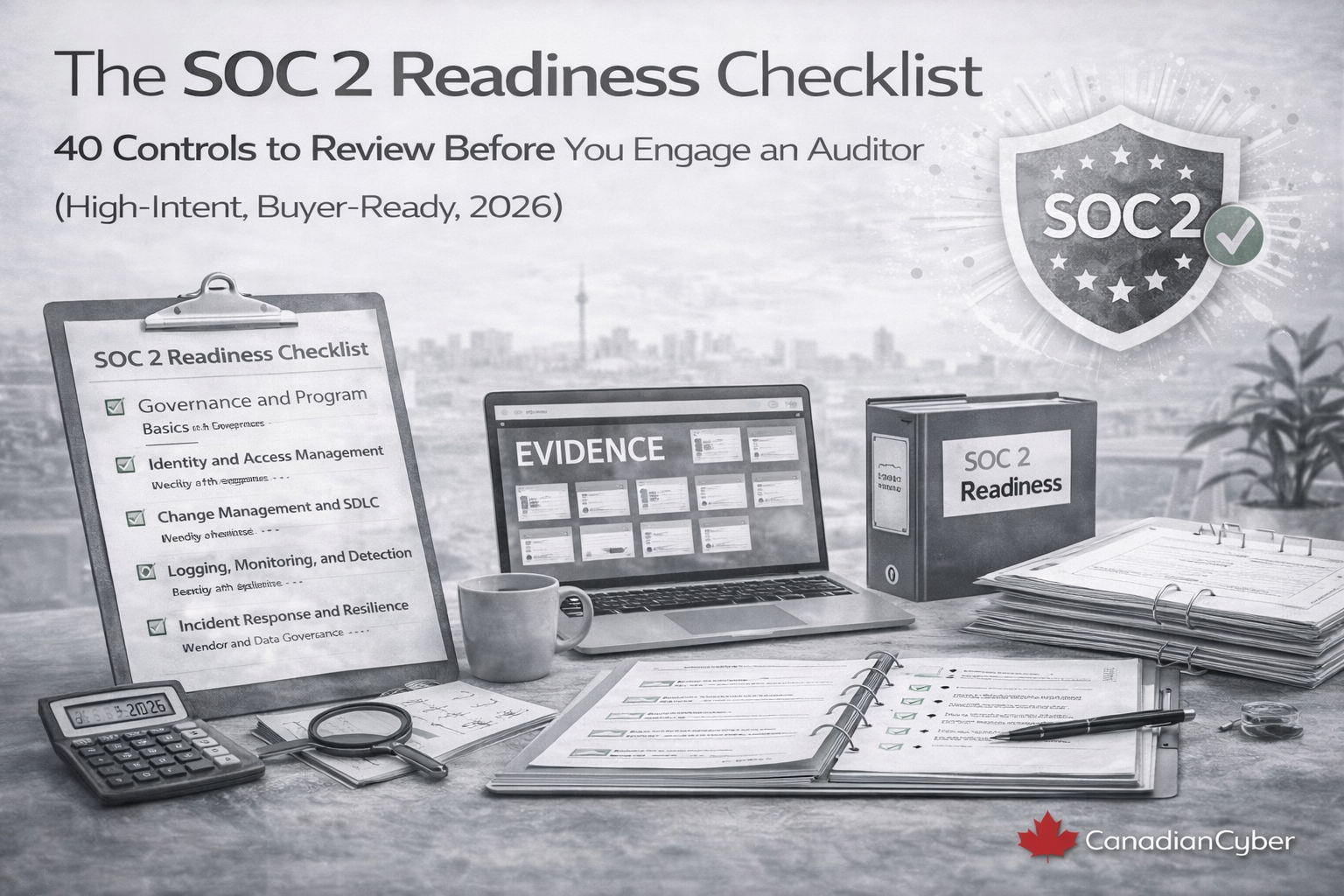
This checklist is built for Canadian SaaS and tech companies selling to enterprise buyers in 2026. Use it as a pre-audit gate. If you can prove most of these controls quickly, you are much closer to a clean SOC 2 process.
For each control, use a simple three-part test. If you cannot pass all three, treat the control as not ready.
| Control | What good looks like | Quick proof example |
|---|---|---|
| SOC 2 scope statement | In-scope systems, services, environments, and boundaries are defined. | Approved scope document. |
| Control owners assigned | Each major control area has a named owner and backup. | RACI or control owner list. |
| Policies approved and current | Policy set is versioned and reviewed at least annually. | Approval history and review date. |
| Risk assessment process exists | Basic risk register with treatment decisions and owners. | Current risk register extract. |
| Exception workflow | Exceptions require approval, expiry date, and compensating controls. | Exception register sample. |
| Security awareness training | New-hire training and annual refreshers are completed and tracked. | Training completion records. |
| Asset inventory | In-scope systems that store or process customer data are known. | Current inventory snapshot. |
| Management reporting cadence | Monthly or quarterly updates drive decisions and actions. | Board or management pack. |
| Control | What good looks like | Quick proof example |
|---|---|---|
| Code changes require review | PR reviews are enforced for production-impacting repositories. | Sample PR with review approvals. |
| CI checks required | Tests or security checks block merge where appropriate. | Branch protection and CI status sample. |
| Deployments are traceable | You can link deployment to PR and ticket or change record. | Deploy log with linked record. |
| Emergency change path exists | Documented emergency process with follow-up review inside 24–48 hours. | Emergency change example. |
| Infrastructure as code controlled | IaC follows same review and deployment discipline as app code. | Sample IaC PR. |
| Secrets management | Secrets are not stored in repos; scanning and vault or KMS are used. | Secret scanning settings and vault proof. |
| Vulnerability management workflow | Identify, prioritize, remediate, and verify process exists. | Issue tracker sample with closure. |
| Patch SLAs defined | Critical patches have deadlines and exceptions are tracked. | Patch SLA and exception sample. |
| Control | What good looks like | Quick proof example |
|---|---|---|
| Incident response plan | Roles, escalation, evidence preservation, and communication guidance exist. | Current IR plan. |
| Tabletop exercise completed | At least annual practice, ideally more often for fast-growing teams. | Tabletop record and actions. |
| Post-incident review process | PIR template exists and feeds corrective actions. | PIR sample with tracked fixes. |
| Backup policy and inventory | What is backed up, how often, and by whom is known. | Backup inventory snapshot. |
| Restore test evidence | Restore is tested and validated at least quarterly or semi-annually. | Restore record with validation. |
These are not always strict SOC 2 requirements, but they reduce questionnaire friction and make your security story easier to trust.
| Readiness level | Practical rule |
|---|---|
| Type I readiness | About 30 to 35 of these controls are implemented and provable. |
| Type II readiness | About 35 to 40 controls are implemented, and recurring controls have operating evidence over 3 to 6+ months. |
If you are below that threshold, you can still engage an auditor, but you should expect more prep work, more follow-ups, and more cost.
The companies that get the most value from SOC 2 audits are usually not the ones with the most documents. They are the ones that can show clean ownership, recurring operation, and evidence that is easy to review.
That is what this checklist is for: helping you know whether you are really ready before you pay for the audit motion.