Get in touch
info@canadiancyber.ca


Rafia Rizwan

April 10, 2026
Learn how to embed ISO 27017 controls into CI/CD pipelines to create audit-ready evidence, prevent cloud misconfigurations, and pass audits faster.
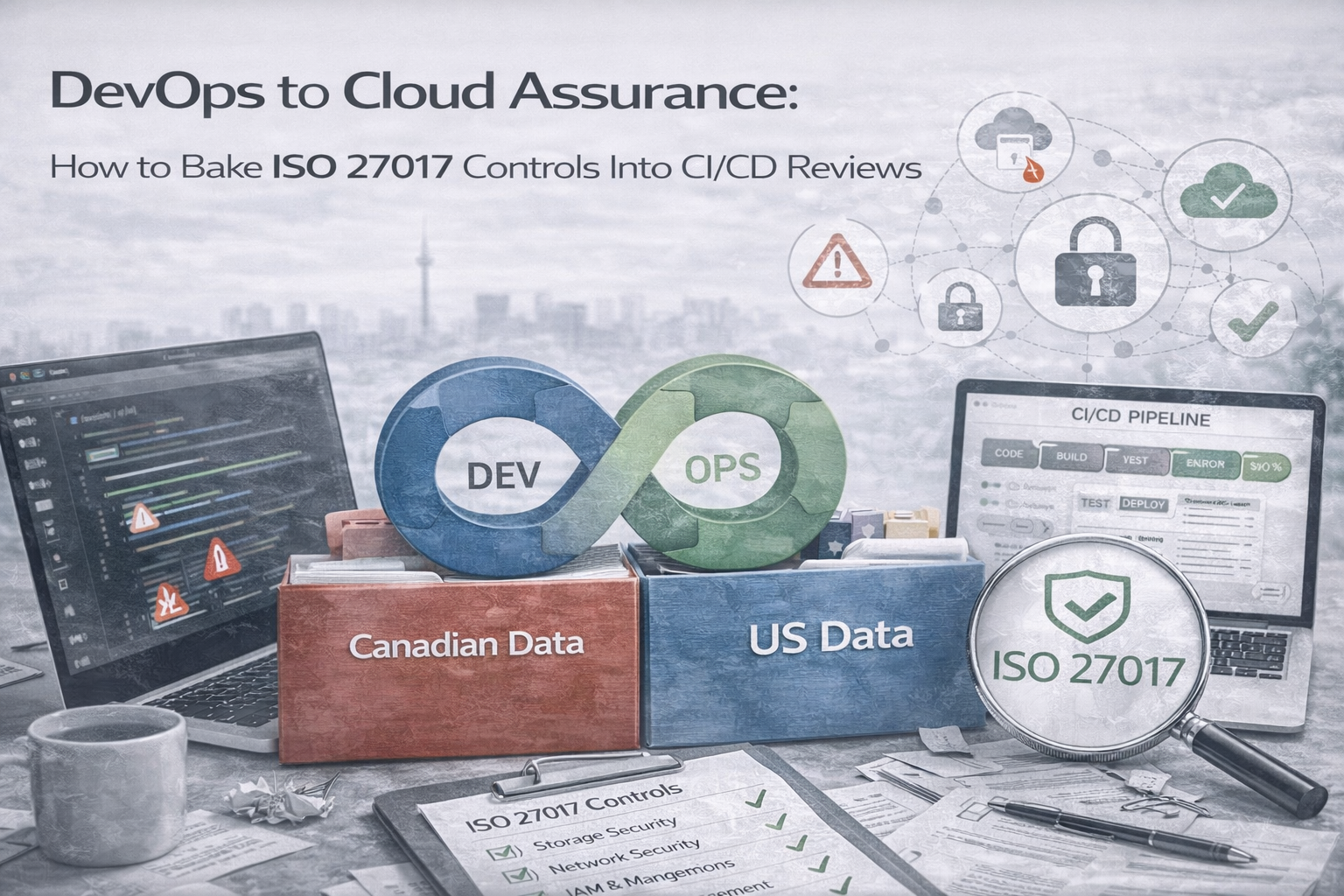
ISO 27017 is useful here because it focuses on cloud-specific shared responsibility and operational controls without forcing a giant compliance machine. The best part is that you do not need a massive program to get value. You need the right checks inside the way you already ship.
Done properly, your CI/CD process starts producing audit-ready evidence automatically instead of making teams scramble for screenshots later.
If you implement this well, every production change creates a repeatable assurance chain that is easy for auditors to sample and easy for engineering to explain.
Auditors love this model because sampling becomes simple. When they ask for three production changes from last quarter, you open the PRs, show the checks, approvals, deployment records, and post-deploy validation. No scrambling. No screenshot chaos. No drama.
You do not need to memorize clause numbers. You need to cover the cloud control themes auditors actually test during reviews.
Once you map those themes into your review process, cloud assurance stops being an after-the-fact audit exercise and starts becoming part of normal engineering work.
Keep the review checklist short enough that engineers actually use it. The goal is not to create a compliance form nobody reads. The goal is to make production-impacting changes traceable and governed.
| Checklist area | What reviewers confirm |
|---|---|
| A) Identity and access | No new Owner or Admin everywhere permissions, IAM roles stay least privilege, and CI roles are not re-used across environments. |
| B) Secrets and keys | No secrets in code, approved vault or KMS is used, and any new secret has an owner and rotation expectation documented. |
| C) Network and exposure | No internet-open admin ports, security groups or NSGs are checked for broad exposure, and any temporary access has an expiry plan instead of shipping permanently. |
| D) Storage and data protection | Storage is not public by default, encryption at rest is enabled where required, and tenant boundaries remain intact for multi-tenant SaaS. |
| E) Logging and monitoring | Logs are enabled for the changed service, alerts or metrics are updated when visibility changes, and retention changes are either unchanged or explicitly approved. |
| F) Change traceability | A ticket is linked, PR approvals are recorded, deployment evidence exists, and post-deploy validation is captured. |
The fastest way to reduce repeat findings is to shift the obvious checks left and make them automatic. When security gates are consistent, audit evidence becomes consistent too.
Auditors do not expect every change to get the same attention. They expect risk-based control. The easiest way to show that is to define standard and high-risk lanes clearly.
| Lane | Examples | Approval model | Evidence expectation |
|---|---|---|---|
| Lane 1: Standard changes | App code changes with no infrastructure exposure, minor config updates, non-security-impacting UI work. | Normal PR review plus CI checks. | Ticket, approvals, CI results, deployment record. |
| Lane 2: High-risk changes | IAM changes, network or NSG changes, storage policy updates, logging retention changes, secret or key changes, tenant-boundary changes. | Two reviewers, one security-capable. | Add a short risk note explaining what changed, why it is safe, and how it was validated. |
This approach reduces both real risk and audit questioning because the rationale is built into the approval path instead of reconstructed later.
Auditors usually ask for sampled changes. So design your CI/CD model so every production pull request becomes a self-contained evidence record.
In cloud environments, exceptions are normal. Late patching, legacy components, vendor constraints, and operational realities happen. Auditors do not punish exceptions by default. They punish undocumented ones.
That is how you avoid the “temporary forever” problem that auditors spot immediately.
ISO 27017-minded auditors expect control operation over time. CI/CD can support that by making sure logging, backup, and resilience impact are not forgotten when infrastructure changes ship.
If your ISMS runs in SharePoint, the best model is simple: build quarterly evidence packs from CI/CD samples. Each quarter gets a clean folder with sampled PRs and a one-page summary explaining why those samples were chosen and which control themes they prove.
| Common finding | CI/CD control fix |
|---|---|
| Open security groups | IaC scanning plus policy-as-code. |
| Overly broad IAM | IAM diff review plus high-risk lane approval. |
| Secrets in repositories | Secrets scanning plus merge blocks. |
| Logging not enabled | Pipeline checks and review hooks for new services. |
| Retention reduced silently | Require approval notes for logging changes. |
| No change traceability | Enforce ticket, PR, and deployment chain. |
| No proof of validation | Require post-deploy checklist and validation note. |
You do not need perfection. You need operating discipline that creates cleaner cloud changes and cleaner audit evidence at the same time.
Cloud assurance does not have to sit outside DevOps. In the best teams, it is built into the way changes are reviewed, approved, deployed, and validated. That is what makes ISO 27017 practical instead of theoretical.
When pull requests carry the right checks, the right approvals, and the right evidence links, auditors stop finding the same cloud gaps and start seeing an operating system they can trust.