

ISO 27017 • Multi-Tenant SaaS • Procurement Readiness
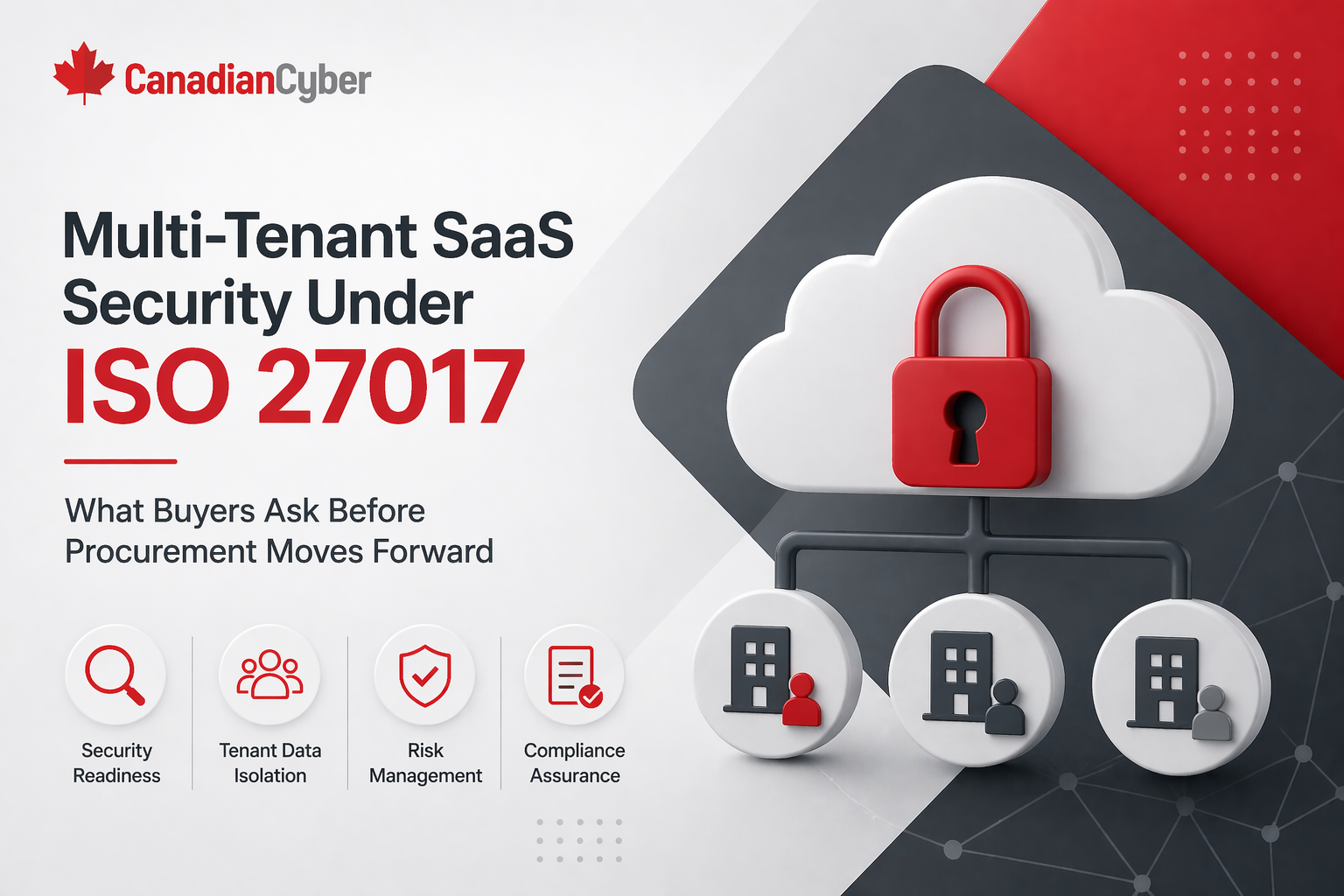
Multi-Tenant SaaS Security Under ISO 27017: What Buyers Ask Before Procurement Moves Forward
For shared-platform SaaS providers, security reviews often decide whether procurement moves forward or slows down. This guide explains what buyers really want to know and how ISO 27017 helps you answer with confidence.
Quick Snapshot
| Category | What This Blog Covers |
|---|---|
| Audience | Multi-tenant SaaS founders, CTOs, security leaders, compliance teams, and procurement-facing stakeholders |
| Main concern | How to prove one tenant cannot affect another in a shared cloud platform |
| Framework angle | ISO 27017 helps explain cloud security, segregation, access, monitoring, and responsibility boundaries more clearly |
| Outcome | Stronger buyer trust, smoother procurement reviews, and a more credible control story |
Introduction
For multi-tenant SaaS companies, security questions usually get sharper right before the deal matters most.
The demo went well. The use case is clear. The buyer likes the platform. Internal champions are positive.
Then procurement and security review step in.
Now the questions change. They are no longer asking only what the product does. They are asking how safely it does it in a shared environment.
That is exactly where multi-tenant SaaS security gets tested.
Because buyers know that in a multi-tenant model, the biggest trust question is simple:
What stops one customer’s data, users, or activity from affecting another customer?
This is where ISO 27017 becomes especially useful.
ISO 27017 adds practical cloud security guidance on top of broader security control thinking, making it highly relevant for SaaS providers running shared cloud platforms. For multi-tenant environments, it helps translate security expectations into a clearer operating model around segregation, access, administration, monitoring, and cloud responsibility.
In simpler terms: ISO 27017 helps multi-tenant SaaS companies explain shared-platform security in a way procurement teams can actually trust.
Why Buyers Focus So Hard on Multi-Tenant Risk
Buyers do not worry about multi-tenancy because they dislike cloud software. They worry because they understand the risk.
In a multi-tenant environment, many customers may share:
- application infrastructure
- databases or storage layers
- compute resources
- logging systems
- support tooling
- administrative workflows
- deployment pipelines
- cloud service dependencies
That shared model can be efficient and scalable. It can also create serious trust concerns if the SaaS provider cannot show that:
- customer data is logically separated
- access is tightly controlled
- administrative actions are governed
- logging can trace cross-tenant issues
- changes do not create accidental exposure
- support access does not bypass customer boundaries
Why ISO 27017 Matters in Multi-Tenant SaaS
ISO 27017 is not a “multi-tenant SaaS certification.” It is cloud security guidance. That is exactly what makes it useful.
Multi-tenant SaaS runs inside a cloud service model with shared responsibility, administrative privilege risk, environment segregation challenges, customer data handling concerns, provider-operated infrastructure, and evolving cloud configurations.
ISO 27017 helps organizations think more clearly about:
- segregation in cloud services
- secure administration
- access governance
- logging and monitoring
- cloud change management
- secure customer use of shared cloud services
- operational responsibility boundaries
A Common Scenario
Picture this: a B2B SaaS company is selling a workflow platform into larger enterprise customers. The platform is multi-tenant and cloud-hosted.
It supports user collaboration, reporting, API integrations, document uploads, admin roles, customer support workflows, usage analytics, and automated notifications.
The buying team likes the product. Then security review begins.
Now the buyer asks:
- How is our data separated from other customers’ data?
- Can your support staff see our records?
- What controls prevent one tenant from accessing another tenant’s information?
- How are admin actions logged?
- Are production changes reviewed before release?
- What happens if a misconfiguration affects multiple tenants?
- Which cloud responsibilities sit with you, and which with your cloud provider?
- How do you monitor for suspicious cross-tenant activity?
What Buyers Actually Want to Understand
Before procurement moves forward, most buyers are not asking for a theoretical cloud security lecture. They want practical confidence in a few key areas:
| Area | What Buyers Want Confidence In |
|---|---|
| Tenant segregation | Their data cannot leak into another customer’s environment |
| Internal access | Your staff cannot casually browse customer data |
| Admin controls | Privileged actions are limited and traceable |
| Logging | You can detect and investigate risky or abnormal activity |
| Change control | Shared-platform changes are reviewed before production |
| Incident response | You can identify and contain tenant impact quickly |
| Cloud governance | You understand and manage shared-responsibility boundaries |
1. Tenant Separation: The First Question Buyers Always Ask
This is usually the biggest one. In a multi-tenant platform, buyers want to know exactly how their data and workflows stay separate from everyone else’s.
Can another customer ever see our data by mistake? Are storage, queries, exports, reporting, and admin actions truly tenant-aware?
What a strong answer usually includes:
- logical tenant segregation in the application layer
- authorization checks that enforce tenant context
- restrictions on cross-tenant data access
- testing practices for segregation-sensitive logic
- review of exports, search, reporting, and admin overrides
2. Access Control and Privileged Administration
The second major concern is internal access. Even if tenant logic is sound, buyers still want to know who inside your company can access their environment or data.
Common buyer questions:
- Do employees have access to customer data by default?
- Is privileged access role-based?
- Are admin rights reviewed regularly?
- Is MFA enforced for internal administrative access?
- Are support actions logged?
What a stronger control model usually includes:
- least-privilege internal access
- role-based administrative permissions
- no broad default customer-data visibility
- MFA on privileged paths
- periodic access reviews
- logging of high-risk admin activity
3. Customer Data Handling Beyond the Core App
Many buyers no longer stop at “is the database secure?” They want to understand where customer data flows through the wider cloud environment.
- backups
- file storage
- logs
- analytics
- support tools
- exports
- integrations
- admin dashboards
A stronger response usually includes a clear description of in-scope data stores, controlled access to file storage and exports, minimization of sensitive data in logs where possible, retention discipline for support artifacts, and tighter handling around downloaded records.
Need Help Answering Buyer Security Questionnaires?
Canadian Cyber helps multi-tenant SaaS teams explain segregation, cloud governance, admin access, monitoring, and procurement security controls in a way buyers can actually trust.
4. Logging and Monitoring: Can the Platform Detect Something Going Wrong?
Procurement and security reviewers increasingly ask not just whether you have controls, but whether you can detect when those controls fail.
What buyers usually want to know:
- Are admin actions logged?
- Can you trace customer-impacting events?
- Do you monitor for suspicious access?
- How do you detect anomalies affecting multiple tenants?
- Can incidents be investigated with enough evidence?
A mature platform usually has centralized logging, privileged activity visibility, authentication event monitoring, alerting on high-risk actions, tenant context in logs, and retention aligned with investigations and audit needs.
5. Change Management: How Do You Prevent Tenant Impact From Cloud and App Changes?
Multi-tenant platforms change constantly. New features roll out. Configurations change. Permissions evolve. Cloud resources are updated. The buyer’s concern is not that changes happen. It is whether they happen in a controlled enough way that one bad change does not affect many customers at once.
| Buyer Question | What a Strong Answer Includes |
|---|---|
| Are production changes reviewed? | Pull request review, peer approval, and release discipline |
| How are risky changes handled? | Special treatment for auth, tenant-affecting, and infrastructure changes |
| Can you roll back a bad deployment? | Documented rollback and emergency change processes |
| Are config changes governed too? | Infrastructure and config changes go through the same discipline as code |
6. Incident Readiness: What Happens If a Shared-Platform Problem Occurs?
Buyers know incidents happen. What they want to understand is whether the provider can respond responsibly in a multi-tenant environment.
- How do you detect incidents affecting customer data?
- How do you scope tenant impact?
- Can you determine whether one tenant or many tenants were affected?
- How are incidents escalated internally?
- How do you communicate with customers?
7. Shared Responsibility and Cloud Provider Dependence
More buyers now ask not only about your app, but about the cloud stack under it. They want to know what your cloud provider handles, what you handle, how you govern that boundary, and how you manage cloud dependencies without creating blind spots.
This is one of the places where ISO 27017 adds particular value, because it helps frame cloud responsibility more clearly.
What Multi-Tenant SaaS Providers Usually Get Wrong
- They explain architecture, but not control ownership.
- They describe tenant separation too vaguely.
- They under-explain internal access.
- They focus only on the app layer.
- They assume buyers understand cloud shared responsibility.
- They treat the questionnaire like a paperwork exercise.
How ISO 27017 Sharpens the Procurement Story
ISO 27017 helps multi-tenant SaaS providers improve this conversation because it adds structure around the cloud security topics buyers care about already: segregation, cloud administration, access control, logging and monitoring, secure operation of shared cloud services, responsibility boundaries, change control, and protection of customer data in cloud environments.
That means the company can answer procurement questions with more than “we have security” or “we follow best practices.”
Instead, it can explain what the control objective is, how it is implemented, who owns it, how it is reviewed, and what evidence proves it operates.
Canadian Cyber’s Take
At Canadian Cyber, we often see multi-tenant SaaS companies lose momentum in procurement not because their platforms are insecure, but because they cannot explain shared-environment controls clearly enough.
The strongest teams usually do a few things well:
- they describe tenant segregation in practical language
- they have a disciplined story around internal access
- they explain how cloud changes are controlled
- they show that logging and incident readiness are operational, not just promised
- they understand how shared responsibility fits their cloud model
Takeaway
For multi-tenant SaaS providers, procurement security reviews are ultimately about one thing:
Can the buyer trust your shared platform to protect their data, users, and operations without being weakened by the fact that other customers share the same environment?
That is why the questions buyers ask before procurement moves forward tend to focus on tenant segregation, internal access and privilege, customer data handling, logging and monitoring, change management, incident response, and cloud responsibility boundaries.
ISO 27017 helps make those answers stronger by giving SaaS companies a more practical cloud security framework for how shared environments should be governed.
How Canadian Cyber Can Help
We help multi-tenant SaaS companies strengthen cloud security governance and procurement readiness using practical control design aligned to ISO 27017 and broader security frameworks.
- multi-tenant SaaS security reviews
- ISO 27017-aligned cloud control mapping
- procurement and questionnaire readiness
- tenant segregation and admin-access assessments
- logging and incident-evidence improvement
- change management and evidence structuring
- vCISO guidance for SaaS trust and audit readiness
Stay Connected With Canadian Cyber
Follow Canadian Cyber for practical guidance on ISO 27017, SaaS trust, cloud governance, and procurement readiness.