Get in touch
info@canadiancyber.ca


Rafia Rizwan

April 23, 2026
A practical guide to API security SOC 2 readiness, focusing on authentication, logging visibility, and controlled change management.
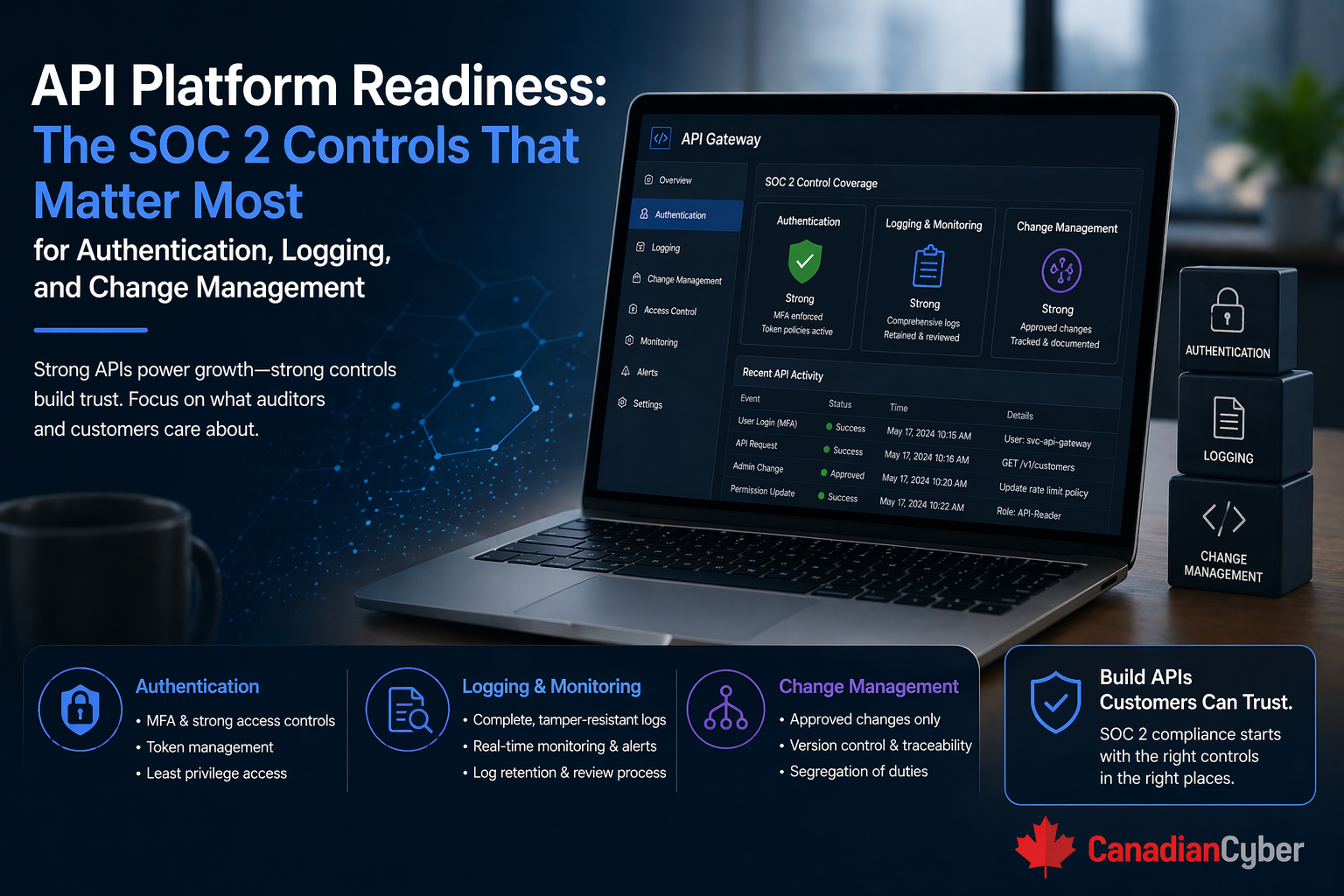
API platforms are often where trust gets tested first.
Before a customer sees your internal processes, they see your API. Before an auditor understands your architecture, they ask how access works. Before procurement signs off, they want to know how requests are authenticated, how activity is logged, and how changes are controlled.
That is why API readiness matters so much for SOC 2.
If your platform exposes APIs to customers, partners, internal systems, or developers, the security story is not just about uptime or documentation. It is about proving that the API environment is controlled in ways that protect data, enforce access, and reduce the chance that one weak integration or one bad change creates a much larger problem.
For most API platforms, three areas matter more than anything else: authentication, logging, and change management.
A lot of software products have APIs. But platforms built around APIs face a heavier trust burden because APIs often do the real work of the service.
That means buyers and auditors often ask tougher questions than teams expect.
This is where many teams realize API readiness is not only about good engineering. It is also about having a controlled operating model.
SOC 2 is not asking whether your API is perfect. It is asking whether the control environment around the API is designed and operating effectively.
That means your team should be able to show that access to the API is controlled appropriately, activity is visible enough to investigate and respond, production changes are reviewed and traceable, privileged or sensitive operations are governed, and API risks are not managed informally.
For most API platforms, that evidence story becomes strongest when authentication, logging, and change management are structured well.
Picture this. A SaaS company has built a successful API platform used by customers, internal services, and a few partner integrations. The engineering team has already done a lot of things right. TLS is enforced, tokens are required, logs are collected centrally, pull requests are used, deployments are automated, and some rate limiting exists.
On the surface, the platform feels mature. Then SOC 2 readiness work begins, and the harder questions start.
Now the issue is not whether security exists somewhere. The issue is whether the company can prove the controls around the API platform actually operate with discipline. That is where readiness becomes real.
A lot of controls support API security. But for SOC 2 readiness, the three most important operational areas are usually authentication, logging, and change management.
Authentication is where the API trust story begins. If the platform cannot strongly identify who or what is calling the API, every other control becomes weaker.
That includes customers, partner applications, service accounts, internal tools, background jobs, and administrators.
The goal is simple. An API client should prove identity in a controlled, attributable, and limited way.
When reviewing API authentication, they usually want to understand what auth methods are supported, whether credentials are unique or shared, whether compromised tokens can be revoked quickly, whether secrets are stored securely, and whether high-risk endpoints are protected differently.
| Evidence type | What it helps prove |
|---|---|
| Authentication standard or API security policy | Auth expectations are defined |
| Token or key configuration examples | Credentials are structured intentionally |
| Secret-management configuration | Secrets are stored securely |
| Credential rotation records | Lifecycle is maintained |
| Admin or client auth design documentation | High-risk access is differentiated |
| Access review outputs for service accounts or privileged integrations | Auth paths are reviewed over time |
Strong authentication evidence does not just show the method. It shows the control around the method.
Logging is where your API platform proves it can see what is happening. Many teams log requests. Fewer log the right things well enough to support security, incident response, and audit review. That difference matters.
Under SOC 2, logging is not only about having records. It is about whether those records help the organization detect misuse, investigate events, trace privileged or risky activity, prove operational discipline, and support incident response.
The key is not to log everything blindly. It is to log what is meaningful and usable.
A well-controlled API platform should be able to answer questions like: Which client made the request? When did it happen? Was authentication successful or failed? Was the action privileged, administrative, or high-risk? Which tenant or customer was involved? Can we see suspicious patterns? Can we connect the event to a ticket or incident if needed?
Visibility without review does not build much confidence.
| Evidence type | What it helps prove |
|---|---|
| Logging architecture or observability design | API activity is captured intentionally |
| Sample auth failure logs | Access attempts are traceable |
| Alert rules for suspicious activity | High-risk patterns are monitored |
| Retention settings | Logs are kept long enough for review |
| Incident tickets tied to log events | Logs support response workflows |
| Admin activity logs | Privileged API actions are visible |
This is what turns logging from a technical feature into a real control.
API platforms change constantly. New routes are added. Fields change. Permissions expand. Auth logic evolves. Gateway settings are modified. Dependencies get upgraded. That speed is normal. But SOC 2 readiness gets weaker fast if those changes are not governed.
One rushed change can introduce broken authorization, weak authentication, data exposure, tenant crossover, missing logs, unstable integrations, or insecure defaults.
The goal is not to slow the team down unnecessarily. It is to show that changes reaching production are reviewed, traceable, and controlled.
API platforms are especially sensitive because not every risky change looks dramatic. A small update can still cause serious exposure, such as a missing auth check, a broader token scope, a route left unintentionally exposed, a field returned that should not be, a logging rule that stops capturing a critical event, or an internal endpoint accidentally made reachable.
| Evidence type | What it helps prove |
|---|---|
| Change management policy or standard | Expectations are defined |
| Pull request samples | Reviews happen before changes merge |
| Deployment logs | Production releases are traceable |
| Testing records | Changes are validated before release |
| Emergency change records | Urgent changes are still governed |
| Approval history for high-risk changes | Sensitive API changes receive more care |
This is one of the strongest readiness areas because it shows the platform can evolve without becoming chaotic.
| Control area | What it protects | Why it matters |
|---|---|---|
| Authentication | Who can access the API and how | Prevents weak or unbounded access |
| Logging | Visibility into API behavior and misuse | Supports detection, accountability, and investigation |
| Change management | How the API evolves safely | Reduces the chance of introducing new security gaps |
If one of these is weak, the others become less valuable. Strong auth with weak logging can hide misuse. Strong logging with weak change control can still allow risky releases. Strong change management with weak auth still leaves access exposure.
That is why these three areas are the clearest readiness priorities for most API platforms under SOC 2.
Before an audit or readiness review, teams should be able to answer questions like these clearly.
If the team struggles to answer several of these, readiness is probably weaker than it looks.
These are exactly the issues that create friction during SOC 2 readiness.
At Canadian Cyber, we often see API platforms with strong engineering capability but weaker control clarity around the areas that matter most for SOC 2. The most common issue is not that nothing exists. It is that the control story is fragmented.
Authentication is handled in one place. Logs exist in another. Change discipline depends on team habit. Service accounts accumulate. Admin endpoints are not always reviewed with the same rigor as customer-facing ones.
The strongest API readiness programs usually improve when they focus first on the three areas that matter most: authentication discipline, meaningful logging, and controlled change management. Once those are strong, the rest of the SOC 2 story becomes much easier to support.
If your company is building around APIs, SOC 2 readiness is not only about proving the platform works. It is about proving the platform is controlled.
For most API environments, the clearest controls to strengthen first are authentication, so the right clients access the right resources, logging, so activity is visible and investigable, and change management, so risky updates do not reach production casually.
Because in the end, a secure API platform is not just one with tokens, logs, and pull requests. It is one where those controls are operated intentionally, reviewed consistently, and supported with evidence strong enough to stand up to real audit and customer scrutiny.