Cyber Maturity • Mid-Market Security • 12-Month Planning
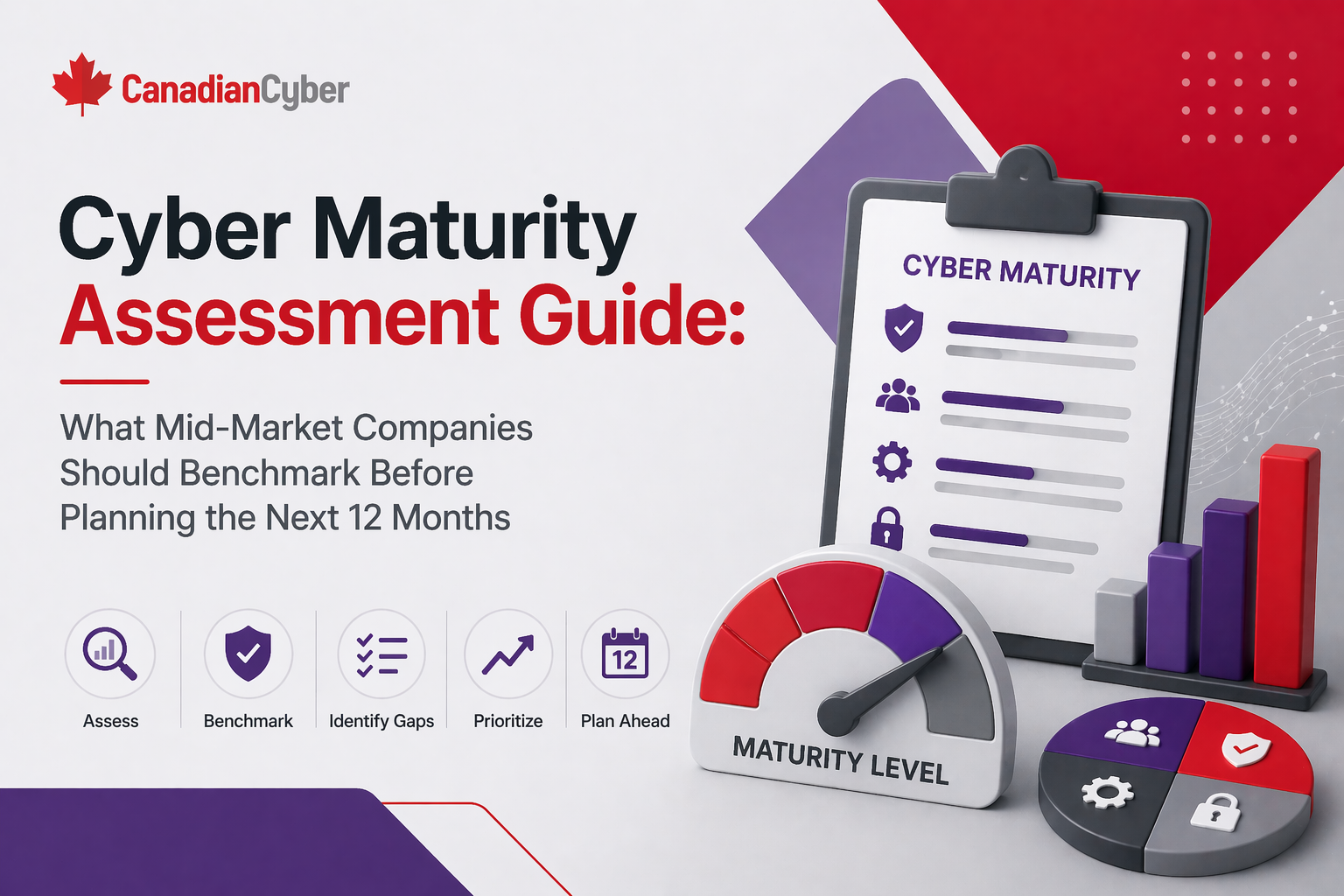
Cyber Maturity Assessment Guide: What Mid-Market Companies Should Benchmark Before Planning the Next 12 Months
Most mid-market companies cannot fix everything at once. A cyber maturity assessment helps leadership understand what is working, what is weak, and what should be prioritized first.
Quick Snapshot
| Category | What This Blog Covers |
|---|---|
| Audience | Mid-market executives, IT leaders, security teams, risk owners, and growing compliance teams |
| Main challenge | Planning cybersecurity improvements without guessing, overbuying tools, or chasing disconnected projects |
| Key focus | Governance, risk, identity, endpoints, cloud, vendors, incident response, awareness, and evidence readiness |
| Outcome | A realistic 12-month roadmap based on maturity, risk, ownership, and measurable improvement |
Introduction
Most mid-market companies do not have unlimited security budgets.
They cannot fix everything at once. They cannot buy every tool. They cannot hire every specialist. They cannot treat every risk like an emergency.
That is exactly why a cyber maturity assessment matters.
Before planning the next 12 months, leadership needs a clear picture of where the organization stands today:
- what is working
- what is weak
- what is missing
- what creates the most business risk
- what should be prioritized first
A cyber maturity assessment helps mid-market companies turn security planning from a wish list into a practical roadmap.
Why Mid-Market Companies Need a Different Approach
Mid-market companies sit in a difficult space. They are no longer small enough for informal security, but they may not yet have a large security team, mature governance, formal risk management, dedicated compliance staff, fully documented processes, round-the-clock monitoring, or enterprise-level tooling.
At the same time, they face real pressure from customers, insurers, regulators, vendors, boards, investors, cyber threats, and internal growth.
That means the security program needs structure, but it also needs realism. A maturity assessment helps leadership decide what matters most for the next phase of growth.
Why Annual Planning Without a Benchmark Fails
Many companies plan security work by reacting to the loudest problem.
A customer asks about SOC 2, so compliance becomes the focus. An insurer asks about MFA, so identity becomes urgent. A phishing incident happens, so training gets attention. A vendor questionnaire asks about incident response, so policies get updated.
Each action may be reasonable. But without a maturity benchmark, the program becomes reactive.
Common Planning Problems
- too many disconnected projects
- no clear priority order
- security spending not tied to risk
- leadership unclear on current capability
- repeated findings from audits or assessments
- weak accountability for improvement
- no way to measure progress year over year
A Common Scenario
Picture this: a mid-market company is preparing its security plan for the next year.
The leadership team has a long list of possible projects:
- improve endpoint protection
- start SOC 2 readiness
- update the incident response plan
- run phishing simulations
- review vendors
- improve backup testing
- deploy a SIEM
- clean up privileged access
- document policies
- strengthen cloud configuration
Everything sounds important. But the company does not know what should come first. A maturity assessment helps turn that messy list into a practical roadmap.
What a Cyber Maturity Assessment Should Benchmark
A useful assessment should not only ask whether tools exist. It should benchmark how well the organization manages security across core capability areas.
| Maturity Area | Why It Matters |
|---|---|
| Governance and leadership | Defines ownership, reporting, accountability, and business alignment |
| Risk management | Helps prioritize controls and spending based on business risk |
| Asset and data visibility | Reduces blind spots across systems, cloud services, vendors, and sensitive data |
| Identity and access control | Limits compromise impact and improves audit readiness |
| Endpoint and device security | Protects laptops, mobile devices, and remote work access points |
| Cloud and infrastructure security | Prevents misconfigurations, weak logging, and uncontrolled admin changes |
| Vendor and third-party risk | Shows that external dependencies are reviewed and governed |
| Incident response and resilience | Tests whether the organization can respond and recover in practice |
| Security awareness | Reduces user-driven risk and improves reporting behavior |
| Compliance and evidence readiness | Makes security easier to prove to customers, auditors, insurers, and leadership |
1. Governance and Leadership
Security maturity starts with ownership. A company may have good tools, but if nobody clearly owns security decisions, maturity remains limited.
What to benchmark:
- Is there a named security leader or accountable executive?
- Does leadership receive regular security reporting?
- Are security responsibilities documented?
- Are policies current and approved?
- Are security decisions connected to business risk?
- Is there a roadmap with owners and deadlines?
| Low Maturity | Higher Maturity |
|---|---|
| Security handled informally by IT | Security ownership and reporting are defined |
| Policies outdated or unused | Policies are reviewed and tied to operations |
| No regular leadership review | Security metrics and risks are reviewed by leadership |
2. Risk Management
A maturity assessment should test whether the company has a real risk process, not just a list of concerns.
What to benchmark:
- Does a risk register exist?
- Are risks scored consistently?
- Are risk owners assigned?
- Are treatment plans documented?
- Is residual risk reviewed?
- Are risks updated after incidents, audits, or major changes?
3. Asset and Data Visibility
You cannot protect what you cannot see. This is a common mid-market weakness.
What to benchmark:
- Is there an asset inventory?
- Does it include cloud and SaaS systems?
- Are owners assigned?
- Is data sensitivity recorded?
- Are critical systems identified?
- Are retired or shadow systems removed?
Need a Clear Cyber Maturity Baseline?
Canadian Cyber helps mid-market companies benchmark security maturity, identify priority gaps, and build a 12-month roadmap leadership can actually act on.
4. Identity and Access Control
Identity is one of the most important maturity areas for mid-market companies. Many breaches start with compromised accounts, excessive privileges, or poor offboarding.
What to benchmark:
- Is MFA enforced for all critical systems?
- Is SSO used where practical?
- Are privileged accounts restricted?
- Are access reviews performed?
- Are joiner, mover, leaver processes consistent?
- Are shared accounts eliminated or controlled?
- Are admin roles reviewed regularly?
5. Endpoint and Device Security
Mid-market companies often rely heavily on laptops, mobile devices, and remote work. Endpoint maturity matters because devices are where users access systems, email, files, and cloud platforms.
| Area | Stronger Practice |
|---|---|
| Device inventory | Active, current, and owner-linked |
| Encryption | Enforced across laptops |
| Patching | Centrally managed and monitored |
| Endpoint protection | Deployed and reviewed |
| Local admin | Restricted and justified |
6. Cloud and Infrastructure Security
Cloud maturity is often uneven in mid-market organizations. Some teams manage cloud environments carefully. Others rely on defaults, manual changes, and limited review.
What to benchmark:
- Are cloud accounts, subscriptions, and tenants inventoried?
- Are configurations reviewed against a baseline?
- Is logging enabled?
- Are admin roles restricted?
- Are changes reviewed before production?
- Are backups tested?
- Are misconfigurations monitored?
7. Vendor and Third-Party Risk
Mid-market companies depend heavily on vendors, including cloud providers, managed IT providers, payroll systems, HR platforms, finance tools, CRM systems, marketing platforms, support tools, and software vendors.
What to benchmark:
- Is there a vendor inventory?
- Are vendors risk-ranked?
- Are high-risk vendors reviewed before onboarding?
- Are SOC 2, ISO 27001, or security documents collected where relevant?
- Are contracts reviewed for security expectations?
- Are vendors reassessed periodically?
- Is vendor offboarding handled?
8. Incident Response and Resilience
A maturity assessment should test whether the company can respond when something goes wrong. Not in theory. In practice.
What to benchmark:
- Does an incident response plan exist?
- Are roles and escalation paths clear?
- Has the plan been tested?
- Are incidents and near misses logged?
- Are lessons learned documented?
- Are backups tested?
- Is business continuity planning connected to cyber risk?
- Has leadership participated in a tabletop exercise?
9. Security Awareness
Security awareness should not be only annual training. It should help reduce real user risk.
What to benchmark:
- Is training assigned to all employees?
- Is new-hire training included?
- Are completions tracked?
- Are phishing simulations used?
- Are repeat failures followed up?
- Are remote work and data handling covered?
- Are privileged users trained differently where needed?
10. Compliance and Evidence Readiness
Many mid-market companies need to respond to customer questionnaires, audits, insurance requests, or certification goals. That requires evidence discipline.
What to benchmark:
- Are policies current?
- Are controls mapped to frameworks?
- Is evidence stored consistently?
- Are corrective actions tracked?
- Are access reviews documented?
- Are vendor reviews retained?
- Are audit findings closed with proof?
- Can leadership see compliance status?
A Practical Maturity Scoring Model
A simple scoring model is often enough. For each area, rate maturity from 1 to 5:
| Level | Meaning |
|---|---|
| 1 | Ad hoc: informal, inconsistent, undocumented |
| 2 | Basic: some controls exist, but limited ownership or evidence |
| 3 | Defined: process exists and is repeatable in key areas |
| 4 | Managed: measured, reviewed, and consistently maintained |
| 5 | Optimized: continuously improved and integrated into business planning |
What to Prioritize First
After the assessment, the next step is prioritization. Do not fix everything at once.
Start with areas that meet one or more of these conditions:
- high business risk
- high customer concern
- high likelihood of exploitation
- high audit or insurance relevance
- low effort with strong risk reduction
- foundational dependency for other controls
For many mid-market companies, early priorities include MFA and privileged access cleanup, asset and SaaS inventory, backup testing, incident response, vendor risk, endpoint visibility, and evidence tracking.
Turning the Assessment Into a 12-Month Roadmap
A maturity assessment is only useful if it becomes a plan. A good roadmap should include priority projects, owners, target dates, expected risk reduction, budget needs, dependencies, and success metrics.
| Quarter | Focus Area | Outcome |
|---|---|---|
| Q1 | Identity and endpoint baseline | MFA, admin cleanup, device visibility |
| Q2 | Incident response and backup testing | Tested restore, tabletop, updated response plan |
| Q3 | Vendor risk and compliance evidence | Vendor tiering, evidence library, corrective actions |
| Q4 | Cloud baseline and leadership reporting | Cloud review, maturity update, next-year roadmap |
Metrics Leadership Should Track
A maturity assessment should lead to measurable improvement. Useful metrics include:
- percentage of critical systems with MFA
- number of privileged accounts reviewed
- backup restore tests completed
- high-risk vendors assessed
- overdue corrective actions
- endpoint encryption coverage
- phishing report rate
- cloud misconfigurations remediated
- incident response exercise completion
- maturity score change by domain
Common Assessment Mistakes to Avoid
- Making the assessment too technical: Leadership needs business risk, not only technical findings.
- Treating every gap equally: Some gaps matter far more than others.
- Ignoring evidence readiness: If you cannot prove a control, it may not help during audits or customer reviews.
- Skipping vendor and SaaS risk: Third-party systems are often where major exposure sits.
- Not assigning owners: A roadmap without ownership is a wish list.
- Assessing once and never revisiting: Maturity should be tracked year over year.
Canadian Cyber’s Take
At Canadian Cyber, we often see mid-market companies working hard on security but struggling to decide what to improve next.
That usually happens because planning begins with tool ideas instead of maturity evidence.
A cyber maturity assessment changes the conversation. It helps leadership see:
- where the company is exposed
- which controls are already working
- where maturity is lagging
- what customers or auditors are likely to ask about
- what the next 12 months should realistically prioritize
Takeaway
A cyber maturity assessment is not just a scorecard.
It is the starting point for a smarter 12-month security plan.
Security planning should not be driven by fear, guesswork, or the loudest request. It should be driven by a clear understanding of maturity, risk, and what improvement will matter most next.
How Canadian Cyber Can Help
We help mid-market companies run practical cyber maturity assessments that lead to realistic, prioritized security roadmaps.
- cyber maturity benchmarking
- 12-month security roadmap planning
- risk and control assessments
- cloud, endpoint, identity, and vendor reviews
- incident response and resilience readiness
- executive reporting and board-level summaries
- vCISO guidance for practical security program improvement
Stay Connected With Canadian Cyber
Follow Canadian Cyber for practical guidance on cyber maturity, vCISO planning, assessments, and security roadmap development.