Cyber Crisis Readiness • Tabletop Exercises • Executive Response
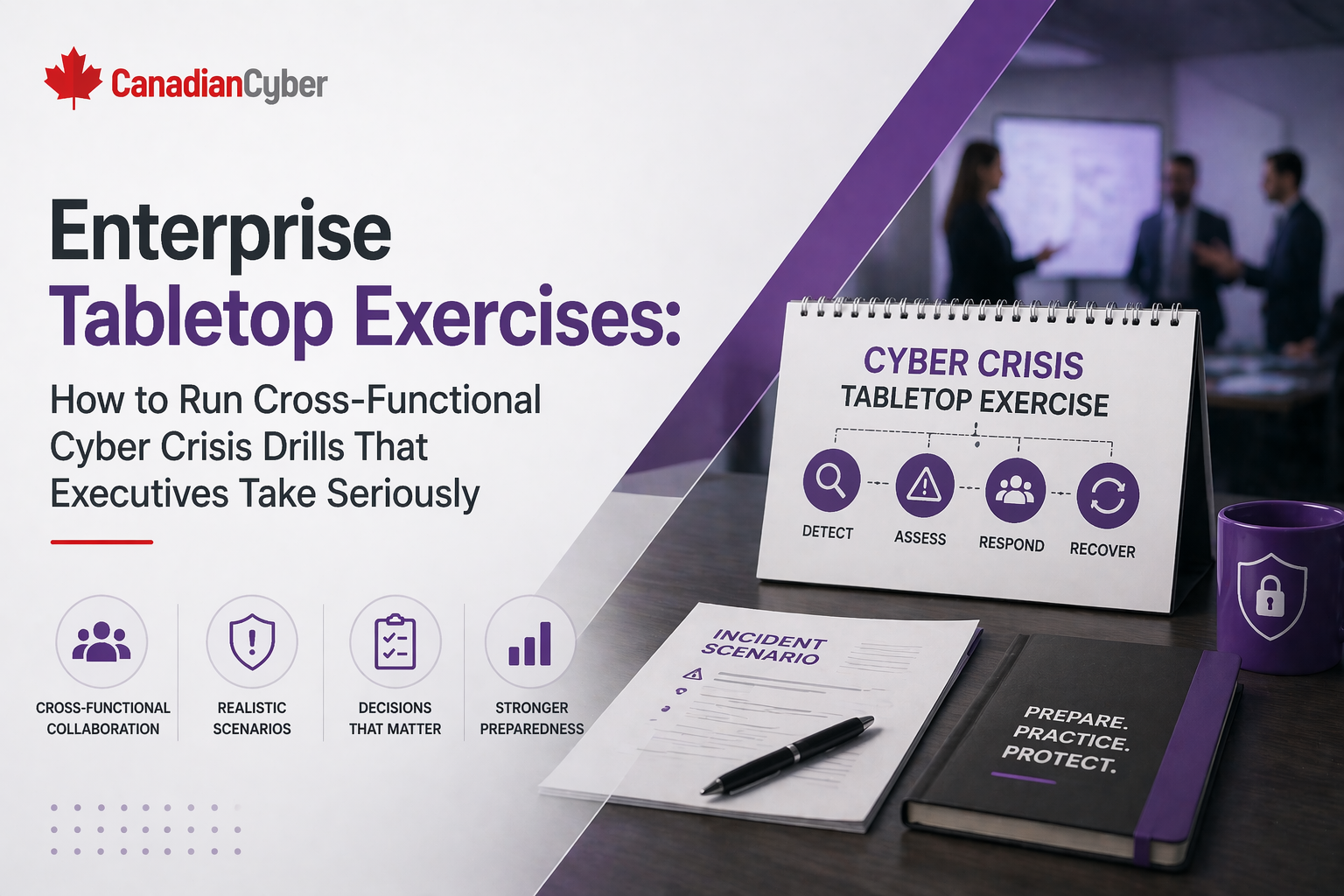
Enterprise Tabletop Exercises: How to Run Cross-Functional Cyber Crisis Drills That Executives Take Seriously
A strong tabletop exercise should not only test whether an incident response plan exists. It should test whether leadership, legal, privacy, IT, communications, operations, and business owners can make coordinated decisions under pressure.

Quick Snapshot
| Category | What This Blog Covers |
|---|---|
| Audience | Executives, security leaders, legal, privacy, IT, operations, communications, HR, finance, and risk teams |
| Main challenge | Running cyber crisis drills that feel realistic, cross-functional, and decision-focused |
| Key focus | Executive decision-making, communication, escalation, evidence logging, and business continuity |
| Outcome | A tabletop exercise that produces real findings, owners, due dates, and stronger crisis readiness |
Introduction
A cyber crisis does not stay inside the security team for long.
A ransomware event affects operations. A data breach pulls in legal and privacy. A cloud outage affects customers. A vendor incident raises procurement questions. A media leak requires communications. A regulator may need notification. A board member wants answers. And executives need to make decisions before every fact is fully known.
That is exactly why enterprise tabletop exercises matter.
They help organizations rehearse how leadership, security, IT, legal, privacy, communications, HR, operations, finance, and business owners will work together during a real cyber crisis.
A good enterprise tabletop exercise should not just test whether the incident response plan exists. It should test whether the organization can make coordinated decisions under pressure.
Why Tabletop Exercises Often Fall Flat
A lot of tabletop exercises are well-intentioned but weak in practice.
Common problems include:
- only IT and security participate
- executives attend but mostly observe
- the scenario is unrealistic
- the exercise has no real decision points
- legal, privacy, communications, and operations are brought in too late
- the facilitator gives away too much information
- there is no pressure around time, customers, regulators, or media
- lessons learned are captured but never turned into action
The exercise checks a box, but the organization does not become much more prepared. Executives take tabletop exercises seriously when the scenario forces them to deal with real business consequences.
What an Enterprise Tabletop Should Actually Test
An effective cyber crisis drill should test more than technical response.
It should test:
- decision-making authority
- escalation paths
- internal communication
- customer communication
- legal and privacy involvement
- executive reporting
- operational continuity
- vendor coordination
- evidence preservation
- media and reputation management
- board-level updates
- recovery prioritization
The question is not only, “Can security investigate the incident?” The better question is, “Can the enterprise coordinate a response while the situation is uncertain, urgent, and visible?”
A Common Scenario
Picture this: a company detects suspicious activity in its cloud environment on a Monday morning.
At first, it looks like an unusual login. Then a privileged account appears involved. Then customer data access cannot be ruled out. Then a major client asks if their data was affected. Then the communications team hears a journalist may be asking questions. Then leadership wants to know whether operations should be paused.
Now the organization needs decisions:
- Who owns the incident?
- When does legal get involved?
- Is this a security incident, privacy incident, or both?
- Should customers be notified now or later?
- What evidence must be preserved?
- Who speaks to the board?
- What can support teams tell customers?
- Should systems be taken offline?
- Who approves external communication?
Step 1: Pick a Scenario That Matches Real Business Risk
The best tabletop exercises start with scenarios that are realistic for the organization.
Avoid generic scenarios like: “An attacker breaches the network.”
Instead, choose something tied to the business model, such as:
- ransomware affecting critical operations
- compromised cloud admin account
- vendor breach involving customer data
- payroll or HR data exposure
- SaaS platform outage during peak customer usage
- stolen executive credentials
- insider misuse of sensitive records
- data leak through misconfigured storage
- third-party support tool compromise
Step 2: Bring the Right People Into the Room
A cyber crisis is not a security-only event. A strong enterprise tabletop should include the teams that would be needed during a real crisis.
| Function | Why They Matter |
|---|---|
| Executive leadership | Decision authority and business prioritization |
| Security / IT | Investigation, containment, and recovery |
| Legal | Privilege, liability, and notification obligations |
| Privacy | Data impact and regulatory analysis |
| Communications / PR | Internal and external messaging |
| Operations | Business continuity and service impact |
| Customer success / support | Client questions and frontline communication |
| HR | Employee issues, insider risk, and staff communication |
| Finance | Fraud, loss tracking, and cyber insurance support |
| Procurement / vendor management | Third-party coordination and vendor escalation |
Want a Tabletop Exercise Executives Actually Engage With?
Canadian Cyber designs and facilitates realistic cyber crisis drills with executive decision points, cross-functional roles, injects, evidence logging, and corrective action tracking.
Step 3: Give Executives Real Decisions, Not Passive Updates
Executives do not need to discuss every technical detail. They need to practice decisions.
Examples include:
- Do we activate the crisis management team?
- Do we notify the board?
- Do we involve outside counsel or forensics?
- Do we pause a service?
- Do we notify customers before full confirmation?
- Do we make a public statement?
- Do we approve emergency spending?
- Do we accept operational downtime to reduce risk?
- Do we disclose to regulators or insurers?
- Do we change recovery priorities?
Step 4: Use Injects to Create Pressure
An inject is a new piece of information introduced during the exercise. Good injects create uncertainty and force the team to adapt.
Examples:
- A customer emails asking if their data was accessed.
- A journalist contacts the company.
- The attacker claims to have stolen data.
- Logs are incomplete.
- A vendor says their investigation will take 48 hours.
- The board asks for an update within one hour.
- A system owner says shutting down the service will affect revenue.
- Legal says notification obligations may apply.
- Support teams are receiving inconsistent customer questions.
Step 5: Test Communication Paths
Communication is often where cyber crisis response breaks down.
The tabletop should test:
- who sends internal updates
- who updates executives
- who briefs the board
- who talks to customers
- who approves public statements
- who handles regulators or insurers
- what support teams are allowed to say
- how updates are documented
Step 6: Rehearse Evidence and Decision Logging
During a crisis, decisions happen fast. If they are not documented, the organization may struggle later to explain what was known, when it was known, who decided what, why a decision was made, what actions were taken, and what evidence was preserved.
A good tabletop should test whether someone is assigned to maintain:
- incident timeline
- decision log
- action tracker
- communication record
- evidence preservation notes
Step 7: Include Business Continuity, Not Just Incident Response
A cyber crisis often affects business operations. That means the tabletop should include questions like:
- Which services must continue?
- What manual workarounds exist?
- Which customers are most affected?
- What is the recovery priority?
- Can the business operate without a key system?
- Who decides when to restore?
- How do we validate systems before bringing them back?
Step 8: End With Real Findings and Owners
A tabletop has little value if the output is only “good discussion.” The exercise should produce gaps found, decisions that were unclear, missing contact lists, weak escalation paths, plan updates, training needs, technical control improvements, communication improvements, and corrective actions with owners and due dates.
| Finding | Action Needed | Owner | Due Date |
|---|---|---|---|
| Board update process unclear | Create crisis board briefing template | General Counsel | 30 days |
| Customer messaging not pre-approved | Draft incident communication templates | Communications Lead | 21 days |
| Vendor escalation contact missing | Update critical vendor contact register | Procurement Lead | 14 days |
| Decision logging not assigned | Add scribe role to incident plan | Security Lead | 14 days |
What Makes Executives Take It Seriously
Executives engage when the tabletop is clearly tied to business risk. That means the exercise should include:
- revenue impact
- customer trust impact
- legal exposure
- operational disruption
- regulatory uncertainty
- board expectations
- media or public pressure
- executive decision points
- time pressure
Common Mistakes to Avoid
- Making the scenario too easy: A good exercise should create tension, not comfort.
- Letting security answer every question: The goal is cross-functional response.
- Skipping legal and communications: They are critical in real incidents.
- Avoiding uncomfortable decisions: The uncomfortable decisions are the point.
- Failing to document outcomes: No action tracker means little improvement.
- Running the same scenario every year: Change the scenario as the business and threat landscape change.
A Practical Tabletop Agenda
| Stage | Purpose |
|---|---|
| 1. Opening briefing | Explain objectives, rules, and scenario background |
| 2. Scenario phase one | Initial detection and escalation |
| 3. Scenario phase two | Impact expands and uncertainty increases |
| 4. Scenario phase three | Customer, legal, media, or operational pressure appears |
| 5. Decision review | Discuss key decisions and missed information |
| 6. Lessons learned | Capture gaps, strengths, and improvement items |
| 7. Corrective action assignment | Assign owners and deadlines |
Canadian Cyber’s Take
At Canadian Cyber, we often see organizations treat tabletop exercises as compliance events instead of leadership readiness exercises. That limits their value.
The strongest tabletop exercises are not the ones with the most technical detail. They are the ones that reveal whether the organization can:
- escalate quickly
- make decisions under uncertainty
- coordinate across departments
- communicate clearly
- preserve evidence
- recover operations
- improve after the drill
Takeaway
Enterprise tabletop exercises work best when they feel like real business crisis rehearsals.
They should be cross-functional, realistic, decision-focused, time-sensitive, documented, and tied to corrective action.
Executives take tabletop exercises seriously when the drill forces them to practice the decisions they would actually face during a ransomware event, data breach, cloud outage, vendor incident, or public-facing security crisis.
How Canadian Cyber Can Help
We help organizations design and run enterprise tabletop exercises that test real crisis readiness, not just policy awareness.
- cyber tabletop scenario design
- executive crisis simulation facilitation
- ransomware, breach, vendor, and cloud incident drills
- cross-functional role and escalation testing
- evidence and decision-log improvement
- corrective action tracking
- vCISO support for incident readiness and executive reporting
Stay Connected With Canadian Cyber
Follow Canadian Cyber for practical guidance on incident response, tabletop exercises, executive cyber readiness, and crisis governance.