vCISO • Ransomware Readiness • Incident Response • Cyber Insurance • Executive Crisis Leadership
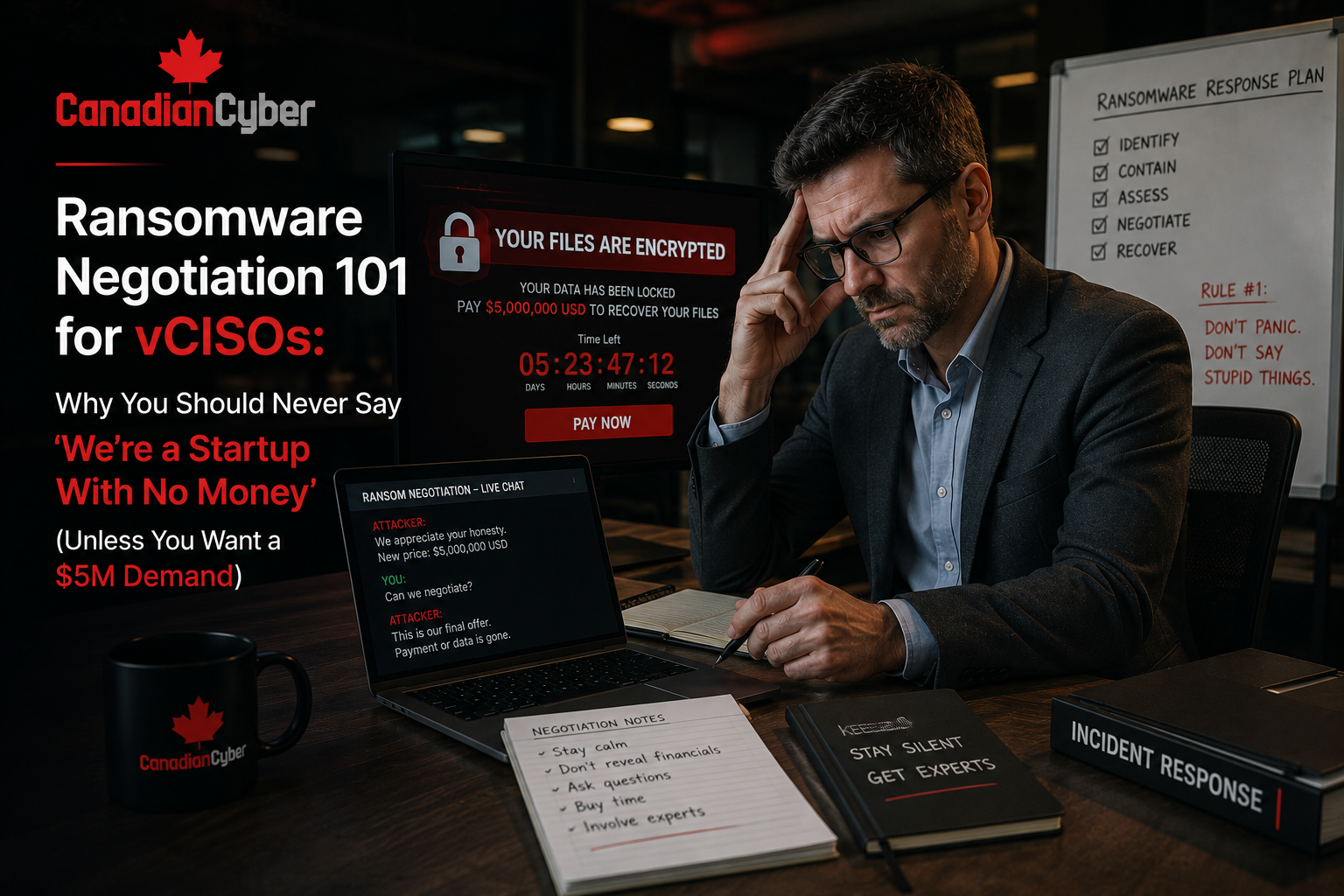
Ransomware Negotiation 101 for vCISOs: Why You Should Never Say “We’re a Startup With No Money”
They may already know your Series A valuation. Your best move is not panic, bluffing, or casual negotiation. Your best move is calm ransomware readiness, controlled communication, legal coordination, insurance alignment, and a vCISO who looks prepared.
Quick Snapshot
| Crisis Area | What the vCISO Must Control |
|---|---|
| First Response | Do not panic, improvise, or overshare financial information. |
| Communication | Use calm, controlled, approved messaging. |
| Negotiation | Do not negotiate casually. Involve legal, insurer, law enforcement, and qualified specialists. |
| Evidence | Preserve logs, ransom notes, screenshots, timelines, and affected system details. |
| Outcome | Better control, less chaos, fewer harmful statements, and stronger recovery posture. |
Introduction
The ransomware note arrived at 3:12 a.m.
The engineering team was awake. The CEO was pacing. The CTO was refreshing Slack. Legal was asking if customer data was involved. Finance was asking whether cyber insurance applied. Sales was asking if customers needed to know.
The attacker was asking for money.
Then someone suggested replying:
“We’re a startup. We don’t have that kind of money.”
The vCISO almost dropped the coffee.
Because here is the painful truth. They may already know your funding round. They may know your revenue range. They may know your headcount. They may know your insurance limit. They may have read your press releases, scraped LinkedIn, reviewed investor announcements, or stolen internal documents before the ransom note appeared.
So saying “we have no money” is not a strategy. It is noise. Worse, it can make the attacker assume you are lying, disorganized, and scared.
Ransomware Scenario Keeping You Up at Night?
Canadian Cyber helps organizations prepare ransomware response plans, run executive tabletop exercises, build cyber insurance evidence packs, review backup readiness, and provide vCISO-led incident response governance.
The Mistake: Treating Ransomware Like a Chat Window
Ransomware negotiation is not customer support. It is not a Slack thread. It is not a founder-to-founder conversation.
It is a high-pressure criminal extortion event where every word can affect risk, timing, legal exposure, insurance response, and business recovery.
The attacker may be watching your behavior. They may look for panic, confusion, weak backups, financial pressure, or customer urgency.
| What Not to Say | Why It Can Backfire |
|---|---|
| “We’re a startup with no money.” | They may already know your funding, revenue, or insurance position. |
| “We cannot operate without these systems.” | You just confirmed business pressure. |
| “Our backups failed.” | You reduced your own leverage. |
| “We will pay if you lower the price.” | You moved into negotiation before legal and insurer review. |
| “We know you did not steal data.” | You may be wrong before forensics are complete. |
Better principle: Say less. Verify more. Coordinate before responding.
The vCISO’s First Job: Slow the Room Down
In a ransomware event, everyone wants to do something. That is normal.
But the first useful job of the vCISO is to slow the room down without freezing response.
The vCISO should help leadership separate four tracks:
- containment
- forensics
- communications
- business decisions
| First-Hour Crisis Question | Why It Matters |
|---|---|
| What systems are affected? | Defines containment and recovery scope. |
| Is encryption ongoing? | Determines urgency of isolation. |
| Is data exfiltration suspected? | Drives legal, privacy, and customer analysis. |
| Are backups safe? | Changes recovery options. |
| Who is authorized to communicate? | Prevents harmful messaging. |
Practical rule: Do not let the first person who sees the ransom note become the company’s negotiator.
The “Liam Neeson vCISO” Posture
No, your vCISO does not need a leather jacket.
But they do need a particular posture.
Calm. Measured. Prepared. Not impressed by pressure. Not reckless. Not emotional. Not chatty.
| Weak Crisis Posture | Strong vCISO Posture |
|---|---|
| “What do we say?” | “No one responds until legal, insurer, and IR lead align.” |
| “Tell them we have no money.” | “Do not discuss finances, insurance, revenue, or backup status.” |
| “Can we just pay?” | “We need legal, sanctions, insurer, and recovery analysis first.” |
| “Are we breached?” | “We do not know yet. Forensics will determine scope.” |
| “Can engineering restore?” | “Only after containment and backup validation.” |
Need Executive Ransomware Crisis Training?
Canadian Cyber can run executive ransomware tabletop exercises that test decision-making, communication control, legal escalation, cyber insurance steps, recovery readiness, and leadership alignment.
Why “We Have No Money” Is a Bad Move
The phrase sounds logical. The business hopes the attacker will lower the demand.
But ransomware groups often do financial reconnaissance before or during attacks.
They may review:
- funding announcements
- company size
- public revenue clues
- customer logos
- job postings
- investor pages
- press releases
- internal finance files if accessed
Do not discuss financial capacity casually. Do not reveal insurance. Do not reveal backup condition. Do not reveal internal chaos.
The Right First Message Is Usually Not a Negotiation
This matters.
The first response should not be a bargaining move. It should be a controlled holding response, if a response is advised at all.
The company should first align with:
- legal counsel
- cyber insurer
- incident response provider
- forensic team
- executive sponsor
- privacy lead
- qualified ransomware negotiator, if needed
Example holding style:
“We are reviewing the information provided. Future communications will be handled through this channel.”
That is intentionally boring. Boring is good. Boring does not create new facts.
When to Call an Actual Ransomware Negotiator
A vCISO should not pretend to be a professional negotiator if they are not one.
The vCISO’s job is crisis governance.
A qualified negotiator may be needed when:
- the attacker is actively communicating
- data theft is claimed
- business disruption is severe
- the insurer requires approved vendors
- legal needs controlled communications
- leadership is considering payment options
- the company needs proof-of-life validation
| Role | Responsibility |
|---|---|
| vCISO | Coordinates security leadership, evidence, controls, and decision structure. |
| Legal Counsel | Advises on legal risk, privilege, notification, sanctions, and contracts. |
| Insurer / Breach Coach | Coordinates policy requirements and approved vendors. |
| Forensics Team | Determines scope, containment, exfiltration, and root cause. |
| Negotiator | Handles threat actor communication if approved. |
The Evidence You Need Before Anyone Talks Money
Before leadership even discusses payment decisions, the company needs facts.
Not vibes. Not fear. Facts.
| Critical Evidence | Why It Matters |
|---|---|
| Ransom note | Confirms demand and contact method. |
| Affected systems list | Defines operational impact. |
| Backup status | Determines recovery options. |
| Log preservation | Supports investigation. |
| Exfiltration indicators | Supports legal and customer impact analysis. |
| Communication record | Preserves all threat actor interaction. |
Need a Ransomware Evidence Pack Structure?
Canadian Cyber can help you design a ransomware evidence workspace for timelines, ransom materials, affected systems, backups, forensics, communications, insurance records, and corrective actions.
The Cyber Insurance Trap
Cyber insurance can help. But it also creates process requirements.
Many policies have rules around:
- notice timing
- approved breach counsel
- approved forensic firms
- approved negotiators
- payment procedures
- sanctions checks
- documentation
- prior consent
| Insurance Question | Why It Matters |
|---|---|
| Who must be notified? | Policy notice requirements. |
| Is breach counsel required? | Privilege and approved response process. |
| Are approved vendors required? | Coverage may depend on it. |
| Is prior consent needed? | Payment decisions may need approval. |
| Are sanctions checks required? | Payment legality risk. |
Practical rule: Call the insurer early. But coordinate with legal and breach coach guidance before sharing sensitive threat actor communications.
The Communication Script Problem
Scripts should reduce panic. They should not reveal strategy.
Internal executive holding statement:
“Current status: we are investigating a suspected ransomware event. No external statements or threat actor communications should be made without approval from the incident lead, legal counsel, and executive sponsor.”
Staff instruction:
“Do not discuss this incident externally. Do not contact the threat actor. Do not delete files, logs, emails, or ransom notes. Report any unusual messages or attacker contact immediately.”
Customer holding style:
“We are investigating a security incident with support from external specialists. We will provide updates if we determine that your data or services are affected. Our current focus is containment, investigation, and continuity of service.”
What the vCISO Should Never Allow
During ransomware response, the vCISO should stop unsafe behavior quickly.
- random employees replying to the attacker
- finance discussing available funds
- leadership revealing insurance limits
- engineering restoring systems before containment
- teams deleting ransom notes or logs
- staff posting about the incident online
- sales making customer promises
- executives saying “no customer data was affected” before forensics
Practical rule: In ransomware response, uncontrolled communication is its own incident.
The “Decoy Strategy” You Actually Need
The safest “decoy” is not lying to the attacker.
The safest decoy is preparation.
Make the company look boring, organized, resilient, and hard to pressure.
| Defensive Control | Why It Helps |
|---|---|
| Tested backups | Reduces pressure to pay. |
| Incident tabletop | Reduces panic. |
| Pre-approved counsel | Speeds legal response. |
| Communication plan | Prevents harmful statements. |
| Evidence vault | Keeps facts organized. |
Prepare Before the Ransom Note Arrives
Canadian Cyber can help your leadership team validate backup readiness, test ransomware decisions, review cyber insurance steps, build communication templates, and document evidence workflows.
The Decision Tree: Pay, Do Not Pay, or Keep Investigating?
This is sensitive. Payment discussion is not a technical decision. It is an executive risk decision with legal, insurance, and law enforcement context.
A vCISO should not make this decision alone.
| Decision Input | Why It Matters |
|---|---|
| Backup recovery status | Can operations be restored without payment? |
| Data exfiltration evidence | Is there confirmed data theft? |
| Business impact | What operations are down? |
| Insurance coverage | What is covered and required? |
| Sanctions risk | Payment may be illegal in some cases. |
Ransomware Readiness Before the Incident
The best ransomware negotiation strategy is to reduce the need to negotiate.
Prepare these now.
| Readiness Item | Why It Matters |
|---|---|
| Incident response plan | Defines roles and escalation. |
| Ransomware playbook | Gives ransomware-specific steps. |
| Executive tabletop | Tests decision-making. |
| Backup restore testing | Proves recovery. |
| Communication templates | Prevents panic messaging. |
The vCISO Ransomware War Room
During a ransomware event, structure matters.
| War Room Role | Responsibility |
|---|---|
| Executive Sponsor | Business decisions. |
| Incident Commander | Coordinates response. |
| vCISO | Security leadership and governance. |
| Legal Counsel | Legal privilege, notification, and contract obligations. |
| Forensics Lead | Scope, root cause, and containment. |
War Room Rules
- One communication channel.
- One decision log.
- One evidence tracker.
- One external message owner.
- No unofficial attacker communication.
- No public statements without approval.
- No restoration without containment validation.
Ransomware Evidence Pack
Build this during response, not after everyone forgets what happened.
| Evidence Pack Section | Evidence |
|---|---|
| Timeline | Key events and decisions. |
| Ransom Materials | Note, portal screenshots, and messages. |
| System Impact | Affected systems and recovery status. |
| Forensics | Indicators, root cause, and containment evidence. |
| Corrective Actions | Lessons learned and remediation. |
Common Crisis Mistakes to Avoid
- Mistake 1: Trying to sound poor. They may already know your financial position.
- Mistake 2: Letting the CTO negotiate. The CTO may be brilliant. That does not make them a ransomware negotiator.
- Mistake 3: Revealing backup status. Backup strength or failure should not be casually shared.
- Mistake 4: Discussing insurance. Insurance details can affect extortion pressure.
- Mistake 5: Restoring too early. If attackers still have access, restoration may fail or reinfection may occur.
- Mistake 6: Saying customer data is safe too soon. Wait for forensic confirmation.
- Mistake 7: Failing to preserve evidence. Logs, ransom notes, messages, and timelines matter.
What Good Looks Like
A strong vCISO-led ransomware response has:
- calm executive leadership
- clear incident command
- legal and insurance coordination
- forensic investigation
- controlled communications
- no casual financial statements
- no unmanaged negotiation
- backup validation
- evidence preservation
- decision logs
- post-incident corrective actions
The goal is not to win a chat argument with criminals. The goal is to protect the business.
Canadian Cyber’s Take
At Canadian Cyber, we often see ransomware readiness treated as a technical backup problem.
That is too narrow.
Ransomware is an executive crisis. It touches security, legal, finance, insurance, customers, operations, vendors, and reputation.
The vCISO’s role is to bring strategic leadership before and during the incident.
That means preparing the playbook, testing executives, validating backups, defining communications, reviewing cyber insurance requirements, and knowing when to call the right specialists.
The worst time to discover your ransomware negotiation strategy is after the ransom note appears.
Takeaway
Ransomware negotiation is not the place for improvisation.
Do not reveal finances. Do not reveal insurance. Do not reveal backup weakness. Do not let random staff respond. Do not make customer promises before forensics. Do not negotiate without legal, insurer, and specialist guidance.
A vCISO helps the company stay calm, organized, and prepared.
The best move is not pretending to be poor. The best move is building enough resilience that the attacker has less leverage.
How Canadian Cyber Can Help
Canadian Cyber helps organizations prepare for ransomware events with practical vCISO support and executive-ready response planning.
- ransomware readiness assessments
- executive ransomware tabletop exercises
- incident response plan development
- ransomware playbook design
- backup and restore evidence reviews
- cyber insurance readiness reviews
- war room role design
- communication templates
- forensic readiness planning
- law enforcement reporting workflow
- vendor and MSP responsibility mapping
- post-incident corrective action tracking
- vCISO strategic leadership for cyber crisis governance
Stay Connected With Canadian Cyber
Follow Canadian Cyber for practical guidance on vCISO leadership, ransomware readiness, incident response, cyber insurance, ISO 27001, SharePoint ISMS, executive tabletops, and crisis governance.