Security Assessment • Red Team • Purple Team
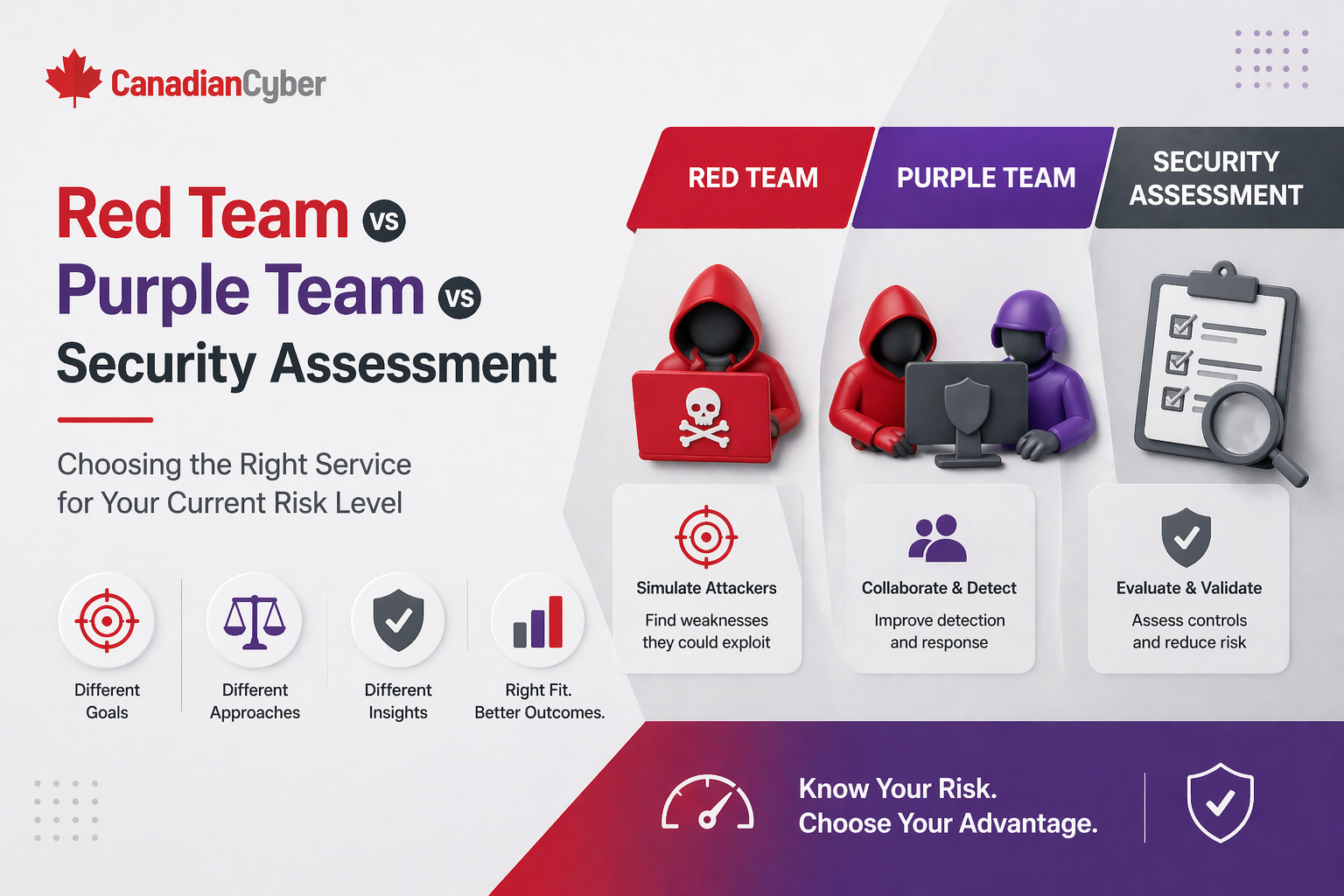
Red Team vs Purple Team vs Security Assessment: Choosing the Right Service for Your Current Risk Level
The right security service depends on your current maturity, internal capability, and what you actually need to learn next. This guide helps you choose the best fit before spending budget on the wrong exercise.

Quick Snapshot
| Service | Main Goal | Best For |
|---|---|---|
| Security Assessment | Identify gaps and baseline controls | Early to mid maturity |
| Red Team | Simulate real attacker behavior | Mature environments |
| Purple Team | Improve detection and response collaboratively | Growing or mature teams |
Introduction
Most organizations reach a point where basic security is no longer enough.
They have MFA in place, endpoint protection deployed, policies written, some monitoring running, and maybe even compliance underway.
But one question starts coming up:
How do we actually know if our security works?
That is where services like security assessments, red team exercises, and purple team engagements enter the conversation.
The problem is that many companies choose the wrong one at the wrong time. They jump into a red team too early. They run a generic assessment too late. They try a purple team without enough internal capability.
The result is often wasted budget, unclear outcomes, findings that cannot be actioned, or a false sense of confidence.
The right security service depends on your current maturity and risk level, not what sounds the most advanced.
Why This Decision Matters More Than It Looks
All three approaches test security in different ways. But they are not interchangeable.
Choosing the wrong one can lead to:
- testing areas you are not ready for
- missing foundational gaps
- overwhelming internal teams
- failing to produce usable outcomes
- confusing leadership about actual risk
A mid-market company with basic controls does not need the same testing approach as a mature enterprise with a SOC and detection engineering team. The decision should always start with: Where are we right now, and what are we trying to learn?
Not Sure Which Security Test You Need?
Canadian Cyber can help you assess your current maturity and choose the right path: assessment, purple team, red team, or a staged roadmap.
The Simple Way to Think About It
Each option answers a different question:
| Approach | Question It Answers |
|---|---|
| Security Assessment | What is missing or weak? |
| Red Team | Can an attacker break through? |
| Purple Team | How well do we detect and respond? |
A Common Scenario
Picture this: a mid-market company is planning its next security investment.
Leadership hears different recommendations:
- “We should do a red team exercise.”
- “We need a gap assessment first.”
- “Purple teaming is more modern.”
The company has:
- MFA for most systems
- endpoint protection
- basic logging
- some policies
- no dedicated SOC
- limited incident response testing
- no recent full assessment
If they jump into a red team now, they may only prove obvious gaps they already suspected. If they start with a structured assessment, they can identify foundational gaps, prioritize improvements, and prepare for more advanced testing later.
1. Security Assessment: The Foundation
A security assessment evaluates your current security posture. It looks at policies, controls, configurations, processes, access management, cloud setup, endpoints, vendor risk, incident readiness, and compliance alignment.
It answers:
“What do we have, and how strong is it?”
When a Security Assessment Makes the Most Sense
- you have never done a full review
- you are preparing for SOC 2 or ISO 27001
- your controls are still maturing
- leadership wants a clear roadmap
- your environment has grown quickly
- you rely heavily on SaaS and cloud
- your team is small or newly formed
What You Get From It
- identified gaps
- prioritized risks
- control maturity scoring
- recommendations
- a roadmap for improvement
- alignment with frameworks such as SOC 2 and ISO 27001
2. Red Team: Simulating a Real Attacker
A red team exercise simulates a real-world attack. The goal is to breach the environment, move laterally, escalate privileges, access sensitive data, and avoid detection.
It answers:
“If a real attacker targeted us, could they succeed?”
When a Red Team Makes Sense
- core controls are already in place
- MFA is enforced consistently
- endpoint security is mature
- logging and monitoring exist
- an incident response process exists
- the organization can act on findings
- leadership wants to test real-world resilience
What It Can Reveal
- real attack paths
- detection failures
- privilege escalation opportunities
- lateral movement weaknesses
- response delays
- communication gaps
Red teaming is powerful, but it can fail when foundational controls are weak, detection capability is minimal, or internal teams cannot act on results.
3. Purple Team: Bridging Attack and Defense
Purple teaming combines offensive and defensive work. Instead of attacking silently like a red team, the red and blue teams collaborate. The goal is to test attack techniques, observe detection, and improve defenses in real time.
It answers:
“How do we improve our detection and response capability quickly?”
When Purple Teaming Makes Sense
- you already have logging and monitoring
- you want to improve detection quality
- your team is ready to learn actively
- you have SIEM, EDR, or monitoring tools in place
- you want faster improvement cycles
What You Get From It
- improved detection rules
- validated alerts
- reduced false positives
- faster response processes
- better collaboration between teams
- immediate feedback on security gaps
Ready to Improve Detection and Response?
Purple teaming helps your team see attack techniques, tune alerts, and improve response workflows in real time.
Choosing Based on Your Current Maturity
| Current Stage | Signs | Best Fit |
|---|---|---|
| Early Stage | Incomplete MFA, weak asset visibility, limited policies, minimal monitoring, unclear ownership | Security Assessment |
| Growing Stage | Baseline controls, some logging, defined access control, basic incident response | Assessment or Purple Team |
| Mature Stage | Strong identity, endpoint protection, SIEM, detection capability, incident response readiness | Red Team or Purple Team |
A Practical Decision Framework
| Question | Best Fit |
|---|---|
| Do we know our current gaps? | Security Assessment |
| Do we want a prioritized roadmap? | Security Assessment |
| Do we want to test real attack scenarios? | Red Team |
| Do we want to improve detection and response? | Purple Team |
| Are we unsure about our maturity? | Start with Assessment |
What Companies Often Get Wrong
- Jumping straight to red teaming: Without strong controls, this produces obvious findings.
- Treating assessments as one-time tasks: Maturity should be tracked over time.
- Skipping purple teaming: Many teams miss the chance to improve detection quickly.
- Choosing based on trends: The most advanced option is not always the right one.
- Ignoring internal readiness: If your team cannot act on findings, the value drops.
How These Services Work Together
The strongest programs use all three over time. A typical progression looks like this:
1. Security Assessment → understand gaps and build roadmap
2. Purple Team → improve detection and response
3. Red Team → validate real-world resilience
Canadian Cyber’s Take
At Canadian Cyber, we often see organizations invest in advanced testing too early. Not because they want to waste budget, but because they want confidence.
The problem is that confidence comes from alignment, not complexity.
The most effective approach is:
- understand your current state
- fix foundational gaps
- build detection capability
- then simulate real-world attacks
Build a Testing Roadmap That Matches Your Risk
We help organizations choose the right sequence of assessments, purple team exercises, and red team testing based on maturity, budget, and business risk.
Plan Your Security Testing Roadmap
Explore Canadian Cyber Services
Takeaway
Red team, purple team, and security assessments are all valuable. But they serve different purposes.
| Service | Value |
|---|---|
| Security Assessment | Gives you clarity |
| Purple Team | Gives you improvement |
| Red Team | Gives you validation |
The best security investment is not always the most advanced one. It is the one that moves your organization forward from where you are today.
How Canadian Cyber Can Help
We help organizations choose and execute the right security testing approach based on real maturity and business risk.
- security maturity assessments
- SOC 2 and ISO 27001 readiness reviews
- red team and adversary simulation exercises
- purple team detection and response improvement
- cloud and identity security assessments
- vCISO guidance for security strategy and roadmap
Stay Connected With Canadian Cyber
Follow Canadian Cyber for practical guidance on assessments, red teaming, purple teaming, vCISO strategy, and security roadmap planning.