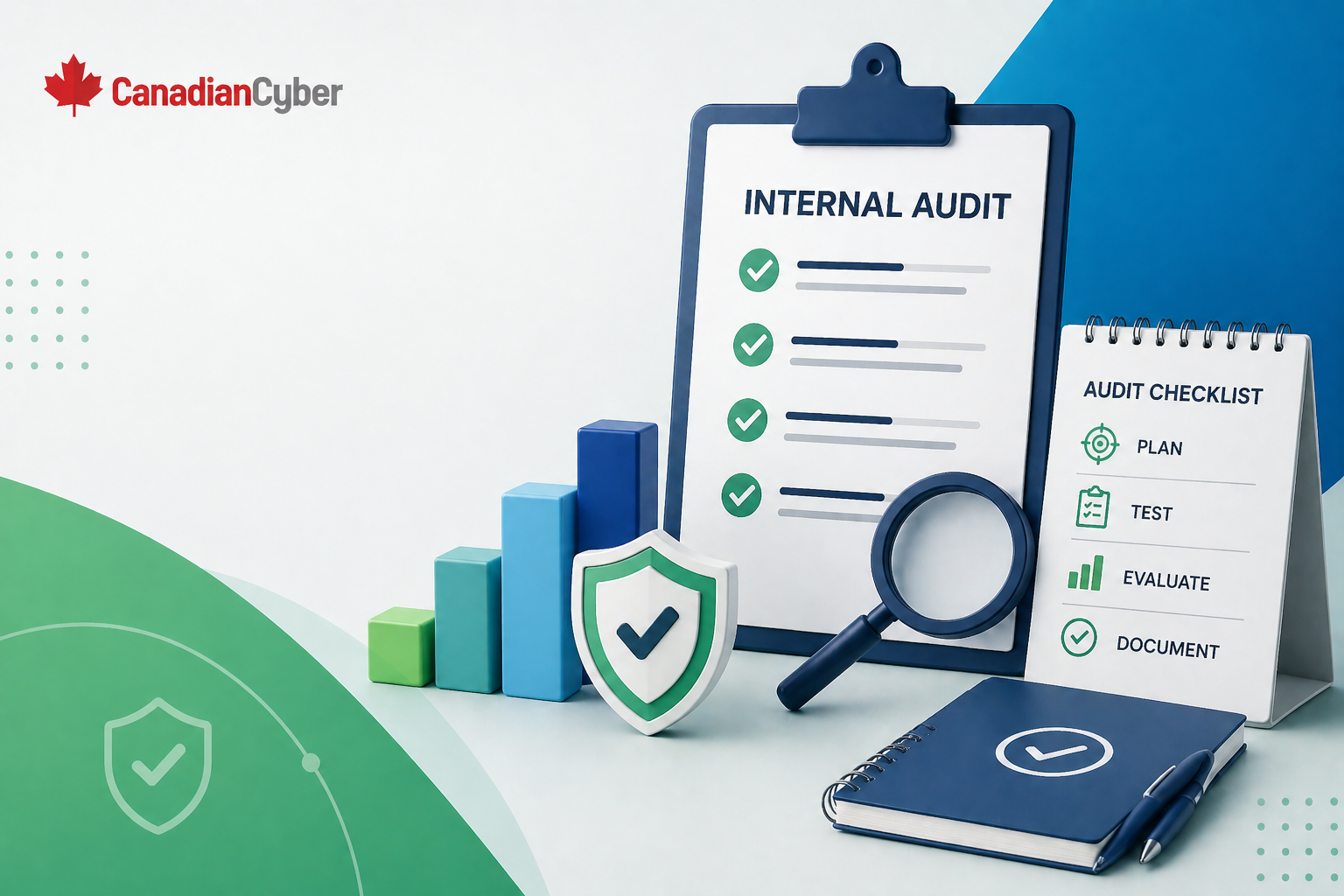
Internal Audit • ISO 27001 • SOC 2 Readiness
Internal Audit DIY Guide: How to Test Controls Without an External Consultant
Internal audits do not always need to be outsourced. With the right scope, evidence review, and corrective action process, your team can test controls before external auditors or customers ask for proof.
Quick Snapshot
| Category | Detail |
|---|---|
| Best for | Compliance leads, security managers, operations leads, and internal reviewers |
| Goal | Test whether controls are actually working before an external audit or customer review |
| Best scope | Access, vendors, incidents, policies, corrective actions, risk register, training, and backups |
| Key rule | Test evidence, not intentions |
Introduction
Internal audits do not have to feel intimidating.
Many organizations assume they need an external consultant every time they want to test controls, review evidence, or prepare for ISO 27001, SOC 2, or broader security governance.
Sometimes external support is helpful. But not every internal audit has to be outsourced.
With a clear method, practical scope, and honest evidence review, a compliance lead, security manager, operations lead, or internal cross-functional reviewer can run a useful DIY internal audit without overwhelming the team.
The goal is simple: test whether your controls are actually working before someone external asks for proof.
Why Internal Audits Matter
An internal audit is not just a compliance formality. It helps answer important questions:
- Are policies being followed?
- Are controls operating as described?
- Is evidence complete and current?
- Do owners understand their responsibilities?
- Are findings being corrected?
- Are risks being reviewed?
- Are review cycles happening on time?
Need Help Building an Internal Audit Process?
Canadian Cyber helps teams create practical audit plans, evidence request lists, corrective action trackers, and SharePoint audit workspaces.
When a DIY Internal Audit Makes Sense
A DIY internal audit works well when:
- your scope is manageable
- your team understands the process
- you have enough independence internally
- you want to test readiness before an external review
- you are reviewing common controls like access, vendors, incidents, policies, and corrective actions
It may not be enough when:
- the audit is highly complex
- independence is required by a specific certification body
- the organization has serious unresolved control failures
- leadership needs external validation
- the audit covers technical areas your team cannot assess objectively
The Big Rule: Test Evidence, Not Intentions
This is the most important part. Do not only ask, “Do we have a process?” Ask, “Can we prove this process worked?”
| Control Area | Weak Test | Better Test |
|---|---|---|
| Access reviews | Ask if reviews happen | Review the latest access review record and follow-up actions |
| Vendor management | Ask if vendors are checked | Inspect completed vendor assessments and next review dates |
| Incident response | Ask if a plan exists | Review an actual incident or near-miss record |
| Policy governance | Ask if policies are reviewed | Check approval history and next review dates |
| Corrective actions | Ask if issues are fixed | Confirm evidence of closure and verification |
Step 1: Define a Small, Clear Scope
Do not audit everything at once. Start with the areas most likely to affect compliance and security maturity.
A practical DIY audit scope might include:
- access control
- vendor management
- incident response
- risk register
- corrective actions
- policy review
- backup testing
- security awareness training
Step 2: Build a Simple Audit Plan
Your audit plan does not need to be complicated. It should include the audit objective, scope, controls being tested, audit dates, people to interview, evidence to review, expected output, and reporting format.
| Audit Element | Example |
|---|---|
| Objective | Test whether key ISMS controls are operating effectively |
| Scope | Access reviews, vendors, incidents, corrective actions |
| Method | Evidence review, short interviews, sample testing |
| Output | Findings, observations, corrective action plan |
| Timeline | Two-week review window |
Step 3: Choose Controls to Test
Select controls that matter most. Good starter controls include access control, vendor management, incident response, policy governance, and corrective actions.
Starter Control Tests
- Access: new users, leavers, privileged access, MFA, exceptions
- Vendors: critical vendors, security reviews, reassessment dates, contracts
- Incidents: incident logs, severity, response actions, closure notes
- Policies: owners, approval dates, review dates, archived versions
- Corrective actions: owners, deadlines, closure evidence, verification
Want Ready-to-Use Control Testing Templates?
Canadian Cyber can help you build lightweight internal audit templates for access, vendors, incidents, policies, corrective actions, and evidence review.
Step 4: Use Sampling
You do not need to test every record. Use samples to keep the audit manageable.
For example:
- 5 new hires
- 5 terminated users
- 3 critical vendors
- 3 incidents or near misses
- 5 corrective actions
- 3 policies due for review
- 2 backup restore tests
Step 5: Ask Short, Practical Questions
Internal audit interviews do not need to be long. Ask control owners practical questions like:
- What process do you own?
- How does it work in practice?
- Where is the evidence stored?
- What happens when something is overdue?
- What exceptions exist?
- What usually breaks?
- What changed since the last review?
Step 6: Review the Evidence
For each sample, check whether evidence is complete, current, linked to the right control, approved where needed, dated, attributable to an owner, stored in the right place, and strong enough to support the claim.
If you are testing access reviews, do not accept a screenshot alone if it does not show the system reviewed, reviewer, date, decisions, and follow-up removals.
Step 7: Rate Your Findings
Not every issue is equal. Use simple categories so leadership knows what needs attention first.
| Finding Type | Meaning | Example |
|---|---|---|
| Major Finding | A control is missing, not operating, or has no evidence | No privileged access review was performed |
| Minor Finding | The control exists, but evidence or consistency is weak | Two critical vendors have missing reassessment dates |
| Observation | An improvement opportunity that may not be a formal failure | Evidence naming is inconsistent |
Step 8: Create Corrective Actions
Every meaningful finding should become an action. A good corrective action includes the issue, root cause, action required, owner, due date, evidence needed, and verification method.
| Finding | Corrective Action | Owner | Due Date |
|---|---|---|---|
| Access review missing follow-up proof | Add removal evidence requirement to access review template | IT Lead | 30 days |
| Incident closure notes inconsistent | Update incident record template and retrain responders | Security Lead | 21 days |
| Vendor reassessment overdue | Complete reviews for critical vendors and set annual reminders | Compliance Lead | 45 days |
Step 9: Prepare a Simple Audit Report
Your report should be clear and useful. Include the objective, scope, dates, controls tested, evidence reviewed, summary of results, findings, observations, corrective actions, and overall readiness view.
Leadership should be able to understand what was tested, what worked, what did not, and what needs to happen next.
Step 10: Follow Up
This is where many DIY audits fail. They complete the report, then forget the follow-up.
Schedule a follow-up review to confirm:
- actions were completed
- evidence was attached
- closure was verified
- repeated issues were escalated
- management review receives the results
An internal audit without follow-up is just a report. An internal audit with follow-up becomes improvement.
A Practical DIY Internal Audit Checklist
| Item | Done? |
|---|---|
| Audit scope defined | ☐ |
| Audit objective written | ☐ |
| Control areas selected | ☐ |
| Evidence list prepared | ☐ |
| Control owners identified | ☐ |
| Samples selected | ☐ |
| Interview questions prepared | ☐ |
| Findings categories defined | ☐ |
| Corrective action tracker ready | ☐ |
| Follow-up date scheduled | ☐ |
Common Mistakes to Avoid
- Auditing too much at once: Start focused.
- Only reviewing documents: Test actual evidence and samples.
- Letting owners audit their own controls without review: Try to maintain some independence.
- Writing vague findings: Findings should be specific and actionable.
- Ignoring root cause: Fix the process, not just the symptom.
- Skipping follow-up: Corrective action closure is part of the value.
What to Store in SharePoint
If you use SharePoint, create a clean audit workspace with:
- audit plan
- evidence request list
- evidence links
- interview notes
- findings register
- corrective action tracker
- final report
- follow-up evidence
Need a SharePoint Audit Workspace?
Canadian Cyber can help structure your audit plan, evidence library, findings register, and corrective action tracker inside SharePoint.
Canadian Cyber’s Take
At Canadian Cyber, we often see organizations delay internal audits because they assume the process must be formal, expensive, or consultant-led.
It does not always have to be.
A useful DIY internal audit can be simple, focused, and practical. The key is to test the right things:
- evidence quality
- ownership
- consistency
- follow-up
- control operation
Takeaway
You do not always need an external consultant to test controls.
A DIY internal audit can work well when the scope is focused, the evidence is reviewed honestly, and findings lead to corrective action.
The value of internal audit is not the report. It is the improvement that follows.
How Canadian Cyber Can Help
We help organizations build internal audit processes that are practical, focused, and useful for ISO 27001, SOC 2, and broader security governance.
- internal audit planning
- control testing templates
- evidence review structures
- SharePoint audit workspaces
- corrective action tracking
- management review reporting
- vCISO guidance for audit readiness
Stay Connected With Canadian Cyber
Follow Canadian Cyber for practical guidance on ISO 27001, SOC 2, internal audit, SharePoint evidence management, and audit readiness.