

ISO 27001 • Multi-Tenant SaaS • Scope & Segmentation
ISO 27001 Implementation for Multi-Tenant SaaS: Avoiding Scope and Segmentation Failures
For multi-tenant SaaS companies, ISO 27001 implementation succeeds when the ISMS scope is clear, customer data flows are understood, and tenant boundaries can be proven.
Quick Snapshot
| Category | What This Blog Covers |
|---|---|
| Audience | Multi-tenant SaaS founders, CTOs, security leads, compliance teams, and platform owners |
| Main challenge | Defining ISO 27001 scope clearly while proving tenant segregation across shared systems |
| Common failure points | Support tools, logs, analytics, backups, CI/CD, cloud IAM, and non-production data use |
| Outcome | A clearer ISMS boundary, stronger evidence, and fewer audit surprises |
Introduction
Multi-tenant SaaS companies face one of the hardest ISO 27001 implementation questions:
Where does the ISMS actually begin and end?
At first, the answer sounds simple. The product is in scope. The cloud environment is in scope. The team supporting the platform is in scope.
But once implementation begins, the details get messy fast.
A multi-tenant SaaS environment may include:
- shared application infrastructure
- customer workspaces
- production databases
- object storage
- APIs
- support tools and admin dashboards
- logging platforms and analytics systems
- CI/CD pipelines and cloud IAM
- third-party integrations and backups
- internal corporate tools
Somewhere inside all of that, the company has to prove that the ISMS scope is clear, customer data is protected, and tenant boundaries are controlled.
That is where many SaaS companies struggle. Not because they do not care about security, but because they underestimate two things: scope clarity and tenant segmentation.
ISO 27001 implementation for multi-tenant SaaS works best when the company can clearly define what is in scope and prove that one customer’s data, users, and activity cannot improperly affect another’s.
Why Multi-Tenant SaaS Makes ISO 27001 Harder
A single-customer environment is easier to explain. One customer. One environment. One boundary. One data set.
Multi-tenant SaaS is different.
Customers may share:
- application services
- databases
- compute infrastructure
- monitoring tools
- deployment pipelines
- support workflows
- backup systems
- logging platforms
That shared model is efficient and scalable. But it also creates important audit questions:
- How is customer data separated?
- Who can access tenant records?
- How are admin actions logged?
- Are support teams restricted?
- Can one tenant’s configuration affect another?
- Are production and non-production environments separated?
- Are backups and logs included in the same protection model?
- Which systems are inside the ISMS boundary?
Need Help Defining Your SaaS ISO 27001 Scope?
Canadian Cyber helps SaaS teams map systems, data flows, support paths, vendors, and tenant boundaries before ISO 27001 implementation gets messy.
Where SaaS Companies Usually Fail First
1. Scope Is Too Vague
The company says: “Our SaaS platform is in scope.”
But that does not explain:
- which systems support the platform
- which departments operate it
- which cloud services store customer data
- which support tools can access tenant information
- which vendors materially affect the service
- which internal systems are excluded and why
2. Segmentation Is Assumed, Not Proven
The company says: “Customer data is logically separated.”
But the auditor or buyer may ask:
- How is tenant context enforced?
- Are authorization checks tested?
- Can support bypass tenant boundaries?
- Are exports tenant-scoped?
- Are logs and analytics segregated properly?
- What prevents cross-tenant access through APIs?
A Common Scenario
Picture this: a growing SaaS company is preparing for ISO 27001.
The platform serves hundreds of customers from one shared cloud environment. The team has strong product engineers, MFA, SSO, cloud security controls, customer roles, backups, monitoring, and policies in progress.
Leadership assumes the scope is obvious. But during implementation, questions appear:
- Is the customer support tool in scope?
- Is the analytics warehouse in scope?
- Are logs that include tenant IDs in scope?
- Are staging environments included?
- Are third-party integrations part of the ISMS boundary?
- Does the scope include the corporate identity provider?
- Are shared admin tools included?
- How is tenant segregation tested and evidenced?
The Real Goal of ISO 27001 Scope for SaaS
ISO 27001 scope should not be a marketing sentence. It should define the real security management boundary.
For multi-tenant SaaS, that usually means identifying:
- the product or service covered
- the cloud environments supporting it
- the teams operating it
- the systems that store or process customer data
- the processes that affect confidentiality, integrity, and availability
- the third parties that materially support the service
- any exclusions and their justification
What Should Usually Be in Scope
For many multi-tenant SaaS companies, the ISO 27001 scope often includes:
| Scope Area | Why It Usually Matters |
|---|---|
| Production application platform | Core SaaS service customers rely on |
| Production cloud infrastructure | Hosts the shared platform and supporting workloads |
| Customer databases and storage | Contains customer records, files, metadata, or tenant content |
| APIs and integration services | Can affect data access, tenant boundaries, and platform behavior |
| Identity and access management | Controls administrative and customer access paths |
| CI/CD and deployment workflows | Can change production logic, authorization rules, and tenant controls |
| Monitoring and logging systems | May contain tenant identifiers, security events, and investigation evidence |
| Support tools | May expose customer data, screenshots, account settings, or tenant records |
| Backup and recovery systems | Contain copies of customer data and affect resilience |
What May Be Out of Scope
Some systems may reasonably sit outside the ISMS boundary if they do not materially affect the SaaS service.
Examples may include:
- marketing website tools not connected to customer data
- isolated R&D sandboxes using synthetic data
- personal productivity tools with no service impact
- inactive legacy environments that are properly decommissioned
- experimental prototypes with no production connectivity
The key is not to exclude systems casually. The key is to document why they are not material to the ISMS scope.
Scope Failure #1: Forgetting Support Access
Support tools are one of the most common scoping mistakes. Many SaaS companies focus heavily on production infrastructure and forget that support teams may access tenant records, customer messages, screenshots, exports, logs, account settings, and admin dashboards.
What to review:
- Can support staff view customer data?
- Can they impersonate users?
- Are support actions logged?
- Is access role-based?
- Are support permissions reviewed?
- Are screenshots and attachments retained properly?
Worried About Support or Admin Access Gaps?
Canadian Cyber reviews SaaS support workflows, privileged access paths, tenant visibility, and logging evidence so your ISO 27001 scope matches reality.
Scope Failure #2: Ignoring Logs, Analytics, and Backups
Customer data does not only live in the primary database. It may also appear in application logs, error traces, analytics tables, BI dashboards, backup snapshots, exported reports, support attachments, and monitoring tools.
If these systems contain tenant information, they may affect the ISMS.
A SaaS company may have strong tenant separation in the application but weak controls over log access, analytics exports, backup restores, support screenshots, or admin reports. A strong ISO 27001 implementation maps customer data beyond the main application.
Scope Failure #3: Treating CI/CD as Separate From Security
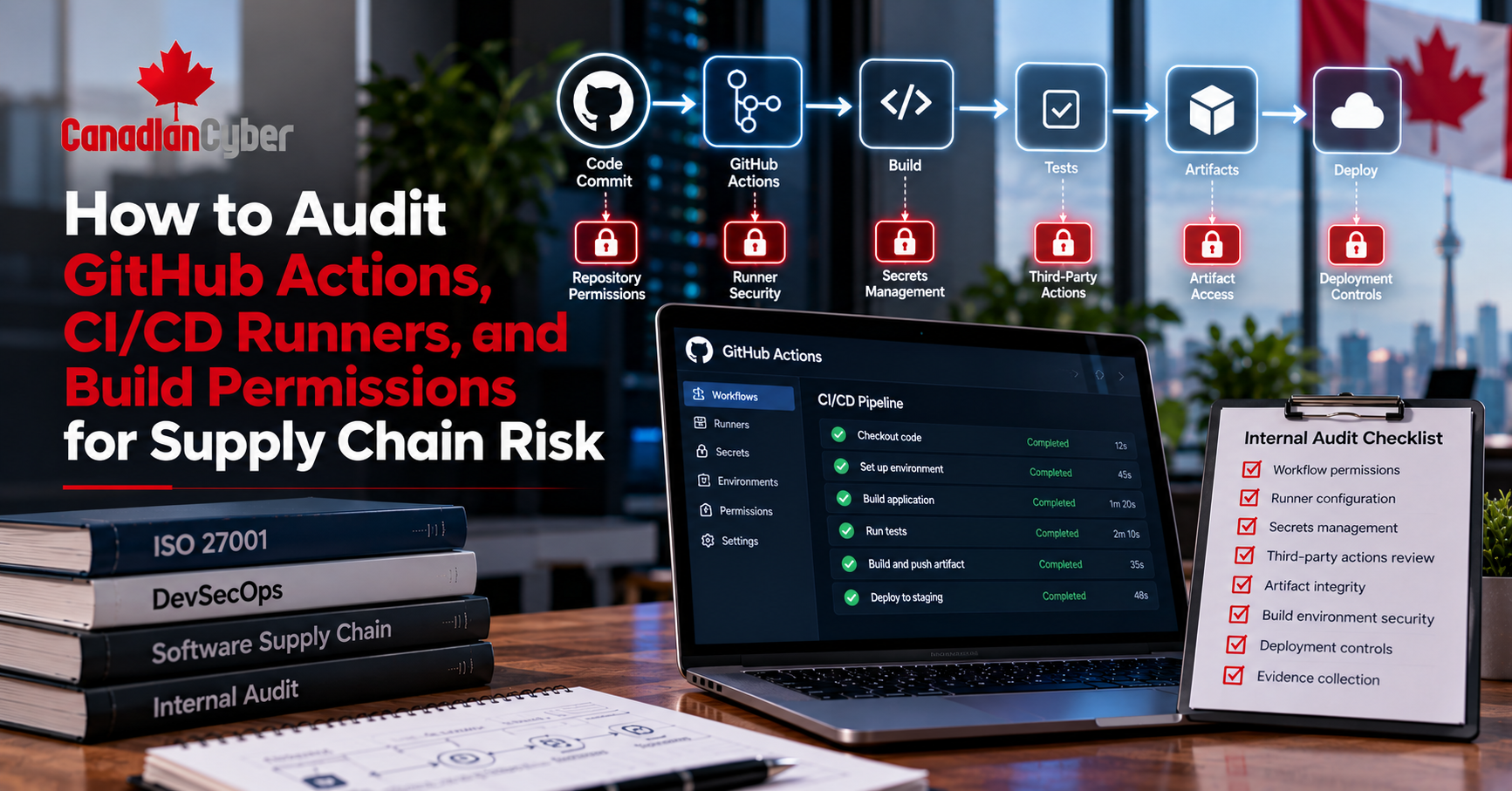
For SaaS companies, CI/CD is often part of the control environment because deployment pipelines can change application logic, authorization rules, infrastructure settings, secrets, API behavior, and tenant isolation controls.
What to include in the implementation:
- source control access
- branch protection
- code review
- deployment approvals
- secrets handling
- infrastructure-as-code review
- production release controls
Scope Failure #4: Underestimating Third-Party Integrations
Many SaaS platforms rely on vendors for cloud hosting, email delivery, payment processing, customer support, analytics, file storage, authentication, monitoring, notifications, and AI or automation features.
Some vendors only support internal work. Others directly affect customer data or platform availability. The implementation should identify which third parties materially affect the SaaS service.
| Vendor Detail | Why to Track It |
|---|---|
| Vendor name | Identifies the service dependency |
| Service provided | Shows how the vendor supports the SaaS platform |
| Data handled | Clarifies whether customer or tenant data is involved |
| Access level | Determines potential security and privacy impact |
| Criticality | Supports risk ranking and review frequency |
| Security review status | Shows whether vendor risk has been reviewed and evidenced |
Segmentation: The Other Half of the Problem
Scope defines what the ISMS covers. Segmentation proves customers are protected inside that scope.
For multi-tenant SaaS, segmentation is one of the most important control areas because buyers and auditors want confidence that one tenant cannot access or affect another.
Segmentation is not only a database design issue. It includes:
- application authorization
- API access
- customer roles
- admin permissions
- support access
- logging
- exports
- backups
- analytics
- integrations
What Good Tenant Segmentation Looks Like
Good segmentation usually includes:
- tenant-aware authorization checks
- role-based customer permissions
- secure API scoping
- restricted internal admin access
- tenant-scoped exports and reports
- separation of production and non-production environments
- controlled support access
- logging of privileged tenant actions
- testing for cross-tenant access risks
Need Proof That Tenant Segmentation Works?
Canadian Cyber helps SaaS teams review tenant isolation, authorization checks, support access, analytics exposure, and evidence needed for ISO 27001 audits.
Segmentation Failure #1: Authorization Checks Are Too Informal
A common SaaS issue is relying on assumptions in application logic. For example, tenant ID is passed by the client, object ownership is not checked consistently, admin endpoints behave differently, list endpoints filter correctly but export endpoints do not, or internal APIs bypass normal controls.
Better practice:
- enforce tenant context server-side
- test object-level authorization
- review high-risk endpoints
- restrict admin override paths
- log sensitive tenant access
- include tenant isolation in security testing
Segmentation Failure #2: Support Can Bypass Tenant Boundaries
Support access is often necessary, but it must be controlled. Common problems include broad support visibility across all tenants, user impersonation without approval or logging, screenshots saved outside controlled systems, temporary access that never expires, and no review of support permissions.
Better practice:
- limit support access by role
- require approval for elevated access
- log impersonation or sensitive support actions
- review support access regularly
- minimize customer data in tickets
- restrict downloads and exports
Segmentation Failure #3: Analytics and Reporting Break Tenant Boundaries
Analytics often creates hidden segmentation risk. Data may be copied from production into warehouses, dashboards, BI tools, reporting exports, and product analytics systems.
If access is too broad, tenant-separated production data can become widely visible in analytics.
Better practice:
- minimize tenant-identifying data where possible
- restrict analytics access
- segment dashboards by business need
- control exports
- review access to BI tools
- define retention for derived datasets
Segmentation Failure #4: Non-Production Uses Real Customer Data
Many SaaS companies create risk by using production-like data in staging, QA, development, demos, and troubleshooting environments. This can weaken segmentation and privacy controls.
Better practice:
- use synthetic or masked data where possible
- restrict production data use in non-production
- document approved exceptions
- apply access controls to any non-production environment containing real data
- delete temporary copies after use
Evidence Auditors and Buyers Want to See
| Evidence Type | What It Proves |
|---|---|
| ISMS scope statement | Boundary is defined |
| Architecture diagram | Systems and data flows are understood |
| Data flow map | Customer data locations are known |
| Access matrix | Internal and customer access is controlled |
| Support access logs | Sensitive support actions are traceable |
| Authorization test results | Tenant isolation is tested |
| CI/CD controls | Changes affecting segmentation are reviewed |
| Vendor register | Dependencies are governed |
A Practical Implementation Checklist
Before moving too far into ISO 27001, multi-tenant SaaS companies should ask:
- Is the ISMS scope specific enough?
- Are support tools included if they touch customer data?
- Are logs, backups, analytics, and exports reviewed?
- Are CI/CD and cloud admin paths included?
- Are material vendors identified?
- Can we explain tenant segregation clearly?
- Are tenant isolation controls tested?
- Are support and admin actions logged?
- Is non-production data use controlled?
- Can we show evidence for all of the above?
Build an Audit-Ready SaaS ISMS Foundation
We help SaaS companies define scope, map customer data flows, review segmentation controls, and structure evidence before the audit process becomes stressful.
Canadian Cyber’s Take
At Canadian Cyber, we often see multi-tenant SaaS companies delay ISO 27001 progress because they begin with policies before they fully understand scope and segmentation.
That creates rework.
The strongest implementations usually start by mapping:
- what service is actually in scope
- where customer data lives
- which teams and tools can affect it
- how tenant boundaries are enforced
- which support and admin paths need control
- what evidence proves segmentation works
Takeaway
For multi-tenant SaaS companies, ISO 27001 implementation depends heavily on two things:
Clear scope and strong segmentation.
Scope defines the security management boundary. Segmentation proves customers are protected inside that boundary.
The biggest failures happen when companies define scope too vaguely, forget support tools or CI/CD, assume tenant separation without testing it, allow reporting workflows to bypass tenant boundaries, or use real customer data in non-production without enough control.
How Canadian Cyber Can Help
We help multi-tenant SaaS companies implement ISO 27001 in a way that reflects real platform architecture, customer data flows, and shared-environment risk.
- ISO 27001 scoping workshops
- tenant segmentation and access-control reviews
- SaaS data-flow and system-boundary mapping
- support and admin access governance
- CI/CD and cloud control alignment
- vendor and evidence structure design
- vCISO guidance for SaaS audit readiness and customer trust
Stay Connected With Canadian Cyber
Follow Canadian Cyber for practical guidance on ISO 27001, SaaS security, tenant segmentation, vCISO strategy, and audit readiness.