vCISO • Vendor Risk • Supply Chain Security • Third-Party Risk • Customer Trust
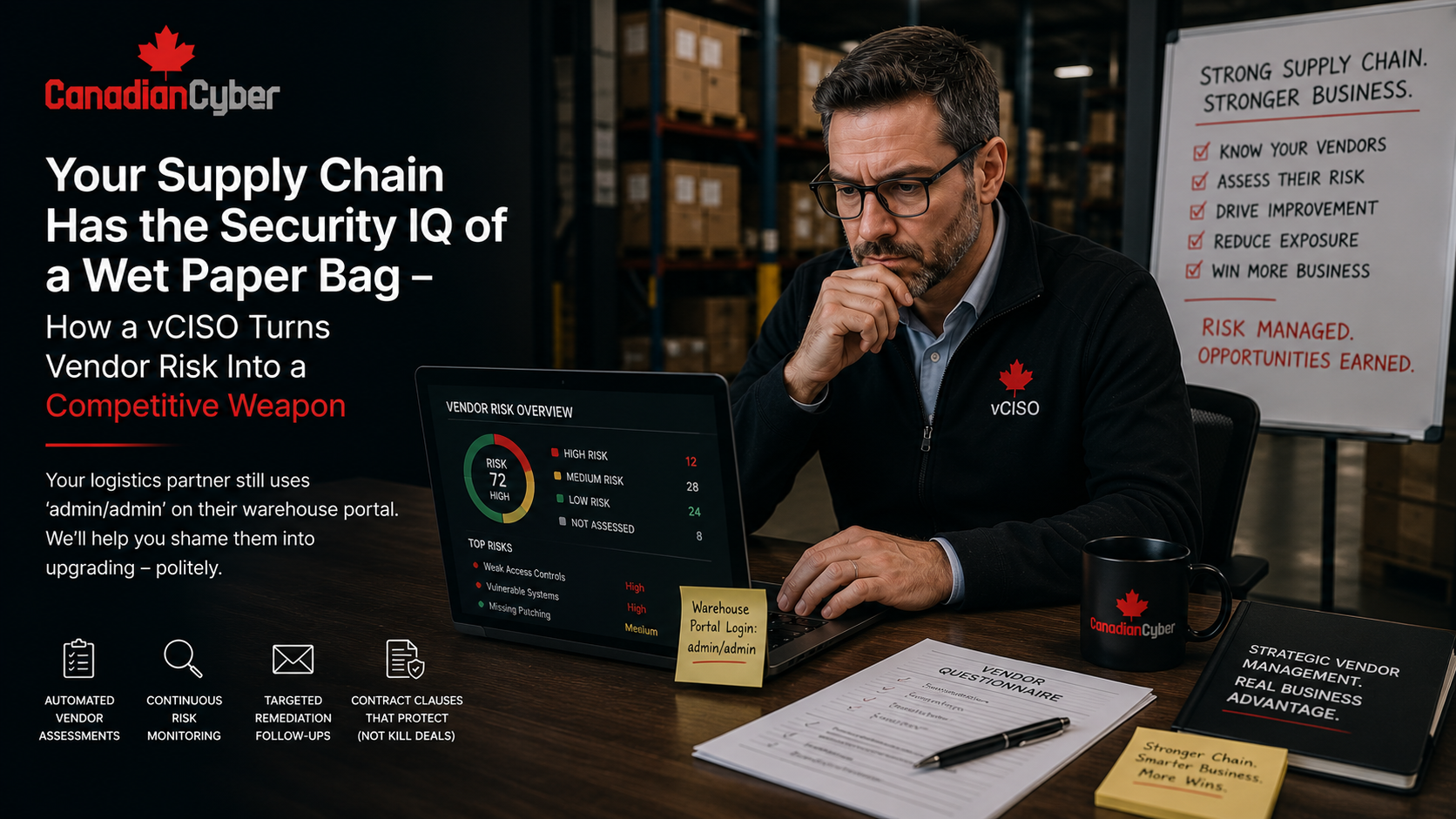
Your Supply Chain Has the Security IQ of a Wet Paper Bag — How a vCISO Turns Vendor Risk Into a Competitive Weapon
Your logistics partner still uses admin/admin. Your SaaS vendor has not updated their SOC 2 report since the last ice age. Your critical supplier says they have MFA, but only for finance because “IT is complicated.” This is where a vCISO turns vendor chaos into customer trust.
Quick Snapshot
| Vendor Risk Area | What Usually Goes Wrong |
|---|---|
| Vendor Questionnaires | Sent once, ignored forever, and stored in a random folder. |
| Remediation Follow-Up | Vendors promise fixes, but nobody tracks them. |
| Contract Clauses | Security terms are missing, vague, or so aggressive they delay deals. |
| Critical Vendors | High-risk vendors are treated the same as low-risk tools. |
| vCISO Role | Turns vendor risk into a repeatable, evidence-backed trust program. |
Introduction
Your company may have strong security.
MFA is enforced. Backups are tested. Policies are approved. SOC 2 is underway. ISO 27001 is on the roadmap. Your board deck looks less embarrassing than last quarter.
Then a customer asks:
“How do you manage third-party risk across your supply chain?”
Suddenly, the room gets quiet.
Because your weakest vendor may be the easiest path into your business.
Customers now care about your vendors because they are not only buying your product or service. They are inheriting your supply chain.
A vCISO helps turn vendor risk from a messy questionnaire exercise into a competitive weapon. That means better vendor tiers, faster reviews, smarter contract clauses, remediation follow-ups, customer-ready evidence, and a security story that makes buyers trust you faster.
Want Vendor Risk to Help Close Deals?
Canadian Cyber helps organizations build vendor risk programs, questionnaire workflows, supplier evidence packs, contract security requirements, remediation trackers, and vCISO-led customer trust materials.
The Problem: Vendor Risk Is Usually Fake Until Something Breaks
Most companies have a vendor list.
That is not the same as a vendor risk program.
A vendor list tells you who you pay. A vendor risk program tells you who can hurt you.
| Vendor List | Vendor Risk Program |
|---|---|
| Name of vendor | Vendor criticality |
| Contract owner | Security owner |
| Renewal date | Review date |
| Cost | Data handled |
| Department | Access level |
| Folder of documents | Approval decision and remediation plan |
A vendor list is admin. A vendor risk program is security governance.
The Wet Paper Bag Problem
Your vendor risk process may be weak if:
- vendor reviews happen only during audits
- critical vendors are not tiered
- SOC 2 reports are collected but not read
- security questionnaires are sent but not followed up
- vendors with customer data are not tracked
- MSPs have broad access but no review
- contract clauses are copied from templates
- customer due diligence answers are inconsistent
That is how vendor risk becomes a liability instead of a trust signal.
Why Customers Now Care About Your Entire Chain
Enterprise buyers have learned a painful lesson.
A company can have strong internal controls and still be exposed through a supplier.
That is why customer security reviews now ask questions like:
- Do you maintain a vendor register?
- Do you risk-rate vendors?
- Do vendors process customer data?
- Do you require breach notification?
- Do you review SOC 2 or ISO evidence?
- Do you track remediation?
- Do you monitor vendor access?
- Do you have contractual security clauses?
Buyers no longer ask only, “Are you secure?” They ask, “Are the companies you depend on secure enough for us to depend on you?”
The vCISO Mindset: Stop Treating Vendor Risk Like Paperwork
A weak vendor risk process is passive.
A strong vCISO makes it active.
| Passive Vendor Risk | vCISO-Led Vendor Risk |
|---|---|
| Send questionnaire. | Tier the vendor. |
| Receive vague answers. | Define data exposure and access level. |
| Upload PDF. | Review assurance evidence. |
| Mark vendor approved. | Assign remediation and conditions. |
| Forget until next year. | Track follow-up and report risk to leadership. |
Vendor risk is not only about avoiding bad vendors. It is about proving to customers that you manage dependencies better than your competitors.
Vendor Tiering: Stop Reviewing the Coffee Vendor Like AWS
Not every vendor deserves the same review.
If you review every vendor with a 200-question security questionnaire, the process will fail.
Your office snack supplier does not need the same review as your cloud provider. Unless the snack supplier is somehow running your production database. In which case, please call us immediately.
| Tier | Vendor Type | Review Depth |
|---|---|---|
| Tier 1 | Critical vendor with customer data, production access, or major dependency. | Full security review. |
| Tier 2 | Important vendor with limited sensitive data or operational impact. | Standard review. |
| Tier 3 | Low-risk vendor with no sensitive data and no system access. | Lightweight review. |
| Tier 4 | Commodity vendor with no security relevance. | Basic procurement record. |
Tier 1 Examples
- cloud provider
- payment processor
- managed IT provider
- customer support platform
- identity provider
- production monitoring tool
- file transfer provider
- AI vendor handling sensitive data
- development platform with source code access
Practical rule: Review based on risk, not based on how loudly procurement asks for the contract to be signed.
Need a Risk-Tiered Vendor Register?
Canadian Cyber can help you classify suppliers, identify critical vendors, map data exposure, review MSP and AI vendors, and build a vendor risk register that supports audits and customer trust.
The Vendor Questionnaire Hack: Automate the Boring, Escalate the Risky
Vendor questionnaires are useful. But they are often handled badly.
A questionnaire should not be a giant PDF that disappears into a folder. It should feed a decision.
| Step | What Happens |
|---|---|
| 1 | Vendor is classified by tier. |
| 2 | Questionnaire is assigned based on risk level. |
| 3 | Vendor answers are reviewed by owner or vCISO. |
| 4 | Gaps are flagged and evidence is requested. |
| 5 | Risk decision is recorded. |
| 6 | Remediation items and next review date are tracked. |
What to Automate
- vendor intake form
- risk tier assignment
- questionnaire routing
- reminder emails
- evidence collection
- approval workflow
- remediation follow-ups
Automation should move the process. Humans should make the risk decision.
The Remediation Follow-Up Nobody Does
Here is where most vendor risk programs fall apart.
The vendor says:
- “We are working on MFA.”
- “We plan to complete SOC 2 next year.”
- “We are improving logging.”
- “We do not support SSO yet.”
- “We will review encryption settings.”
Then nobody follows up.
Six months later, the same risk is still open.
| Tracker Field | Purpose |
|---|---|
| Vendor Name | Tracks supplier. |
| Finding | What is weak. |
| Required Action | What must change. |
| Owner | Vendor or internal owner. |
| Due Date | Prevents drift. |
| Evidence Needed | Proof of remediation. |
A vendor promise is not a control. A tracked remediation with evidence is.
Automate Vendor Reviews Without Losing Risk Judgment
Canadian Cyber helps teams automate vendor questionnaires, approval workflows, remediation tracking, review dates, and vendor evidence management in SharePoint or compliance platforms.
The “Shame Them Politely” Strategy
Your logistics partner still uses admin/admin.
You cannot send them a message that says, “Your portal has the security IQ of a wet paper bag.”
Tempting. But not helpful.
A vCISO knows how to apply pressure without killing the relationship.
Polite pressure language:
“Our customer security obligations require us to confirm that vendors with access to operational or customer-related systems use named accounts, MFA, and basic access controls. We need your team to confirm the remediation timeline and provide evidence when completed.”
A good remediation email includes:
- what gap exists
- why it matters
- what control is required
- what evidence is needed
- deadline
- business impact if unresolved
Contract Clauses That Do Not Kill Deals
Security clauses matter.
But if they are unrealistic, legal negotiations slow down.
A vCISO helps create clauses that are strong enough to protect the business and practical enough to close deals.
| Clause Area | What It Should Cover |
|---|---|
| Security Controls | MFA, access control, encryption, and baseline safeguards. |
| Breach Notification | Required timing and communication process. |
| Sub-processors | Approval or notice requirements. |
| Data Return / Deletion | What happens at termination. |
| AI / Data Use | Restrictions on training models or using customer data. |
| Compliance Evidence | SOC 2, ISO 27001, questionnaire, or equivalent evidence. |
Contract requirements should match actual vendor risk. A 40-page security addendum for a low-risk vendor is not strategy. It is a deal killer.
Turning Vendor Risk Into a Sales Advantage
This is the part most companies miss.
A strong vendor risk program can help sales.
When enterprise buyers ask how you manage suppliers, your answer should not be, “We send questionnaires.”
Better answer:
“We maintain a risk-tiered vendor register. Critical vendors are reviewed before approval and at least annually. Reviews include data handled, service criticality, assurance evidence, security controls, contractual terms, remediation items, approval decisions, and next review dates. Vendor risks are tracked and reported through our security governance process.”
Customer Trust Pack Vendor Section
- sub-processor list
- vendor review summary
- critical vendor process
- assurance review method
- breach notification expectations
- AI vendor rules, if relevant
- vendor risk owner process
Build a Customer Vendor Trust Pack
Canadian Cyber helps organizations build customer-ready vendor risk summaries, sub-processor lists, critical vendor review summaries, and security review responses that support enterprise sales.
The vCISO Vendor Risk Dashboard
Vendor risk needs visibility.
Not just a spreadsheet. A vCISO dashboard should show what leadership needs to know.
| Dashboard Area | What It Shows |
|---|---|
| Critical Vendors | Tier 1 suppliers and status. |
| Overdue Reviews | Vendors past review date. |
| Open Remediation | Supplier gaps needing follow-up. |
| Data Exposure | Vendors handling sensitive or customer data. |
| Customer Impact | Vendors relevant to enterprise due diligence. |
If leadership cannot see vendor risk, vendor risk is not governed.
The MSP and Managed Service Provider Problem
MSPs deserve special attention.
They often have broad access to email, identity, endpoints, backups, firewalls, cloud settings, admin accounts, security tools, and incident response support.
That makes them a critical vendor.
| MSP Review Question | Why It Matters |
|---|---|
| Who has admin access from the MSP? | Privileged access risk. |
| Is MFA enforced for MSP accounts? | Account takeover risk. |
| Are MSP actions logged? | Accountability. |
| Are backups monitored and tested? | Ransomware recovery. |
| Are security responsibilities documented? | Avoids ownership gaps. |
If your MSP has the keys to your kingdom, do not review them like a low-risk vendor.
AI Vendors: The New Supply Chain Headache
AI tools are now part of supply chain risk.
They may process:
- source code
- customer support tickets
- meeting transcripts
- contracts
- internal documentation
- client data
- logs and prompts
| AI Vendor Question | Why It Matters |
|---|---|
| Is customer data used for training? | Data leakage risk. |
| Can prompts be retained? | Confidentiality risk. |
| Where is data stored? | Data residency. |
| Does the tool support SSO? | Access control. |
| Can data be deleted? | Retention and privacy. |
Vendor Risk Evidence Pack
A strong vendor risk program needs evidence.
| Evidence | What It Proves |
|---|---|
| Vendor Register | Complete supplier view. |
| Risk Tiering Method | Reviews are based on risk. |
| Critical Vendor Reviews | Tier 1 vendors assessed. |
| SOC 2 / ISO Review Notes | Assurance was reviewed, not just collected. |
| Remediation Tracker | Gaps are followed up. |
| Management Review Summary | Leadership visibility. |
Evidence Naming Examples
- VendorRisk-CriticalVendorRegister-2026-Q2.xlsx
- VendorRisk-MSP-PrivilegedAccessReview-2026-Q2.pdf
- VendorRisk-SupportTool-SOC2Review-2026-Q1.pdf
- VendorRisk-LogisticsPortal-MFARemediation-2026-Q2.pdf
- VendorRisk-AIVendor-DataUseReview-2026-Q2.pdf
Need Vendor Risk Evidence for SOC 2, ISO 27001, or Enterprise Buyers?
Canadian Cyber helps teams build vendor risk evidence packs, supplier review notes, remediation trackers, MSP reviews, AI vendor reviews, and customer-ready trust materials.
The Strategic Narrative: From Liability to Differentiator
A weak vendor risk program says:
“We hope our vendors are fine.”
A strong vendor risk program says:
“We know which vendors matter, what data they touch, what controls they have, what gaps remain, and what we are doing about it.”
| Buyer Concern | Strong Vendor Risk Answer |
|---|---|
| Who processes our data? | Here is our sub-processor list. |
| Are vendors reviewed? | Critical vendors are reviewed before approval and annually. |
| What if a vendor has a breach? | Contracts include notification requirements. |
| Are vendor gaps tracked? | Remediation items are tracked to closure. |
| Can you prove this? | Evidence is stored in our vendor risk evidence pack. |
Common Vendor Risk Mistakes
- Mistake 1: Sending the same questionnaire to every vendor. Risk-tier the vendor first.
- Mistake 2: Collecting SOC 2 reports without reviewing them. A stored report is not a risk decision.
- Mistake 3: Forgetting remediation follow-up. Vendor promises need owners and dates.
- Mistake 4: Ignoring vendors with system access. Access risk can be more important than data storage.
- Mistake 5: Letting procurement own security alone. Procurement can manage contracts. Security must review risk.
- Mistake 6: Using aggressive clauses for low-risk vendors. Match terms to risk.
- Mistake 7: Not preparing customer-ready answers. Vendor risk can support sales if packaged properly.
What Good Looks Like
A strong vCISO-led vendor risk program has:
- vendor inventory
- risk tiering
- data handling records
- critical vendor reviews
- MSP access review
- AI vendor review
- security questionnaire workflow
- assurance review notes
- contract security terms
- remediation tracker
- approval decisions
- sub-processor list
- customer trust summary
- leadership dashboard
The goal is not to make every vendor perfect. The goal is to know where the risk is and manage it intentionally.
Canadian Cyber’s Take
At Canadian Cyber, we often see organizations with decent internal security and weak vendor governance.
They have MFA. They have backups. They have policies. They have endpoint protection. They have SOC 2 or ISO 27001 goals.
But vendor risk is still handled through emails, spreadsheets, and hope.
That is not enough anymore.
Customers now expect you to understand your supply chain. Auditors expect evidence. Insurers ask about vendors. Enterprise buyers ask about sub-processors. AI tools are adding new third-party exposure.
A vCISO helps turn this mess into a practical system. Tier vendors. Review the critical ones. Track gaps. Negotiate reasonable clauses. Follow up on remediation. Prepare customer-ready evidence.
That is how vendor risk becomes a competitive weapon instead of a wet paper bag.
Takeaway
Your supply chain can either weaken your security story or strengthen it.
If vendors are unmanaged, they create risk. If vendors are reviewed, tiered, tracked, and evidenced, they become part of your trust story.
Start with critical vendors. Identify who touches customer data. Review who has system access. Automate questionnaires. Track remediation. Use contract clauses that match risk. Prepare customer-ready answers. Show leadership the vendor dashboard.
Do not wait for a vendor breach to discover your supply chain has no backbone. Build the program now.
How Canadian Cyber Can Help
Canadian Cyber helps organizations turn vendor risk into a practical, customer-ready security program.
- vCISO-led vendor risk programs
- third-party risk assessments
- vendor questionnaire automation
- vendor register design
- critical vendor reviews
- MSP security reviews
- AI vendor reviews
- sub-processor list preparation
- contract security requirement design
- vendor remediation tracking
- customer trust pack development
- SOC 2 vendor evidence
- ISO 27001 supplier security controls
- SharePoint vendor risk workspaces
- management review reporting
Stay Connected With Canadian Cyber
Follow Canadian Cyber for practical guidance on vCISO leadership, vendor risk, third-party security, SOC 2, ISO 27001, SharePoint ISMS, customer trust, and supply chain governance.