Incident Response • Business Impact Analysis • BIA • Cyber Resilience • vCISO
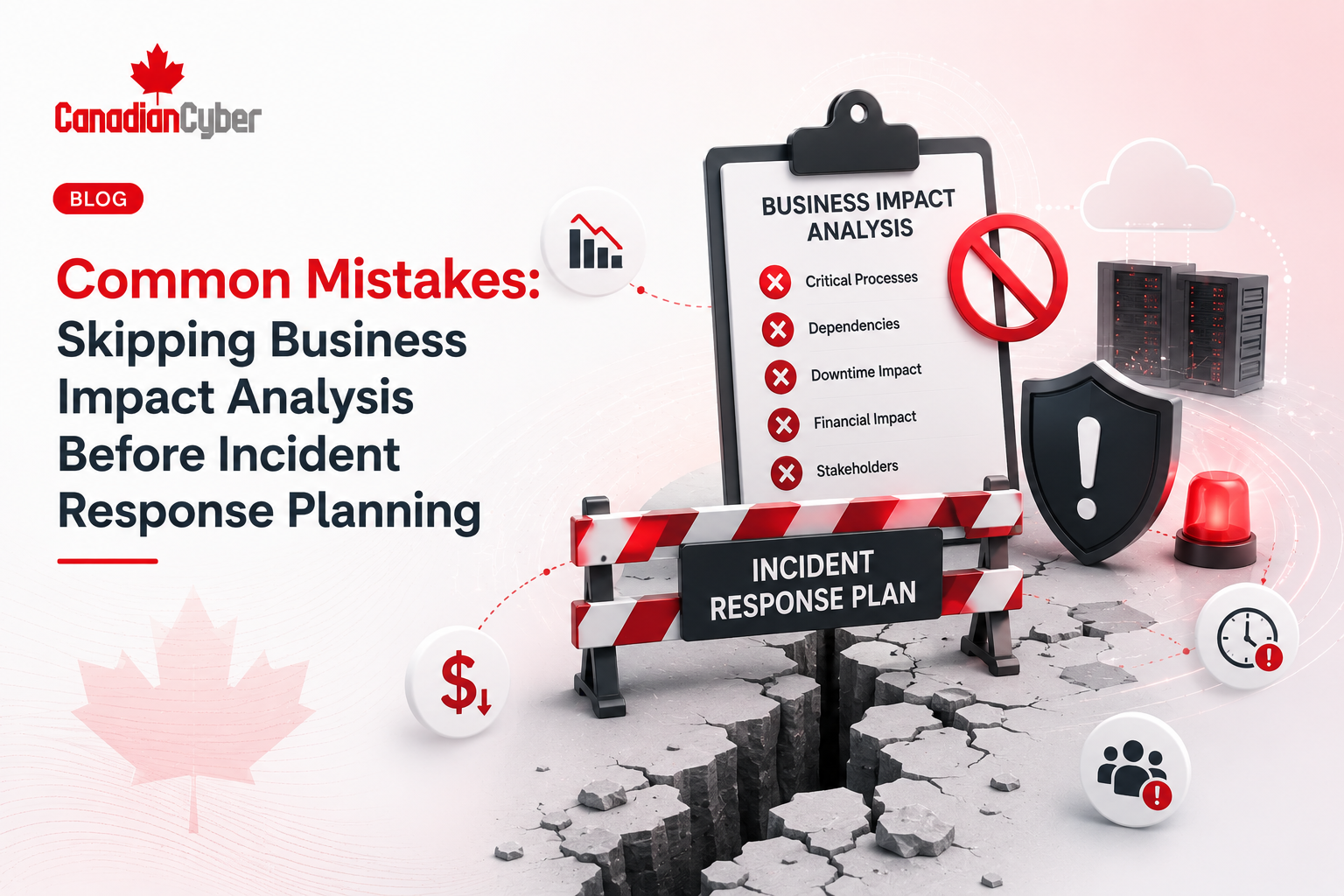
Common Mistakes: Skipping Business Impact Analysis Before Incident Response Planning
An incident response plan without a Business Impact Analysis is like a fire drill where nobody knows which room has the oxygen tanks, payroll records, customer contracts, or production systems. You may have a plan, but you may still protect the wrong things first.
Quick Snapshot
| Area | Why It Matters |
|---|---|
| Business Impact Analysis | Identifies critical services, systems, data, people, vendors, and recovery priorities. |
| Incident Response Plan | Defines how the organization detects, escalates, contains, communicates, and recovers. |
| Common Mistake | Writing the incident response plan before understanding business impact. |
| Main Risk | Teams respond technically but miss customer, legal, financial, operational, or reputation impact. |
| Best Outcome | Incident response decisions are based on business priority, not panic. |
Introduction
Many organizations start incident response planning with a template.
The template looks good. It includes roles, escalation, severity levels, containment steps, communication guidance, and a post-incident review.
But one important question is often missing.
What actually matters most to the business during a cyber incident?
That is where Business Impact Analysis comes in.
A Business Impact Analysis, or BIA, helps identify which services, systems, teams, vendors, data, and workflows are most critical to the organization.
Without it, incident response can become reactive. IT may restore the easiest system first. Executives may focus on the loudest customer. Legal may miss notification obligations. Operations may discover too late that a small system supports a critical service.
Need Incident Response That Matches Business Risk?
Canadian Cyber helps organizations run Business Impact Analysis, incident response planning, ransomware tabletop exercises, backup readiness reviews, and vCISO-led cyber resilience programs.
What Is Business Impact Analysis?
Business Impact Analysis identifies how disruption affects the business.
It helps answer:
- Which services are critical?
- Which systems support those services?
- Which data must be protected or restored first?
- Which customers are most affected?
- Which vendors are essential?
- Which legal or contractual obligations apply?
- How long can the business tolerate disruption?
- What recovery order makes sense?
| Business Impact Analysis | Incident Response Plan |
|---|---|
| Identifies what matters most. | Defines how to respond. |
| Sets recovery priorities. | Coordinates containment and recovery. |
| Maps systems to business services. | Assigns response roles. |
| Defines tolerance for downtime. | Defines escalation and communication. |
| Highlights customer and legal impact. | Guides notification and decision-making. |
Simple rule: BIA tells you what to protect first. Incident response tells you how to respond. You need both.
Mistake 1: Treating All Systems as Equal
During a cyber incident, not every system deserves the same priority. But without a BIA, teams may treat everything as urgent.
That creates chaos.
Imagine ransomware affects several systems:
- file server
- customer portal
- HR system
- billing platform
- internal wiki
- backup console
- support ticketing system
| System | Business Impact | Priority |
|---|---|---|
| Customer Portal | Customers cannot access service. | Critical |
| Backup Console | Required for recovery. | Critical |
| Support Ticketing | Customer communication and incident tracking. | High |
| Billing Platform | Revenue impact if outage continues. | Medium |
| HR System | Important but not immediate. | Lower |
| Internal Wiki | Useful but not critical. | Lower |
Criticality should be decided before the incident, not during the incident.
Mistake 2: Writing Severity Levels Without Business Context
Many incident response plans include severity levels: critical, high, medium, and low.
But those levels are often defined only by technical impact. That is not enough.
A low technical issue can still have high business impact.
| Severity Factor | Example |
|---|---|
| Customer Impact | Customers cannot access the platform. |
| Data Sensitivity | Confidential or personal data exposed. |
| Operational Impact | Core service disrupted. |
| Financial Impact | Revenue processing unavailable. |
| Legal Impact | Notification obligations triggered. |
| Recovery Impact | Backups or identity systems affected. |
| Reputation Impact | Public incident or media attention. |
Severity is not only technical. Severity is business impact plus technical risk.
Mistake 3: Not Knowing Recovery Time Expectations
Incident response needs recovery targets.
Two common terms matter:
| Term | Meaning |
|---|---|
| RTO | Recovery Time Objective. How quickly a system or service should be restored. |
| RPO | Recovery Point Objective. How much data loss is acceptable. |
| Service | RTO | RPO |
|---|---|---|
| Customer Portal | 4 hours | 15 minutes |
| Payment Processing | 2 hours | 5 minutes |
| Support Ticketing | 8 hours | 1 hour |
| HR Platform | 3 days | 24 hours |
| Internal Wiki | 5 days | 24 hours |
Without recovery expectations, IT may not know what recovery success looks like. The business may expect recovery in four hours, while backups and restore testing only support recovery in two days.
Need Help Defining RTO, RPO, and Recovery Priorities?
Canadian Cyber can help map critical services, recovery expectations, backup capabilities, customer impact, and incident response priorities.
Mistake 4: Assuming Backups Are Enough
Backups are not a business continuity plan. They are one part of recovery.
A BIA helps determine whether backups match business needs.
| Question | Why It Matters |
|---|---|
| Which systems need backups? | Defines scope. |
| Which data must be restored first? | Supports recovery order. |
| How fast must systems recover? | Defines RTO. |
| How much data loss is acceptable? | Defines RPO. |
| Are backups protected from ransomware? | Supports recovery confidence. |
| Have restores been tested? | Provides evidence of readiness. |
A backup that cannot meet business recovery needs is not enough. Test restoration against real business priorities.
Mistake 5: Ignoring Customer and Contract Impact
Cyber incidents are not only internal problems.
They can affect customers, partners, regulators, insurers, and contracts. A BIA helps identify these obligations before the incident.
| Customer Impact Question | Why It Matters |
|---|---|
| Which customers depend on this service? | Prioritizes communication. |
| Are there contractual uptime commitments? | Creates legal and business risk. |
| Are notification timelines defined? | Prevents missed obligations. |
| Are regulated customers affected? | Increases sensitivity. |
| Is there a public status page commitment? | Supports communications planning. |
| Are customer data types known? | Supports privacy and breach assessment. |
Your incident response plan should know which customer obligations matter before the incident starts.
Mistake 6: Leaving Legal Out of the BIA
Legal is often added late. That is a mistake.
Legal should help identify:
- contractual notification requirements
- privacy obligations
- regulatory reporting expectations
- cyber insurance conditions
- data processing terms
- vendor obligations
- customer commitments
- privilege considerations
Legal should help define impact, not only review messages after the incident.
Mistake 7: Forgetting Vendor Dependencies
A business service may depend on several vendors. Without BIA, those dependencies stay hidden.
| Business Service | Vendor Dependency |
|---|---|
| Customer Portal | Cloud provider, identity provider, CDN. |
| Payment Workflow | Payment processor, bank API, fraud tool. |
| Support Operations | Ticketing platform, email provider. |
| Remote Monitoring | IoT platform, telecom provider, cloud logging. |
| Payroll | HRIS, payroll vendor, banking integration. |
Ask these vendor questions:
- Which vendors support critical services?
- Who is the emergency contact?
- What are their response commitments?
- Do contracts include incident notification?
- Can they provide logs?
- Are vendor access rights reviewed?
Build a BIA That Connects Systems, Vendors, and Recovery
Canadian Cyber can help build a Business Impact Analysis that connects critical services, systems, vendors, data, and recovery priorities to your incident response plan.
Mistake 8: Not Mapping Data Sensitivity
Incident response depends heavily on data impact.
A BIA should identify which services and systems contain sensitive data, such as:
- customer data
- personal information
- payment data
- health information
- employee data
- legal files
- financial records
- source code
- API keys
- AI prompts and model outputs
| Data Type | Incident Impact |
|---|---|
| Customer Data | Customer trust, contracts, notification. |
| Personal Information | Privacy obligations. |
| Payment Data | Financial and regulatory impact. |
| Source Code | Intellectual property and security risk. |
| API Keys | Credential compromise. |
| AI Prompts / Outputs | Confidentiality and privacy risk. |
You cannot assess breach impact quickly if you do not know what data lives where.
Mistake 9: Creating an Incident Plan That Does Not Match Reality
Some incident response plans look good but do not match how the business actually works.
| Plan Says | Reality |
|---|---|
| Incident commander will lead. | Nobody knows who that is. |
| Backups will be restored. | No restore test exists. |
| Customers will be notified. | No customer list or template exists. |
| Legal will review. | Legal contact is not in the plan. |
| Vendors will support recovery. | Vendor contacts are missing. |
| Logs will be reviewed. | Logs are not retained long enough. |
A BIA helps make the plan real. Incident response should be based on actual business operations, not ideal assumptions.
Mistake 10: Skipping Tabletop Exercises After BIA
BIA is not the end. It should feed tabletop exercises.
| Critical Area | Tabletop Scenario |
|---|---|
| Customer Portal | Cloud outage or account compromise. |
| Backup System | Ransomware affects recovery environment. |
| Payment Workflow | Payment processor breach. |
| Support Platform | Customer data exposure in tickets. |
| OT / Field System | Remote monitoring disruption. |
| AI Platform | Customer prompt or output exposure. |
If the tabletop does not test critical business services, it is too generic.
What a Good BIA Should Include
| BIA Core Field | Purpose |
|---|---|
| Business Service | What the organization provides. |
| Process Owner | Who owns the service. |
| Supporting Systems | Technology dependencies. |
| Supporting Vendors | Supplier dependencies. |
| Data Types | Sensitive or regulated information. |
| Customer Impact | Who is affected. |
| Legal / Contract Impact | Notification or SLA obligations. |
| RTO and RPO | Recovery time and acceptable data loss. |
| Recovery Priority | Order of restoration. |
BIA to Incident Response Checklist
Use this before finalizing your incident response plan.
| Question | Yes / No |
|---|---|
| Are critical business services identified? | |
| Are system dependencies mapped? | |
| Are vendor dependencies mapped? | |
| Are sensitive data types identified? | |
| Are RTO and RPO defined? | |
| Are customer impacts documented? | |
| Are legal and contractual obligations included? | |
| Are recovery priorities defined? | |
| Are backup capabilities aligned with recovery needs? | |
| Are tabletop scenarios based on BIA results? |
If several answers are “no,” your incident response plan may be missing business context.
Common Warning Signs
Your organization may have skipped BIA if:
- IT decides recovery order alone.
- Every system is marked critical.
- No one knows customer notification requirements.
- Restore testing does not match business expectations.
- Legal is not involved until after the incident.
- Vendor dependencies are not mapped.
- Executives cannot name the most critical services.
- Tabletop scenarios feel generic.
- Incident severity is based only on technical impact.
What Good Looks Like
A strong BIA-supported incident response plan can show:
- critical services
- system dependencies
- vendor dependencies
- data sensitivity
- customer impact
- RTO and RPO
- recovery order
- executive decision points
- legal obligations
- communication needs
- backup alignment
- tabletop scenarios
- corrective actions
The response plan becomes practical because it is based on the business, not just technology.
Canadian Cyber’s Take
At Canadian Cyber, we often see organizations with incident response plans that look complete but lack business context.
They know who to call. They know how to open an incident ticket. They know how to isolate a laptop. They know who manages backups.
But they do not know which services must recover first, which customers are most affected, which contracts trigger notification, which vendors are critical, or which systems support revenue.
That gap matters. Business Impact Analysis connects cyber response to business reality. It helps executives make better decisions, helps IT recover in the right order, helps legal assess obligations, and helps communications speak clearly.
Takeaway
Do not build incident response planning on guesswork.
Start with Business Impact Analysis:
- identify critical services
- map systems and vendors
- classify data
- define recovery expectations
- identify legal and customer impact
- prioritize restoration
- test the plan through tabletop exercises
- track gaps to closure
An incident response plan tells you how to respond. A Business Impact Analysis tells you what matters most. You need both.
How Canadian Cyber Can Help
Canadian Cyber helps organizations connect Business Impact Analysis with incident response, resilience, audit readiness, and executive decision-making.
- Business Impact Analysis workshops
- incident response plan development
- ransomware tabletop exercises
- executive incident response training
- backup and restore evidence reviews
- RTO and RPO planning
- critical service mapping
- vendor dependency mapping
- customer notification planning
- cyber insurance readiness
- ISO 27001 incident and continuity evidence
- SOC 2 incident response evidence
- vCISO support for cyber resilience
Stay Connected With Canadian Cyber
Follow Canadian Cyber for practical guidance on Business Impact Analysis, incident response, cyber resilience, SOC 2, ISO 27001, SharePoint ISMS, vCISO leadership, and evidence management.