ISO 27001 • Implementation Timeline • Certification Readiness • 30-60-90-180 Day Plan
ISO 27001 Implementation Timeline: 30, 60, 90, and 180-Day Paths Compared
ISO 27001 implementation can move quickly, but it should not be rushed blindly. The right timeline depends on your scope, maturity, evidence quality, internal resources, customer pressure, and certification goals.
Canadian Cyber ISO 27001 Implementation Support
Choose the Right ISO 27001 Timeline Before the Project Starts
Canadian Cyber helps organizations build realistic ISO 27001 roadmaps, complete gap assessments, implement ISMS controls, prepare internal audit evidence, support management review, and create SharePoint ISMS workspaces inside Microsoft 365.
Quick Answer
An ISO 27001 implementation timeline can range from 30 to 180 days or more depending on company size, scope, maturity, documentation quality, evidence readiness, internal resources, control gaps, and certification goals.
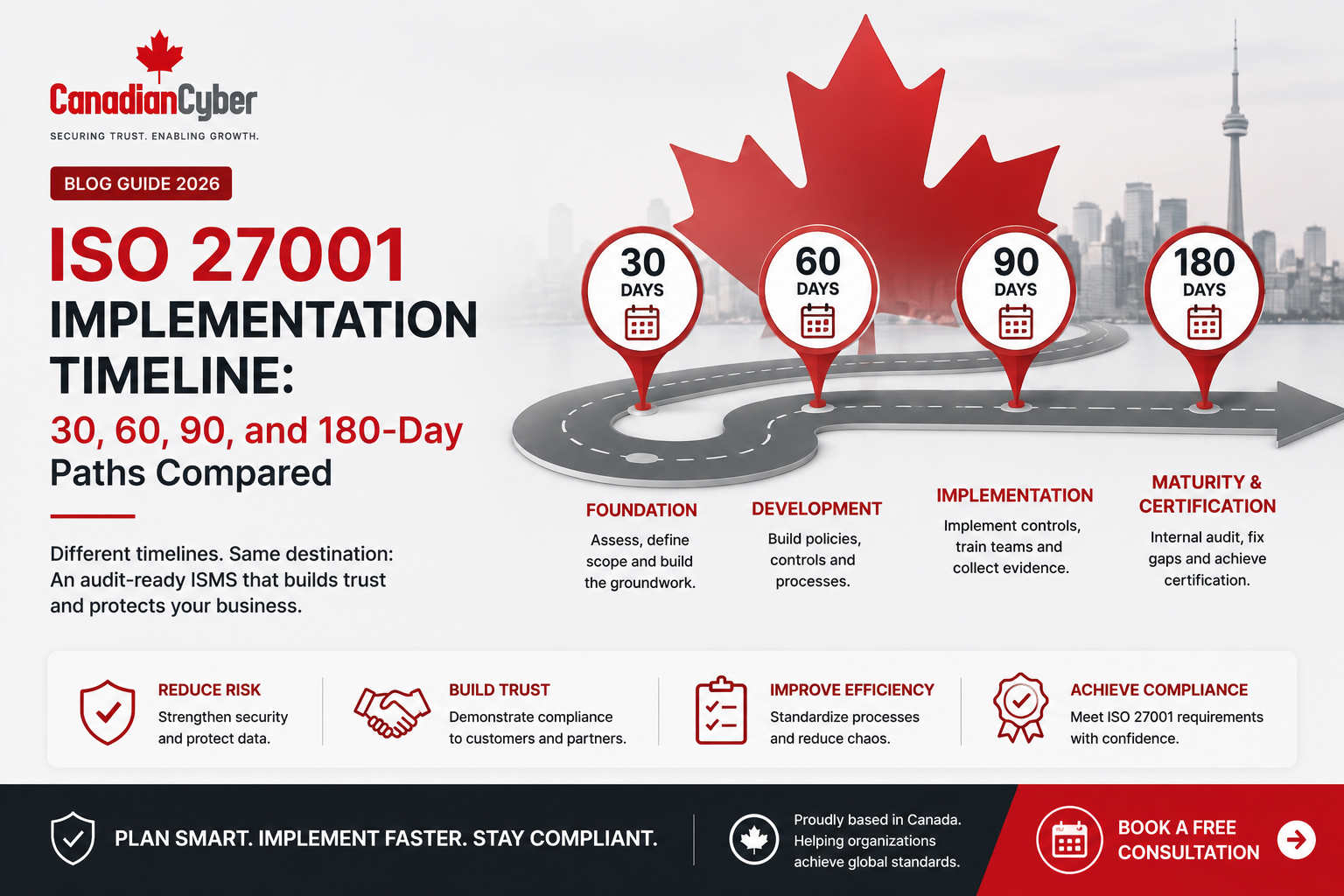
A 30-day path is usually best for a gap assessment or urgent readiness sprint. A 60-day path can build the ISMS foundation. A 90-day path is often realistic for focused implementation. A 180-day path is usually stronger for certification readiness and long-term ISMS maturity.
Practical takeaway: The best timeline is not always the shortest one. It is the one that creates enough evidence to support the audit and enough structure to maintain the ISMS after certification.
Quick Snapshot
| Timeline | Best For | Main Risk |
|---|---|---|
| 30 Days | Gap assessment, urgent customer response, focused readiness sprint. | Too short for full control operation. |
| 60 Days | Core ISMS setup, policies, risk assessment, evidence structure. | May still need more evidence before certification. |
| 90 Days | Practical implementation for focused-scope organizations. | Requires strong internal ownership. |
| 180 Days | Stronger certification readiness and sustainable ISMS maturity. | Longer timeline requires disciplined project management. |
How Long Does ISO 27001 Implementation Take?
ISO 27001 implementation is one of the most important cybersecurity and trust-building projects a growing company can start. It helps organizations build a formal Information Security Management System, manage security risks, organize policies, prepare evidence, improve customer trust, and get ready for certification.
Some companies want to move fast because an enterprise customer is asking for certification. Others need a realistic roadmap because they have limited internal resources. Some simply want to understand whether 30, 60, 90, or 180 days is practical before committing budget and leadership time.
ISO 27001 can be accelerated, but it should not be rushed blindly.
The goal is not to finish quickly on paper. The goal is to build an ISMS that works, proves control operation, satisfies auditors, supports customers, and continues after certification.
Who This Guide Is For
- SaaS companies preparing for ISO 27001 certification.
- Canadian SMBs trying to win enterprise clients.
- Founders and CEOs planning an ISO 27001 project.
- CTOs and IT managers responsible for implementation.
- Compliance leads building an ISMS roadmap.
- Organizations comparing ISO 27001, SOC 2, and customer security requirements.
- Security leaders deciding between a fast sprint and a sustainable implementation plan.
Why the ISO 27001 Timeline Matters Now
ISO 27001 is no longer only an internal security initiative. It is connected to sales, procurement, customer trust, cyber insurance, vendor risk, privacy, cloud security, board oversight, and enterprise due diligence.
A delayed ISO 27001 project can affect:
security questionnaire responses
vendor onboarding
cyber insurance renewal evidence
investor due diligence
customer trust
audit readiness
management accountability
At the same time, rushing ISO 27001 can create weak documentation, poor evidence, unclear ownership, and audit findings.
Practical rule: ISO 27001 implementation should be fast enough to support business goals and structured enough to survive an audit.
What Happens During ISO 27001 Implementation?
ISO 27001 implementation means building an Information Security Management System, also called an ISMS. An ISMS is the governance system used to manage information security risks, controls, responsibilities, evidence, audits, and continual improvement.
| Activity | What It Means |
|---|---|
| Scope Definition | Define which services, systems, teams, locations, and data are included. |
| Gap Assessment | Compare current practices against ISO 27001 requirements. |
| Risk Assessment | Identify and evaluate information security risks. |
| Statement of Applicability | Document which Annex A controls apply and why. |
| Policy Development | Create and approve required policies and procedures. |
| Control Implementation | Put controls into practice across access, vendors, assets, incidents, backups, training, and more. |
| Evidence Collection | Store proof that controls are operating. |
| Internal Audit | Review whether the ISMS is implemented and effective. |
| Management Review | Leadership reviews risks, performance, issues, and improvement needs. |
| Corrective Actions | Track and resolve findings before certification. |
Practical rule: The timeline depends on how much already exists and how much must be built from scratch.
The 30-Day ISO 27001 Path
A 30-day ISO 27001 path is best for a focused readiness sprint, not a full from-scratch implementation. It can work when the company already has many controls in place and needs to organize scope, gaps, risks, evidence, and a roadmap quickly.
A 30-day timeline may work if:
- the scope is narrow
- leadership is available
- key documents already exist
- security controls are already operating
- evidence can be collected quickly
- the company needs a customer-facing roadmap
- the goal is readiness, not immediate certification
| Week | Focus |
|---|---|
| Week 1 | Scope definition, kickoff, document request, initial gap assessment. |
| Week 2 | Risk assessment, control review, policy review, evidence structure. |
| Week 3 | Statement of Applicability draft, priority remediation plan, owner assignments. |
| Week 4 | Readiness report, roadmap, evidence workspace, management briefing. |
A 30-day ISO 27001 path is useful for speed and clarity, but risky if treated as full certification readiness from scratch.
The 60-Day ISO 27001 Path
A 60-day ISO 27001 path can build the core ISMS foundation. This timeline works for companies that need momentum but still want enough time to document risks, policies, controls, evidence owners, and remediation priorities.
| Phase | Days | Key Activities |
|---|---|---|
| Phase 1 | Days 1–10 | Kickoff, scope, stakeholder mapping, document collection. |
| Phase 2 | Days 11–25 | Gap assessment, risk assessment, policy review. |
| Phase 3 | Days 26–40 | SoA, control register, evidence library, owner assignments. |
| Phase 4 | Days 41–55 | Remediation planning, access reviews, vendor reviews, incident response updates. |
| Phase 5 | Days 56–60 | Leadership review, readiness dashboard, next-step roadmap. |
Typical 60-day deliverables include:
gap assessment report
risk register
risk treatment plan
SoA draft
policy library
control register
evidence library
owner matrix
remediation tracker
Need Senior ISO 27001 Timeline Guidance?
Canadian Cyber helps organizations choose the right ISO 27001 implementation path based on urgency, current maturity, certification goals, and internal capacity.
The 90-Day ISO 27001 Path
A 90-day ISO 27001 path is often the most practical accelerated implementation timeline for growing companies. It gives enough time to define the ISMS, complete risk work, build policies, assign owners, collect evidence, address priority gaps, and prepare for internal audit.
| Timeline | Focus | Outcomes |
|---|---|---|
| Days 1–30 | Scope, gap assessment, risk assessment, ISMS planning. | Clear roadmap, risks, scope, documentation priorities. |
| Days 31–60 | Policies, controls, SoA, evidence setup, owner assignments. | ISMS structure, control mapping, evidence library. |
| Days 61–90 | Remediation, internal audit prep, management review prep. | Stronger readiness, evidence status, corrective actions. |
Practical rule: A 90-day path works best when the organization treats ISO 27001 as a weekly operating priority, not a side project.
The 180-Day ISO 27001 Path
A 180-day ISO 27001 path is often the strongest option for organizations that want a more sustainable ISMS. It gives the company more time to implement controls properly, collect evidence, train employees, conduct access reviews, review vendors, test incident response, complete internal audit, hold management review, and close corrective actions before certification.
| Phase | Timeline | Key Activities |
|---|---|---|
| Phase 1 | Days 1–30 | Scope, gap assessment, project plan, evidence workspace. |
| Phase 2 | Days 31–60 | Risk assessment, SoA, policy development. |
| Phase 3 | Days 61–90 | Control implementation, access reviews, vendor reviews. |
| Phase 4 | Days 91–120 | Evidence collection, incident response tabletop, training records. |
| Phase 5 | Days 121–150 | Internal audit, management review, corrective actions. |
| Phase 6 | Days 151–180 | Certification readiness review, evidence cleanup, audit preparation. |
The 180-day path gives time for:
stronger control operation
employee training
leadership engagement
internal audit maturity
vendor review completion
risk treatment progress
less last-minute pressure
30 vs 60 vs 90 vs 180 Days: Which Path Should You Choose?
| Timeline | Best For | What You Can Achieve | Main Limitation |
|---|---|---|---|
| 30 Days | Gap assessment, customer roadmap, urgent readiness sprint. | Scope, gaps, risks, roadmap, evidence structure. | Not enough for full implementation from scratch. |
| 60 Days | ISMS foundation. | Policies, risk assessment, SoA, control register, evidence setup. | Limited time for control operation. |
| 90 Days | Accelerated implementation. | Core ISMS, evidence collection, remediation, internal audit prep. | Requires strong commitment. |
| 180 Days | Sustainable certification readiness. | Full ISMS cycle, internal audit, management review, corrective actions. | Requires longer planning and discipline. |
What Affects the ISO 27001 Implementation Timeline?
- Scope size: A narrow SaaS product scope may move faster than an organization-wide scope.
- Current maturity: Existing SOC 2 evidence, policies, access reviews, and vendor reviews can speed up the project.
- Leadership availability: ISO 27001 requires management involvement for risk decisions and management review.
- Control owner response time: HR, IT, engineering, legal, operations, support, and management must respond on time.
- Evidence quality: Scattered evidence across email, Teams, folders, and personal drives slows implementation.
- Remediation needs: Major gaps in MFA, access reviews, vendors, backups, and incident response can extend the timeline.
- Tooling: A structured SharePoint ISMS can reduce delays by centralizing evidence, owners, risks, controls, and review tasks.
Practical Checklist: Choose Your ISO 27001 Timeline
Use this checklist to decide whether 30, 60, 90, or 180 days is realistic.
| Question | Yes / No |
|---|---|
| Is your ISO 27001 scope clearly defined? | |
| Do you already have approved security policies? | |
| Do you have a current risk register? | |
| Do you have a Statement of Applicability draft? | |
| Are MFA, access reviews, backups, and incident response controls already operating? | |
| Do you have vendor review evidence? | |
| Is evidence stored in a central workspace? | |
| Are control owners assigned? | |
| Can leadership attend risk and management review meetings? | |
| Can your team commit weekly time to implementation? |
If most answers are “no,” a 180-day path is usually safer than a 30- or 60-day sprint.
Common Mistakes to Avoid
- Choosing 30 days because of sales pressure. A rushed ISMS can create weak evidence and audit risk.
- Starting without scope. Scope drives timeline, cost, audit effort, and evidence.
- Writing policies before understanding risks. ISO 27001 should be risk-based.
- Treating evidence as an audit-week task. Evidence should be collected during implementation.
- No internal owner. Consultants can support the project, but someone inside the company must own the ISMS.
- Skipping internal audit preparation. Internal audit helps identify weaknesses before certification.
- Ignoring management review. Leadership must review ISMS performance, risks, incidents, and improvements.
- Not planning post-certification maintenance. ISO 27001 continues after certification.
How Canadian Cyber Helps
Canadian Cyber helps organizations choose and execute the right ISO 27001 implementation timeline.
We help companies move from scattered documents, unclear ownership, and customer pressure to structured implementation, centralized evidence, internal audit readiness, and certification confidence.
Canadian Cyber can support:
SharePoint ISMS for Faster ISO 27001 Implementation
Canadian Cyber’s ISMS SharePoint Solution can help organize policy libraries, risk registers, control registers, Statement of Applicability evidence, asset registers, vendor registers, evidence tasks, access review evidence, incident response records, internal audit evidence, corrective action trackers, management review dashboards, and auditor-ready views.
This helps reduce delays, improve ownership, and keep the ISO 27001 implementation timeline on track.
Frequently Asked Questions
How long does ISO 27001 implementation take?
ISO 27001 implementation can take 30 days for a focused readiness sprint, 60 days for an ISMS foundation, 90 days for accelerated implementation, or 180 days or more for stronger certification readiness. The right timeline depends on scope, maturity, evidence, and internal resources.
Can ISO 27001 be implemented in 30 days?
A 30-day ISO 27001 sprint can support gap assessment, scope definition, risk review, roadmap development, and evidence structure. It is usually not enough for full implementation from scratch unless the organization is already very mature.
Is 90 days enough for ISO 27001 certification?
Ninety days may be enough for focused implementation if the organization already has many controls in place, leadership is available, and evidence is organized. Certification readiness still depends on internal audit, management review, remediation, and certification-body scheduling.
What is the most realistic ISO 27001 timeline?
For many growing companies, 90 to 180 days is more realistic than 30 days. A 180-day path is often stronger when documentation, evidence, access reviews, vendor reviews, or control maturity need improvement.
What delays ISO 27001 implementation?
Common delays include unclear scope, missing policies, weak risk assessment, no control owners, scattered evidence, poor access review records, incomplete vendor reviews, leadership delays, and unresolved corrective actions.
Can SharePoint help speed up ISO 27001 implementation?
Yes. A structured SharePoint ISMS can centralize policies, risks, controls, evidence, owners, due dates, internal audit records, management review actions, and auditor-ready views.
Takeaway
ISO 27001 implementation timelines should be chosen carefully. A 30-day path can create quick clarity. A 60-day path can build the ISMS foundation. A 90-day path can support accelerated implementation. A 180-day path can build stronger certification readiness and long-term governance.
The best timeline depends on your scope, maturity, evidence quality, internal capacity, customer pressure, and certification goals.
The goal is not to finish quickly on paper. The goal is to build an ISMS that works, proves control operation, satisfies auditors, supports customers, and continues after certification.
Planning ISO 27001 Implementation?
Canadian Cyber can help you choose the right timeline before the project begins. We can assess your current state, define scope, build a 30-, 60-, 90-, or 180-day roadmap, implement your ISMS, prepare internal audit evidence, support management review, and create a SharePoint ISMS workspace inside Microsoft 365.
Stay Connected With Canadian Cyber
Follow Canadian Cyber for practical guidance on ISO 27001 implementation timelines, certification readiness, SOC 2, ISO 42001, ISO 27017, ISO 27018, SharePoint ISMS, cybersecurity assessments, audit evidence, and vCISO support.