Clause 6
Business Alignment
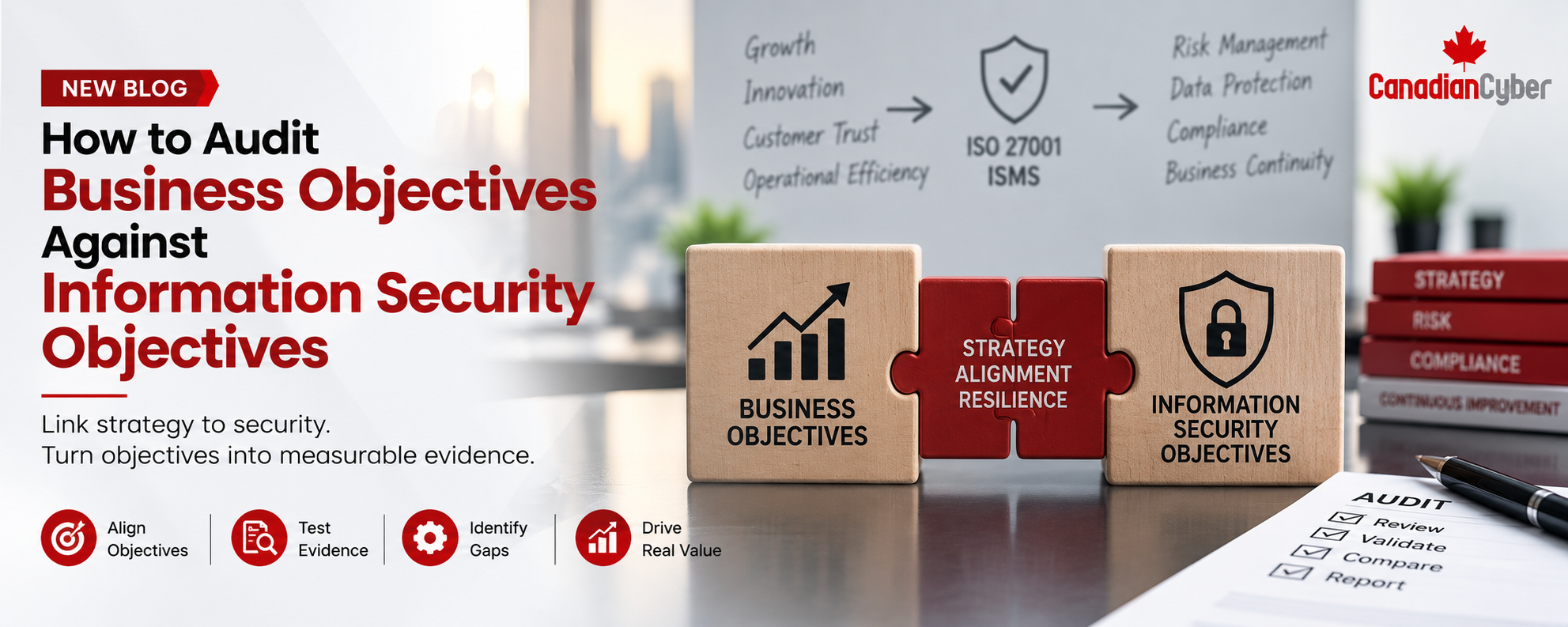
How to Audit Business Objectives Against ISO 27001 Information Security Objectives
Learn how to audit business objectives against ISO 27001 information security objectives with clear alignment, owners, metrics, risk links, leadership review, evidence, and certification readiness.
Quick Answer
How do you audit business objectives against ISO 27001 information security objectives?
To audit business objectives against ISO 27001 information security objectives, compare the organization’s strategic goals with its security objectives, risks, metrics, evidence, management review records, and corrective actions.
Strong alignment means each objective is measurable, owned, evidence-based, linked to risk, reviewed by leadership, and useful for business decisions.
The goal is simple: prove that security objectives support business priorities such as certification readiness, client trust, operational resilience, data protection, vendor oversight, cloud security, AI governance, and service continuity.
Security Objectives Should Support the Business
Information security objectives should not sit in a spreadsheet that no one reads.
They should support the business.
That is where many organizations struggle during ISO 27001 internal audits.
The security objectives may look complete.
However, internal audit should test whether those objectives actually support business reality.
Practical rule: information security objectives should help the business move safely, not slow it down with disconnected compliance tasks.
The Main Internal Audit Question
The strongest audit question is not, “Do we have information security objectives?”
A better question is:
Do our information security objectives support our business objectives, reduce meaningful risks, and produce measurable results that leadership reviews?
Quick Objectives Alignment Snapshot
| Audit Area | What Internal Audit Should Test |
|---|---|
| Business Objectives | Are strategic business goals documented and understood? |
| Security Objectives | Are information security objectives defined, measurable, and relevant? |
| Alignment | Do security objectives support business priorities? |
| Risk Link | Are objectives connected to risks and treatment actions? |
| Ownership | Is each objective assigned to a responsible owner? |
| Leadership Review | Does management review progress and make decisions? |
Why Business Alignment Matters
ISO 27001 should not create security activity for the sake of activity.
The ISMS should support the organization’s purpose, risk environment, client expectations, legal obligations, and business direction.
That means security objectives must connect to real business outcomes.
What Are ISO 27001 Information Security Objectives?
Information security objectives are measurable goals that help the organization manage and improve information security.
They should be relevant to the ISMS and aligned with business needs.
Practical rule: a security objective should be measurable enough that the organization can tell whether it was achieved.
What Are Business Objectives?
Business objectives are the organization’s strategic, commercial, operational, or service goals.
They may not use security language. However, they often depend on strong security.
Why This Audit Area Gets Missed
Many internal audits review security objectives as a standalone document.
That is not enough.
Step 1: Identify Current Business Objectives
Before testing security objectives, internal audit should identify the business objectives that matter.
This gives the auditor the context needed to judge whether security objectives are useful.
Evidence to Review
- Business strategy document.
- Leadership meeting notes.
- Management review minutes.
- Client security requirement register.
- Product roadmap.
- Certification project plan.
Common finding: business objectives changed, but information security objectives were not updated.
Step 2: Review the Information Security Objectives
Next, review the security objectives themselves.
Each objective should be measurable, owned, realistic, and supported by evidence.
| Objective Field | Good Objective Format |
|---|---|
| Objective | Complete quarterly access reviews for critical systems. |
| Owner | IT Manager. |
| Metric | 100% of critical systems reviewed quarterly. |
| Evidence | Access review records, exception list, removal tickets, and approval. |
| Business Link | Supports client trust, certification readiness, and unauthorized access risk reduction. |
Step 3: Map Security Objectives to Business Objectives
This is the key audit step.
The auditor should test whether the objectives connect.
| Business Objective | Supporting Information Security Objective |
|---|---|
| Win enterprise SaaS clients. | Maintain a client-ready ISO 27001 evidence pack and close high-risk findings before client review. |
| Achieve ISO 27001 certification. | Complete internal audit, management review, risk treatment, and corrective actions before external audit. |
| Reduce downtime. | Complete backup monitoring and restore testing for critical systems. |
| Launch AI-enabled features. | Approve AI use cases, review AI vendors, and update the AI risk register. |
| Support remote work. | Review endpoint security, remote access, MFA, and employee awareness. |
Practical rule: every major security objective should have a clear business reason.
Need to Align Security Objectives With Business Goals?
Canadian Cyber helps organizations audit ISO 27001 information security objectives against business objectives, risk registers, leadership priorities, evidence dashboards, and certification readiness needs.
We help turn security objectives into measurable, owner-ready, management-reviewed objectives that support real business outcomes.
Step 4: Test the Risk Connection
Security objectives should connect to risk.
If the organization has high-risk areas, objectives should help manage them.
Example:
Risk: Unauthorized access to customer data.
Security objective: Complete quarterly access reviews for all critical systems and remove unauthorized access within defined timelines.
Evidence: Access review reports, exception records, removal tickets, and approval.
Common finding: objectives exist, but they are not linked to current risks or risk treatment actions.
Step 5: Test Ownership and Accountability
Objectives need owners.
Without ownership, objectives become statements.
Audit Questions
- Who owns each security objective?
- Does the owner understand the objective?
- Does the owner have authority to act?
- Who provides evidence?
- Who reviews progress?
- Who escalates delays?
Practical rule: an objective should have one accountable owner, even if several teams contribute.
Step 6: Test Measurement and Evidence
Internal audit should verify how each objective is measured.
The evidence should prove whether the target was achieved.
| Objective | Metric | Evidence |
|---|---|---|
| Complete access reviews. | 100% of critical systems reviewed quarterly. | Access review sign-offs. |
| Review critical vendors. | 100% annual review completion. | Vendor review records. |
| Improve training completion. | 95%+ completion by due date. | Training report. |
| Review AI tools. | 100% approved AI tools inventoried. | AI tool register. |
| Test restore capability. | Annual restore test for critical systems. | Restore test report. |
Step 7: Review Management Oversight
Leadership should review information security objectives.
This is important because objectives support business priorities.
Step 8: Test Whether Objectives Drive Corrective Action
A missed objective should not be ignored.
Internal audit should test whether the organization responds.
Example:
Objective: Complete all critical vendor reviews by quarter-end.
Result: 70% completed.
Corrective action: Assign vendor owners, add review reminders, escalate overdue critical vendors, and update the vendor register.
Practical rule: a missed objective is useful only if it triggers learning and action.
Step 9: Check Whether Objectives Are Still Relevant
Objectives can become outdated.
The business may change, and the security objectives should change with it.
Strong Business-to-Security Alignment Examples
Enterprise Client Growth
Business objective: win enterprise clients and pass security due diligence faster.
Security objective: maintain an ISO 27001 evidence pack with current policies, access reviews, vendor reviews, risk register, SoA, incident evidence, and management review records.
Certification Readiness
Business objective: achieve ISO 27001 certification this year.
Security objective: complete internal audit, management review, corrective action closure, and high-risk evidence review before external audit.
AI Product Governance
Business objective: launch AI-enabled services responsibly.
Security objective: maintain AI tool inventory, approve AI use cases, review AI vendors, document data restrictions, and update AI-related risks.
Weak Objectives vs Strong Objectives
| Weak Objective | Strong Objective |
|---|---|
| Improve security. | Complete quarterly access reviews for all critical systems. |
| Train employees. | Achieve 95% security awareness completion by due date. |
| Manage vendors. | Complete annual security review for all critical vendors. |
| Control AI. | Review and approve all AI tools before business use. |
| Improve reporting. | Present security objectives dashboard at each management review. |
Common Internal Audit Findings
Corrective Action Examples
| Finding | Correction | Corrective Action |
|---|---|---|
| Objective not measurable. | Add metric and target. | Update objective-setting procedure. |
| No owner assigned. | Assign owner. | Add ownership field and review cadence. |
| Not linked to business goal. | Map objective to business priority. | Add business alignment review to management review. |
| Missed objective ignored. | Create corrective action. | Add missed-target escalation process. |
Internal Audit Checklist
Business Objective Review
- Business objectives are documented.
- Certification goals are identified.
- Client expectations are considered.
- Cloud, vendor, AI, and data risks are considered.
Security Objective Review
- Objectives are documented.
- Objectives are measurable.
- Objectives have owners.
- Objectives have evidence requirements.
Performance Review
- Progress is measured.
- Evidence supports status.
- Missed targets are reviewed.
- Management reviews progress.
SharePoint Evidence for Objectives Alignment
A SharePoint ISMS workspace can make objective alignment easier to audit.
It can connect objectives to owners, metrics, risks, evidence, corrective actions, and management review.
Track strategic goals and priorities.
Track owners, metrics, and targets.
Link objectives to key risks.
Track missed targets and remediation.
Link evidence to each objective.
Track leadership decisions and follow-up.
Practical rule: objectives should be visible, measurable, and connected to evidence.
Leadership Questions for Objectives Alignment
Leadership should be directly involved in reviewing objectives.
Management should review objectives as business performance indicators, not compliance decorations.
- Do our security objectives support current business goals?
- Which objectives help certification readiness?
- Which objectives help win or retain clients?
- Which objectives reduce our highest risks?
- Which objectives are overdue?
- Which objectives need resources?
- Which new objectives are needed because of AI, cloud, vendors, or market changes?
How Canadian Cyber Helps
Canadian Cyber helps organizations audit business objectives against ISO 27001 information security objectives.
We help build practical alignment between strategy, risk, evidence, leadership reporting, and certification readiness.
Frequently Asked Questions
What are information security objectives in ISO 27001?
Information security objectives are measurable goals that help the organization manage, monitor, and improve information security performance within the ISMS.
Why should security objectives align with business objectives?
Alignment ensures the ISMS supports business priorities such as certification readiness, client trust, operational resilience, data protection, vendor oversight, cloud security, and AI governance.
How do auditors test information security objectives?
Auditors review whether objectives are documented, measurable, owned, monitored, linked to risks, supported by evidence, reviewed by management, and updated when business priorities change.
What is an example of a good ISO 27001 security objective?
A good objective is: “Complete quarterly access reviews for all critical systems, including privileged, vendor, contractor, and service accounts, with documented exceptions and removal evidence.”
What is a weak security objective?
A weak objective is: “Improve access control.” It is too broad and does not define a measurable target, owner, date, or evidence requirement.
Should missed objectives create corrective actions?
Yes. Missed objectives should be reviewed. Depending on risk and impact, they may require root cause analysis, corrective action, management decision, resource support, or risk register updates.
Can SharePoint help track ISO 27001 objectives?
Yes. SharePoint can track objectives, owners, metrics, targets, review dates, evidence links, risk links, corrective actions, and management review dashboards.
Can Canadian Cyber help audit business and security objective alignment?
Yes. Canadian Cyber helps organizations review ISO 27001 information security objectives, align them with business goals, build dashboards, prepare management review evidence, and support certification readiness.
Takeaway
Information security objectives should not be isolated compliance statements.
They should help the business.
A strong internal audit tests whether objectives are measurable, owned, evidence-based, risk-linked, business-aligned, reviewed by leadership, and updated when business changes.
When objectives support business priorities, ISO 27001 becomes more than a certification project.
It becomes a management tool that helps leadership see whether security is supporting growth, trust, resilience, client confidence, cloud operations, vendor oversight, AI governance, and certification readiness.
Align ISO 27001 Objectives Before Internal Audit
Canadian Cyber can help your organization align business objectives with information security objectives, prepare management review evidence, improve security metrics, and build a SharePoint ISMS objectives dashboard.
We support ISO 27001 internal audits, objective alignment reviews, management review preparation, risk register alignment, SharePoint ISMS dashboards, corrective action tracking, vCISO support, SOC 2 readiness, ISO 42001, ISO 27017, ISO 27018, and cybersecurity assessments.
Stay Connected With Canadian Cyber
Follow Canadian Cyber for practical guidance on ISO 27001 internal audits, business objective alignment, information security objectives, certification readiness, SharePoint ISMS, corrective actions, SOC 2 readiness, AI governance, and vCISO services.