

Cybersecurity Awareness • Data Breach Response • Executives • Founders • Incident Response
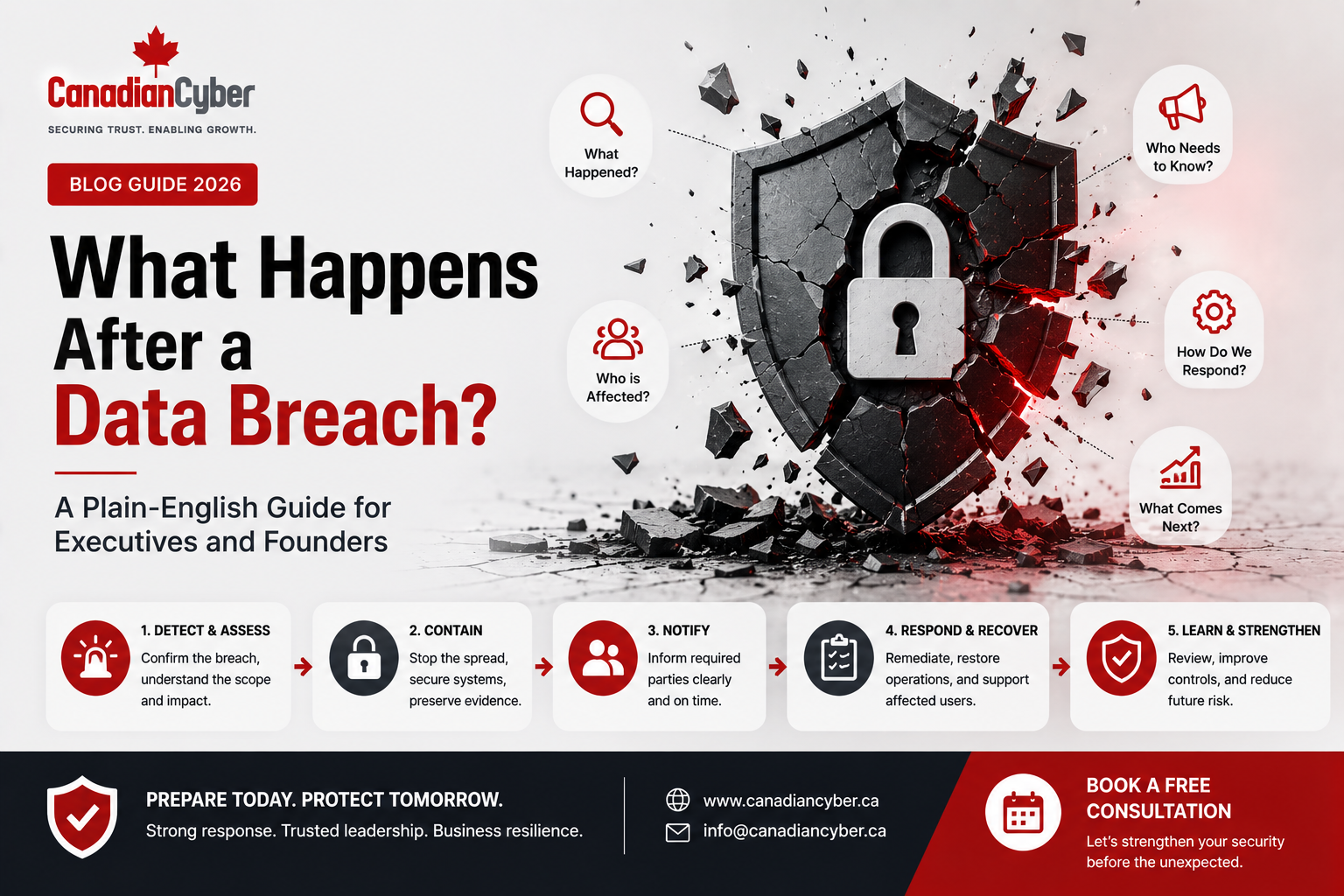
What Happens After a Data Breach? A Plain-English Guide for Executives and Founders
A data breach is not only an IT problem. It can affect operations, customers, contracts, insurance, compliance, reputation, revenue, and trust. This guide explains what executives and founders should expect after a breach and how to respond with calm accountability.
Quick Answer
After a data breach, the organization should contain the incident, preserve evidence, investigate what happened, identify affected data and systems, involve legal and insurance contacts, communicate carefully, notify required parties where applicable, fix the root cause, monitor for further activity, document decisions, and improve controls.
The goal is not panic. The goal is controlled response, clear accountability, and evidence-based decision-making.
Practical takeaway: The best breach response is planned, practiced, documented, and led by a prepared leadership team.
Quick Snapshot
| Breach Response Step | Executive Focus |
|---|---|
| Confirm the Incident | Understand whether this is suspicious activity, an incident, or a confirmed breach. |
| Activate the Team | Bring together IT, legal, privacy, finance, communications, insurance, and leadership. |
| Contain the Issue | Stop the incident from getting worse while balancing business continuity. |
| Preserve Evidence | Keep logs, alerts, emails, screenshots, access records, and decision timelines. |
| Communicate Carefully | Say what is known, avoid guessing, and involve legal where needed. |
| Improve Controls | Turn lessons learned into corrective actions and stronger governance. |
Why Executives Need to Understand Breach Response
A data breach is one of the most stressful moments a business can face. Systems may be down. Customer data may be exposed. Employees may be confused. Legal questions may appear quickly. Customers may start asking what happened. The leadership team may not know what to say first.
For executives and founders, the hardest part is not only the technical issue. The hardest part is making the right decisions while the situation is moving fast.
Technical teams may investigate systems, logs, accounts, malware, cloud activity, and access records. But executives must decide how the organization will protect customers, continue operations, involve legal and insurance, communicate responsibly, preserve evidence, and restore trust.
During a breach, leadership should not improvise. Leadership should follow a prepared incident response plan.
Who This Guide Is For
- Founders, CEOs, COOs, CFOs, and CTOs.
- Board members and business owners.
- Startup leaders and SaaS executives.
- Healthcare, FinTech, legal, accounting, and professional services firms.
- Companies without a full security team.
- Organizations preparing incident response plans.
- Teams preparing for ISO 27001, SOC 2, cyber insurance, or customer security reviews.
Step 1: Confirm Whether There Is an Incident
Not every alert is a breach. Sometimes the issue is a false alarm. Sometimes it is suspicious activity. Sometimes it is a confirmed data exposure. The first step is to understand what is happening.
Common warning signs include:
Practical rule: Do not call everything a breach too early, but do not ignore warning signs either.
Step 2: Activate the Incident Response Team
Once an incident appears credible, activate the right people. A breach response usually requires more than IT.
| Role | Responsibility |
|---|---|
| Executive Lead | Makes business decisions and approves major actions. |
| IT / Security Lead | Leads technical containment and investigation. |
| Legal Counsel | Advises on notification, privilege, contracts, and regulatory risk. |
| Privacy Lead | Reviews personal information impact. |
| Communications Lead | Prepares internal and external messaging. |
| Finance | Handles insurance, fraud, payments, and vendor costs. |
| External Forensics | Investigates complex or serious incidents. |
| Cyber Insurance Contact | Coordinates insurer requirements where applicable. |
Step 3: Contain the Breach
Containment means stopping the incident from getting worse. The right containment action depends on the incident and must be balanced against business continuity.
Contain first, but preserve evidence before making unnecessary destructive changes.
Step 4: Preserve Evidence
Evidence is critical. After a breach, the organization may need evidence for investigation, insurance, legal review, customer communication, regulators, auditors, or future litigation.
| Evidence to Preserve | Why It Matters |
|---|---|
| Logs and alerts | Shows activity, timing, and possible attacker behavior. |
| Emails and screenshots | Supports phishing, communication, and evidence review. |
| Access records | Shows which accounts accessed systems or data. |
| Cloud activity history | Helps identify changes, downloads, exposed storage, and admin actions. |
| Decision timeline | Shows leadership actions, approvals, and response sequence. |
Would Your Leadership Team Know What to Do After a Breach?
Canadian Cyber helps organizations prepare incident response plans, tabletop exercises, breach readiness assessments, and SharePoint ISMS incident evidence workspaces. For senior advisory support, you can also view Waqar Mehboob’s profile.
Step 5: Investigate What Happened
The investigation should answer the basic facts: how the attacker got in, which accounts were used, which systems were accessed, what data was viewed or copied, how long the attacker was present, whether malware was involved, and what root cause allowed the incident.
Common root causes include:
weak passwords
lack of MFA
unpatched systems
misconfigured cloud storage
compromised vendor
exposed API key
poor access control
Step 6: Identify What Data Was Affected
This is one of the most important steps. Notification decisions depend heavily on what data was affected and what evidence supports that conclusion.
| Data Type | Executive Question |
|---|---|
| Customer personal information | Which customers are impacted? |
| Employee personal information | Were employees affected? |
| Financial data | Does payment, invoice, or banking data require action? |
| Healthcare-related or PHI-adjacent data | Are healthcare customers, patients, or providers affected? |
| Credentials, API keys, or source code | Do secrets, keys, or code need to be rotated or protected? |
| Support tickets, logs, emails, or AI outputs | Did operational tools expose sensitive information? |
Step 7: Involve Legal and Insurance Early
Executives should not handle breach communication alone. Legal counsel can help determine notification obligations, contractual duties, privilege considerations, and wording. Cyber insurance may also have strict requirements, including early notice, approved vendors, documentation, and forensic coordination.
Before sending breach-related messages externally, involve legal and insurance contacts where applicable.
Step 8: Communicate Carefully
Communication can either build trust or create more damage. Executives should avoid guessing, minimizing, blaming, or overpromising.
| Good Communication | Avoid Saying |
|---|---|
| What is known and what is not yet known. | “There is no risk” before investigation is complete. |
| Who is leading the response. | “No data was affected” unless confirmed. |
| What actions are being taken. | “We are fully secure now” without validation. |
| How employees should report concerns. | “This will never happen again.” |
Step 9: Notify Required Parties Where Applicable
Some breaches may require notification. Notification requirements can depend on data type, location, industry, contracts, customers, regulators, and legal obligations.
affected individuals
business partners
regulators
insurers
law enforcement
auditors
vendors
Step 10: Restore Systems and Monitor Closely
After containment and investigation, the organization must restore normal operations safely. Do not rush restoration without confidence that the root cause has been addressed.
Step 11: Document the Timeline
A clear timeline helps leadership, legal, insurance, auditors, customers, and investigators understand the response. It should include when the incident started if known, when it was detected, who detected it, when response began, key decisions, containment actions, communications, restoration, root cause, corrective actions, and closure.
Step 12: Conduct Lessons Learned
After the urgent response is complete, the company should review what happened and what must improve. The breach response is not complete until lessons learned become corrective actions.
| Lessons Learned Output | Purpose |
|---|---|
| Lessons learned report | Documents what worked and what failed. |
| Corrective action plan | Turns gaps into assigned remediation tasks. |
| Updated incident response plan | Improves future response readiness. |
| Updated risk register | Connects the incident to risk management. |
| Management review input | Shows leadership oversight and continual improvement. |
Common Mistakes After a Data Breach
- Waiting too long to act. Delays can increase damage and reduce evidence quality.
- Letting too many people investigate. Uncoordinated investigation can destroy evidence and create confusion.
- Communicating too early without facts. Fast communication matters, but inaccurate communication can damage trust.
- Ignoring legal and insurance requirements. This can create avoidable legal, contractual, and financial problems.
- Not preserving logs. Logs often answer the most important breach questions.
- Assuming the first root cause is the only root cause. A phishing email may be the entry point, but deeper weaknesses may exist.
- Not testing backups before a crisis. Backups are only useful if they can be restored.
- Closing the incident without fixing the process. If the same weakness remains, the incident may happen again.
Executive Breach Readiness Checklist
| Item | Ready? |
|---|---|
| Incident response plan exists. | |
| Response roles are assigned. | |
| Legal contact is identified. | |
| Cyber insurance contact is documented. | |
| Forensic support option is identified. | |
| Customer communication process exists. | |
| Critical systems are identified. | |
| Backups are tested. | |
| MFA is enforced. | |
| Logs are retained. | |
| Access reviews are performed. | |
| Tabletop exercise has been completed. |
How Canadian Cyber Helps
Canadian Cyber helps organizations prepare for, respond to, and recover from cybersecurity incidents with practical, executive-friendly support.
Canadian Cyber can support:
SharePoint ISMS and Breach Evidence
Canadian Cyber’s ISMS SharePoint Solution can help organizations manage incident response evidence inside Microsoft 365.
It can organize the incident response plan, incident register, severity matrix, escalation contacts, decision timeline, evidence records, communication approvals, corrective actions, risk register updates, management review inputs, tabletop exercise evidence, policy updates, and client-ready security summaries.
Practical rule: A controlled SharePoint ISMS helps organizations prove that incidents are handled through a documented, auditable process.
Senior Advisory Support
For organizations that need senior guidance around breach readiness, incident response planning, executive decision-making, vCISO oversight, ISO 27001 readiness, cyber insurance readiness, SharePoint ISMS evidence management, and cybersecurity governance, Canadian Cyber also provides advisory support.
Frequently Asked Questions
What is the first thing executives should do after a data breach?
The first step is to confirm the situation, activate the incident response team, contain the issue, preserve evidence, and involve legal or insurance contacts where appropriate.
Should a company notify customers immediately after a breach?
Customers should be notified when required and when the company has enough verified information to communicate responsibly. Notification should be reviewed with legal counsel.
Is a data breach only an IT issue?
No. A data breach can affect legal, finance, operations, customers, insurance, contracts, compliance, reputation, and leadership decisions.
What evidence should be preserved after a breach?
Logs, alerts, emails, screenshots, access records, cloud activity, endpoint reports, communication records, and decision timelines should be preserved.
What is a post-incident review?
A post-incident review is a structured review after the incident to identify what happened, what worked, what failed, what controls need improvement, and what corrective actions must be completed.
Can Canadian Cyber help with breach readiness?
Yes. Canadian Cyber supports incident response planning, tabletop exercises, breach readiness assessments, cybersecurity assessments, vCISO services, ISO 27001 internal audits, and SharePoint ISMS incident evidence management.
Takeaway
A data breach is stressful, but panic makes it worse. Executives and founders do not need to know every technical detail, but they do need to understand the response process.
After a breach, the organization should confirm the incident, activate the response team, contain the issue, preserve evidence, investigate the cause, identify affected data, involve legal and insurance, communicate carefully, restore systems safely, document the timeline, complete lessons learned, and fix the root cause.
The best breach response is not improvised. It is planned, practiced, documented, and led with calm accountability.
Not Sure What Would Happen After a Data Breach?
Canadian Cyber can help you prepare before the pressure begins. We support incident response planning, tabletop exercises, cybersecurity assessments, vCISO services, ISO 27001 implementation, ISO 27001 internal audits, SOC 2 readiness, cyber insurance readiness, and SharePoint ISMS incident evidence management. You can also learn more about senior advisory support through Waqar Mehboob’s profile.
Stay Connected With Canadian Cyber
Follow Canadian Cyber for practical cybersecurity guidance on data breach response, incident response planning, tabletop exercises, ISO 27001, SOC 2, cyber insurance readiness, Microsoft 365 security, cybersecurity assessments, and vCISO support.