ISO 42001
AI Governance
Healthcare
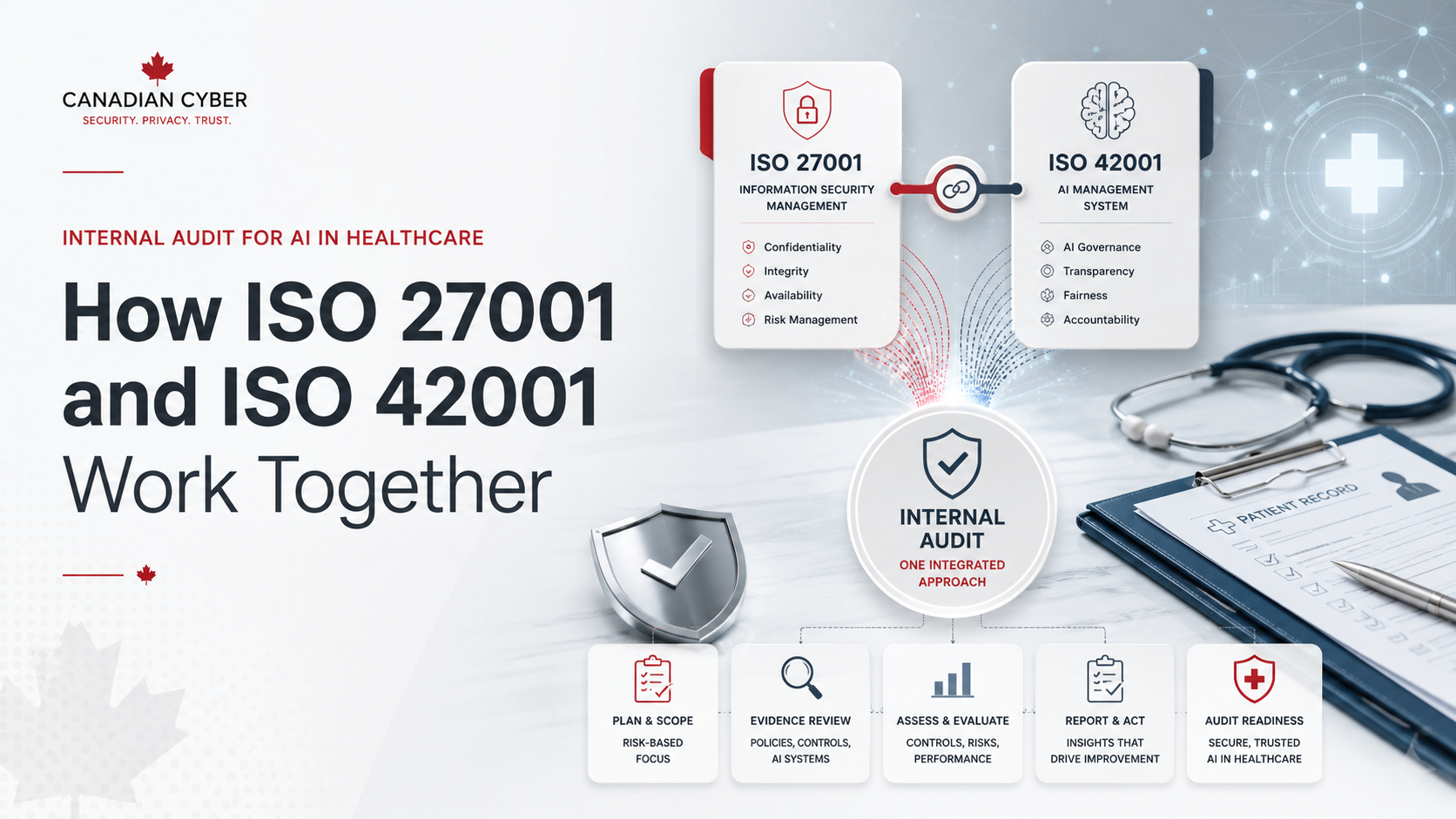
Internal Audit for AI in Healthcare: How ISO 27001 and ISO 42001 Work Together
Internal audit for AI in healthcare should test both information security and AI governance. ISO 27001 helps protect healthcare data. ISO 42001 helps govern AI systems.
Quick Answer
How do ISO 27001 and ISO 42001 work together for healthcare AI?
Healthcare organizations can use ISO 27001 and ISO 42001 together by auditing AI tools through two lenses.
ISO 27001 checks PHI protection, access control, vendor risk, cloud security, incident response, backups, logs, and risk management.
ISO 42001 adds AI governance. It helps check AI ownership, intended use, impact assessment, human oversight, vendor review, monitoring, accountability, and continual improvement.
Bottom line: internal audit for AI in healthcare should prove that AI tools are secure, governed, risk-assessed, monitored, and safe for patient-related workflows.
Canadian Cyber AI Audit Support
Audit Healthcare AI With ISO 27001 and ISO 42001 Readiness
Canadian Cyber helps healthcare and HealthTech organizations review AI tools, PHI handling, clinical workflows, AI vendors, access control, cloud apps, support tickets, human oversight, risk registers, and corrective actions.
We also help build SharePoint AI governance evidence workspaces for internal audits and hospital security reviews.
Quick Snapshot
| Audit Area | ISO 27001 Focus | ISO 42001 Focus |
|---|---|---|
| Patient Data | Protect PHI and clinical data. | Define whether AI can process sensitive data. |
| Access Control | Control user, admin, vendor, and cloud access. | Control who can use, approve, configure, and monitor AI tools. |
| Vendor Risk | Review suppliers and service providers. | Review AI providers, AI scribes, model providers, and subprocessors. |
| Risk Register | Track information security risks. | Track AI-specific risks, misuse, accuracy, bias, and accountability. |
| Human Review | Protect integrity and accountability. | Require human oversight before clinical, patient, or business use. |
| Evidence | Prove security controls are operating. | Prove AI governance and oversight are operating. |
Why AI in Healthcare Needs Internal Audit
AI is no longer a future healthcare topic.
It already appears in clinical documentation, patient support, appointment workflows, medical administration, analytics, chatbots, support ticket summaries, meeting transcripts, and HealthTech SaaS platforms.
AI can help teams work faster.
However, it also creates serious questions about PHI, vendors, human review, accuracy, training, incidents, risks, and audit evidence.
If AI touches patient data, clinical workflows, healthcare support, or HealthTech product features, it belongs in the internal audit plan.
Who This Blog Is For
- Healthcare providers, clinic networks, and telehealth providers.
- HealthTech companies, Healthcare SaaS vendors, and patient portal providers.
- AI health platforms, AI scribe providers, and clinical workflow software vendors.
- Privacy officers, security managers, IT managers, ISMS managers, AI governance leads, internal auditors, and vCISO teams.
- Canadian healthcare organizations preparing for ISO 27001, ISO 42001 readiness, or hospital security reviews.
Why ISO 27001 Alone Is Not Enough for AI
ISO 27001 is strong for information security.
It helps healthcare organizations ask where sensitive data is stored, who can access it, which vendors process it, whether backups are tested, and whether incidents are handled.
These questions are essential. Still, AI adds more questions.
AI Adds Questions Like These
Practical rule: ISO 27001 protects the information environment. ISO 42001 strengthens governance around the AI system itself.
Why ISO 42001 Alone Is Not Enough for Healthcare Security
ISO 42001 helps govern AI.
But healthcare organizations still need strong security controls around the systems and data AI depends on.
AI governance becomes weak when PHI is not classified, vendors are not assessed, access is not reviewed, or incident response does not include PHI exposure.
AI governance should sit on top of strong information security controls. It should not replace them.
How ISO 27001 and ISO 42001 Work Together
Healthcare internal audit should not treat ISO 27001 and ISO 42001 as two disconnected programs.
The strongest approach connects them.
| Framework | Main Audit Question |
|---|---|
| ISO 27001 | Is the information secure? |
| ISO 42001 | Is the AI system governed responsibly? |
| Together | Is AI being used securely, responsibly, transparently, and with evidence? |
Audit Area 1: AI Tool Inventory
Internal audit for AI in healthcare should start with inventory.
Healthcare organizations cannot govern AI tools they do not know about.
Evidence to Review
- AI tool inventory.
- Approved AI tool list.
- Restricted AI tool list.
- SaaS and cloud app inventory.
- AI feature register.
- Department AI use survey.
Common Finding
The organization says it does not officially use AI.
However, staff use AI scribes, AI meeting tools, AI summarizers, AI chatbots, or AI copilots informally.
Audit Area 2: PHI and Clinical Data Handling
AI in healthcare becomes high risk when it touches PHI or clinical data.
The audit should check what data AI tools can process and what data is prohibited.
| Internal Audit Question | Evidence to Review |
|---|---|
| Can PHI be entered into AI tools? | AI acceptable use policy and PHI restriction guidance. |
| Can clinical notes or transcripts be processed? | Data classification policy and AI vendor terms review. |
| Can screenshots or support tickets be uploaded? | Support ticket handling procedure and training records. |
| Are outputs stored in the patient record? | Clinical workflow procedure and human review evidence. |
Audit Area 3: AI Vendor Risk
AI tools are vendors.
For healthcare, AI vendors may create privacy, security, accuracy, availability, contractual, and subprocessor risks.
AI Vendor Evidence to Review
Need to Map ISO 27001 and ISO 42001 AI Evidence?
Canadian Cyber helps healthcare and HealthTech organizations connect AI governance evidence to ISO 27001 controls and ISO 42001 readiness.
For senior advisory support, view Waqar Mehboob’s profile.
Audit Area 4: Approved AI Use Cases
AI tools should not be approved for unlimited use.
Healthcare AI should be approved by use case.
Use Case Evidence Should Show
Audit Area 5: Human Oversight of AI Outputs
AI outputs can be wrong.
In healthcare, inaccurate AI output may affect documentation, communication, support, triage, analytics, or workflow decisions.
| Question | Evidence |
|---|---|
| Are AI-generated clinical notes reviewed? | Clinical note review workflow. |
| Are patient messages checked before sending? | Support response review procedure. |
| Are staff trained not to blindly trust AI? | Training records. |
| Are high-risk outputs escalated? | Exception records and QA evidence. |
Audit Area 6: Access Control for AI Tools
AI tools may access documents, transcripts, patient communications, ticketing systems, cloud data, or internal knowledge bases.
Access should be controlled and reviewed.
Access Evidence to Review
Audit Area 7: AI in Support Tickets and Client Data Handling
HealthTech vendors often use AI in support workflows.
That creates risk because support tickets may include screenshots, logs, patient identifiers, credentials, device details, clinical workflow information, or client system details.
Support tickets should be audited as both PHI-risk locations and AI input sources.
Audit Area 8: AI Risk Register
AI risks should be visible in the risk register.
They should not be hidden inside general technology risks.
AI Risks to Include
Audit Area 9: AI Incident Response
AI-related incidents should be reportable.
Incident response should cover AI misuse, AI-related PHI exposure, AI vendor incidents, unsafe outputs, and unexpected AI behavior.
| Possible AI Incident | Evidence to Review |
|---|---|
| PHI entered into an unapproved AI tool. | Incident register and PHI incident procedure. |
| AI chatbot gives unsafe guidance. | AI incident category and escalation records. |
| AI output used without required review. | Lessons learned and corrective action tracker. |
| AI vendor reports a security or privacy incident. | Vendor incident procedure and management review summary. |
Audit Area 10: Monitoring and Continual Improvement
AI governance is not one-time approval.
AI tools change. Vendors change. Models change. Use cases expand. Employees discover new tools.
Internal audit should test whether AI governance is reviewed over time.
Evidence to Review
Internal Audit Checklist: ISO 27001 + ISO 42001 for Healthcare AI
| Checklist Item | Ready? |
|---|---|
| AI tools are inventoried. | |
| AI features inside healthcare platforms are identified. | |
| AI tools are included in asset and vendor registers. | |
| AI use cases are approved. | |
| PHI and clinical data rules are documented. | |
| Prohibited AI data inputs are clearly defined. | |
| AI vendors are risk-assessed. | |
| AI access is role-based and reviewed. | |
| AI outputs require human review where needed. | |
| AI use in support tickets is governed. | |
| AI risks are included in the risk register. | |
| AI incidents are reportable. | |
| AI monitoring and review are scheduled. | |
| Management review includes AI governance. |
Common Internal Audit Findings
The organization uses AI tools, but there is no complete AI inventory.
Staff do not know whether clinical notes, transcripts, screenshots, patient messages, or support tickets can be entered into AI tools.
AI vendors are used without security, privacy, contract, subprocessor, or data retention review.
AI-generated notes, summaries, replies, or recommendations are used without defined human review.
The organization uses AI, but AI-related risks are not formally assessed or owned.
AI approvals, vendor reviews, training, and risk decisions are spread across emails, chats, and folders.
Corrective Action Examples
| Finding | Immediate Correction | Corrective Action |
|---|---|---|
| AI inventory missing. | Build initial AI tool list. | Create quarterly AI discovery and review process. |
| PHI rules unclear. | Issue temporary AI data guidance. | Update AI acceptable use policy and training. |
| AI vendor not reviewed. | Complete vendor assessment. | Add AI vendors to procurement and risk workflow. |
| AI output not reviewed. | Require human review. | Create AI output review checklist. |
| AI evidence scattered. | Centralize evidence. | Build a SharePoint AI governance evidence workspace. |
How SharePoint Can Help Manage AI Evidence
A SharePoint ISMS workspace can help healthcare teams manage AI evidence in a structured way.
It can connect AI tools, owners, risks, evidence, approvals, and due dates in one workspace.
Suggested SharePoint Views
How Canadian Cyber Helps
Canadian Cyber helps healthcare and HealthTech organizations audit AI using ISO 27001 and ISO 42001 together.
We help teams move from informal AI use to structured, evidence-based AI governance.
Frequently Asked Questions
How do ISO 27001 and ISO 42001 work together?
ISO 27001 helps manage information security risks through an ISMS. ISO 42001 helps manage AI-specific governance through an AI management system. Together, they help organizations audit both the security of information and the responsible governance of AI systems.
Is ISO 42001 required for healthcare AI?
Not every healthcare organization must pursue ISO 42001 certification immediately. However, ISO 42001 readiness can help organizations build stronger AI governance when AI tools process patient data, clinical data, transcripts, support tickets, or product data.
What should internal audit check first?
Internal audit should first check the AI tool inventory, approved AI use cases, PHI restrictions, AI vendor reviews, access control, human review requirements, AI risks, and AI incident reporting.
Should AI scribes be included in internal audit?
Yes. AI scribes should be included because they may process patient conversations, clinical notes, recordings, transcripts, or other PHI-related information.
Should AI vendors be reviewed like other vendors?
Yes. AI vendors should be reviewed through vendor risk management. The review should also include AI-specific issues such as intended use, data retention, subprocessors, output quality, human oversight, and monitoring.
Can SharePoint help manage AI audit evidence?
Yes. SharePoint can track AI tools, approved use cases, vendor reviews, PHI restrictions, human review evidence, access reviews, incidents, risks, corrective actions, and management dashboards.
Can Canadian Cyber help with ISO 27001 and ISO 42001 together?
Yes. Canadian Cyber helps healthcare and HealthTech organizations align ISO 27001 internal audit evidence with ISO 42001 AI governance readiness, including AI tools, AI vendors, PHI handling, risk registers, corrective actions, and SharePoint evidence workspaces.
Takeaway
AI in healthcare needs more than excitement.
It needs governance.
ISO 27001 helps healthcare organizations protect sensitive information, including PHI and clinical data.
ISO 42001 helps organizations govern AI systems, use cases, oversight, risk, monitoring, and continual improvement.
Together, they give healthcare teams a stronger internal audit approach for patient trust, hospital confidence, responsible AI, and safer service delivery.
Ready to Audit AI in Healthcare?
Canadian Cyber can help your healthcare or HealthTech organization audit AI tools through ISO 27001 and ISO 42001 readiness.
We provide AI internal audits, ISO 27001 internal audit readiness, ISO 42001 AI governance readiness, PHI handling reviews, AI vendor assessments, AI scribe governance reviews, SharePoint AI governance workspaces, corrective action tracking, vCISO services, SOC 2 readiness alignment, ISO 27017, ISO 27018, and cybersecurity assessments.
Stay Connected With Canadian Cyber
Follow Canadian Cyber for practical guidance on AI governance, ISO 27001 internal audits, ISO 42001 readiness, healthcare cybersecurity, PHI protection, HealthTech security, SharePoint ISMS, SOC 2, vCISO services, ISO 27017, ISO 27018, and certification readiness.