

Healthcare
HealthTech
Audit Findings
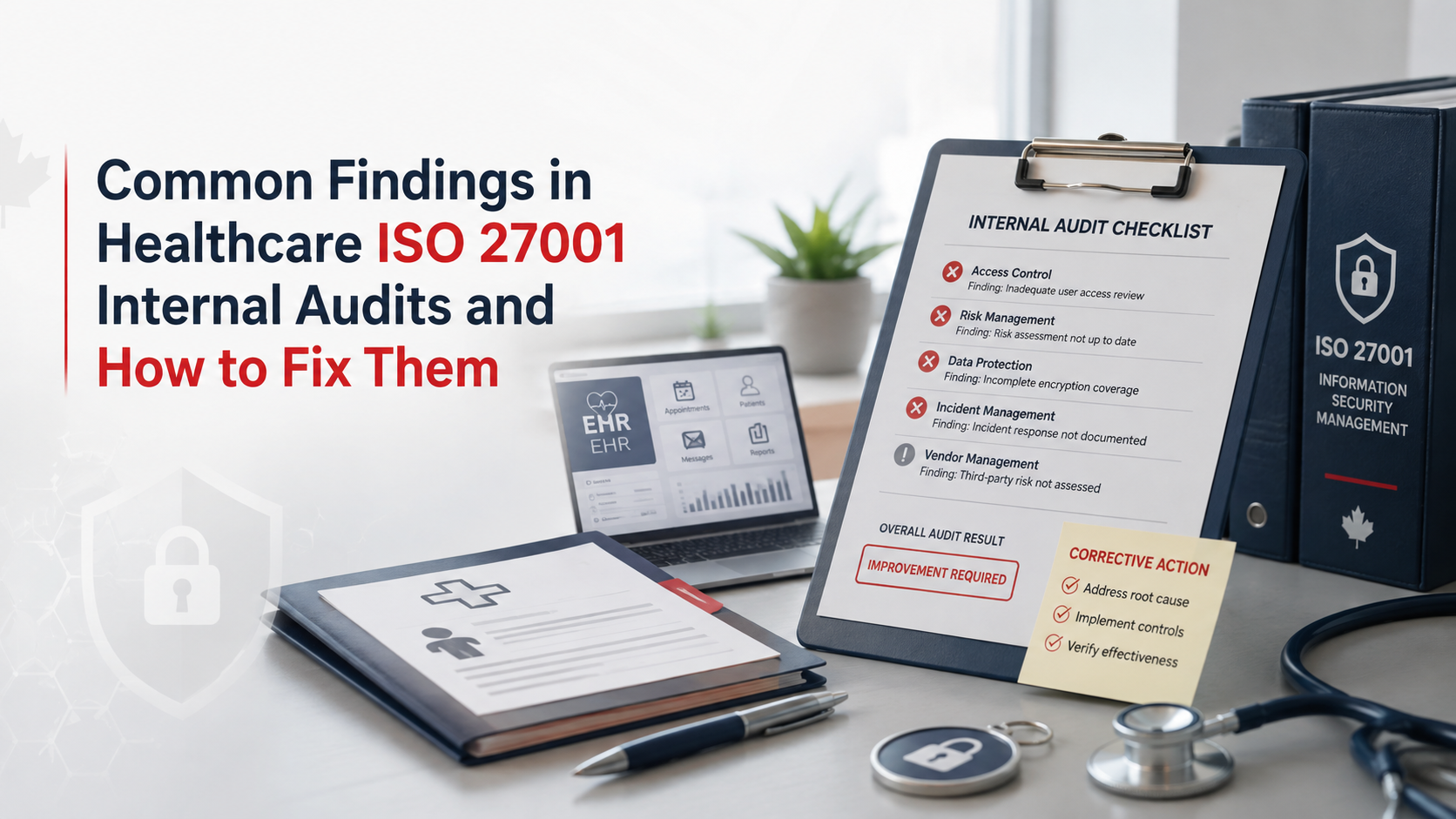
Common Findings in Healthcare ISO 27001 Internal Audits and How to Fix Them
Healthcare ISO 27001 internal audit findings usually appear when policies exist, but evidence does not prove that PHI, cloud, vendor, AI, backup, and log controls are working.
Quick Answer
What are common healthcare ISO 27001 internal audit findings?
Common healthcare ISO 27001 internal audit findings include incomplete PHI inventories, weak access reviews, excessive privileged access, unmanaged vendor access, PHI in support tickets, missing restore tests, logs that are not reviewed, AI tools without governance, generic incident response, weak risk registers, and corrective actions closed without proof.
These findings can be fixed with better PHI mapping, stronger access review evidence, vendor access tracking, support ticket rules, AI governance, restore testing, log review ownership, healthcare-specific risks, and verified corrective actions.
Bottom line: healthcare internal audit is not only about having controls. It is about proving that controls are operating.
Canadian Cyber Healthcare Audit Support
Fix Healthcare ISO 27001 Findings Before They Repeat
Canadian Cyber helps healthcare and HealthTech organizations identify, prioritize, and fix ISO 27001 internal audit findings.
We review PHI evidence, cloud apps, vendor access, support workflows, AI tools, backups, logs, privileged access, risk registers, corrective actions, and SharePoint ISMS evidence.
Quick Snapshot
| Common Finding | Why It Matters | Practical Fix |
|---|---|---|
| PHI inventory is incomplete | The organization cannot prove where patient data exists. | Build a PHI inventory and data flow map. |
| Access reviews are weak | Former or excessive users may retain access. | Run quarterly access reviews with evidence. |
| Vendor access is unmanaged | Third parties may access PHI without oversight. | Create a vendor access register. |
| Backups are not restore-tested | Recovery is assumed, not proven. | Schedule restore tests and document results. |
| AI tools are not governed | PHI may be processed by unapproved AI tools. | Add AI approval and vendor review. |
| Corrective actions lack verification | Findings may close without proof. | Require evidence and verification. |
Why Healthcare Internal Audit Findings Happen
Healthcare and HealthTech organizations do not fail internal audits only because they lack policies.
Many already have MFA, cloud tools, vendors, training, and backup systems.
The problem often appears when the auditor asks for evidence.
Can the organization prove where PHI lives, who can access it, which vendors are reviewed, which backups were restored, which logs were checked, and which corrective actions were verified?
Healthcare ISO 27001 internal audit findings usually appear where evidence is incomplete, outdated, scattered, or not reviewed.
Who This Blog Is For
- Healthcare providers, clinic networks, and digital health platforms.
- HealthTech companies, Healthcare SaaS companies, and patient portal providers.
- Telehealth providers, medical billing platforms, and healthcare MSPs.
- AI health tool providers and clinical workflow platforms.
- Security managers, privacy officers, IT managers, ISMS managers, and internal auditors.
- Canadian healthcare organizations preparing for ISO 27001, SOC 2, client reviews, or certification audits.
The Main Audit Question
The strongest audit question is not:
“Do we have policies?”
The stronger question is:
“Can we prove that PHI, cloud, vendor, AI, backup, log, incident, and corrective action controls are working?”
Finding 1: PHI Inventory Is Incomplete
One common healthcare ISO 27001 internal audit finding is an incomplete PHI inventory.
The main clinical platform may be known, but PHI may also appear in support tickets, screenshots, logs, cloud folders, backups, AI transcripts, analytics tools, and vendor portals.
Evidence to Review
- PHI inventory.
- Data classification register.
- Data flow diagram.
- Cloud app inventory.
- Vendor register.
- Backup scope list.
How to Fix It
Create a PHI inventory with system name, data type, owner, vendor, location, access group, retention rule, backup status, and review date.
Then link the inventory to the risk register and audit plan.
Practical rule: healthcare organizations cannot protect PHI properly until they know where PHI actually lives.
Finding 2: Cloud Apps Are Not Classified by PHI Risk
Healthcare organizations often use many cloud tools.
Some are obvious, such as patient portals. Others are less obvious, such as ticketing tools, analytics dashboards, marketing platforms, collaboration spaces, AI tools, and file-sharing systems.
| Common Gap | Fix |
|---|---|
| SaaS inventory is incomplete. | Create a complete cloud app inventory. |
| Cloud tools are not classified by data sensitivity. | Use PHI approved, PHI restricted, internal data only, public data only, under review, and prohibited categories. |
| Cloud app owners are missing. | Assign a business and technical owner. |
| AI features inside cloud apps are not assessed. | Add AI feature review before activation. |
Finding 3: Access Reviews Are Too Generic
Many healthcare organizations perform access reviews.
The finding appears when the review is too broad and does not clearly show access to PHI systems, patient portals, admin dashboards, support tools, or production databases.
Access Reviews to Run Separately
An access export is not enough. The evidence should show review, decision, removal, exception, date, and reviewer sign-off.
Finding 4: Privileged Access Is Too Broad
Privileged access is a common high-risk finding.
Admins may access cloud infrastructure, databases, patient portals, support systems, analytics tools, backup systems, and security tools.
| Privileged Access Gap | Fix |
|---|---|
| Too many global admins. | Reduce admin roles and require justification. |
| Temporary admin access becomes permanent. | Set expiry dates for temporary access. |
| Service accounts have excessive permissions. | Assign owners and review service account permissions. |
| Break-glass accounts are not monitored. | Document, test, and monitor emergency accounts. |
Need Help Fixing Healthcare ISO 27001 Findings?
Canadian Cyber can review your findings, identify root causes, verify closure evidence, and prepare your team for certification or client reviews.
For senior advisory support, view Waqar Mehboob’s profile.
Finding 5: Vendor Access Is Not Properly Reviewed
Healthcare organizations depend on vendors.
Vendor risk becomes a finding when access, contracts, security reviews, and subprocessors are not controlled.
Track These Vendor Details
Finding 6: PHI Appears in Support Tickets Without Controls
Support tickets are one of the most overlooked PHI locations.
Tickets may include screenshots, portal errors, patient identifiers, clinical notes, billing records, logs, and attachments.
| Support Ticket Risk | Fix |
|---|---|
| Screenshots show patient details. | Create screenshot redaction rules. |
| Logs include identifiers, tokens, or credentials. | Add log review and credential handling rules. |
| AI tools summarize tickets without approval. | Review AI ticket tools before use. |
| Ticket retention settings are unclear. | Define retention and access rules. |
Finding 7: Backups Exist, But Restore Testing Is Missing
Many organizations can show backup reports.
Fewer can show restore evidence. For healthcare, this is a major issue because availability matters.
Restore Testing Evidence Should Include
Finding 8: Logs Are Collected But Not Reviewed
Healthcare systems often generate logs.
Internal audit findings appear when log review ownership, cadence, and evidence are unclear.
| Log Review Item | What to Define |
|---|---|
| Critical log source. | Owner and retention period. |
| Review cadence. | Daily, weekly, monthly, or risk-based review. |
| Alert criteria. | High-risk events and escalation triggers. |
| Evidence. | Tickets, review notes, alerts, and incident links. |
Finding 9: AI Tools Are Used Without Healthcare Governance
AI is becoming common in healthcare and HealthTech.
AI may support documentation, scribing, patient support, ticket summaries, coding, analytics, meeting notes, or product features.
Healthcare AI Governance Controls
AI tools that touch PHI should be audited as privacy, vendor, access, security, and accountability risks.
Finding 10: Incident Response Is Too Generic
Healthcare incident response should be specific.
It should cover PHI exposure, cloud incidents, vendor incidents, AI misuse, ransomware, unauthorized access, and patient portal issues.
Add These Healthcare Scenarios
Finding 11: Risk Register Is Too Generic
A healthcare ISO 27001 risk register should reflect real healthcare operations.
Generic risks such as “cybersecurity incident” are not enough.
Healthcare Risks to Include
Finding 12: Corrective Actions Are Closed Without Verification
Healthcare audit findings should not be closed casually.
A finding should close only after evidence is uploaded, reviewed, and verified.
| Corrective Action Status | Meaning |
|---|---|
| Open | Finding is logged and assigned. |
| In Progress | Owner is working on the action. |
| Pending Evidence | Closure evidence is needed. |
| Pending Verification | Evidence is uploaded and ready for review. |
| Closed and Verified | Closure evidence has been reviewed and accepted. |
Healthcare ISO 27001 Findings Checklist
| Checklist Item | Ready? |
|---|---|
| PHI inventory is complete. | |
| PHI data flows are mapped. | |
| Cloud apps are classified by PHI risk. | |
| PHI systems are included in access reviews. | |
| Privileged access is reviewed separately. | |
| Vendor access is tracked. | |
| Support ticket PHI handling is documented. | |
| AI tools are inventoried and reviewed. | |
| Restore tests are documented. | |
| Logs are collected and reviewed. | |
| Incident response includes PHI, vendor, cloud, and AI scenarios. | |
| Corrective actions require evidence and verification. |
Practical 30-Day Fix Plan
Week 1
Identify the biggest evidence gaps across PHI inventory, cloud apps, vendors, access, backups, logs, AI tools, and open findings.
Week 2
Fix high-risk access and vendor issues. Prioritize privileged access, vendor access, inactive users, support accounts, and AI tools processing PHI.
Week 3
Build evidence workflows. Create owners, review dates, SharePoint libraries, corrective action statuses, and reminders.
Week 4
Prepare management review inputs. Summarize high-risk findings, corrective actions, PHI risks, AI risks, vendor risks, and readiness status.
How SharePoint Can Help Manage Healthcare Internal Audit Findings
A SharePoint ISMS workspace can help healthcare and HealthTech organizations manage audit findings, evidence, owners, due dates, and corrective actions in one controlled location.
Findings are easier to fix when evidence, risk links, and verification status are visible.
Suggested SharePoint Views
How Canadian Cyber Helps
Canadian Cyber helps healthcare and HealthTech organizations identify, prioritize, and fix ISO 27001 internal audit findings.
We help teams move from scattered evidence and repeated gaps to structured, audit-ready security governance.
Frequently Asked Questions
What are common ISO 27001 internal audit findings in healthcare?
Common findings include incomplete PHI inventory, weak access reviews, excessive admin access, unmanaged vendor access, PHI in support tickets, missing restore testing, logs not reviewed, AI tools not governed, generic incident response, weak risk register entries, and corrective actions closed without verification.
Why is PHI inventory important?
PHI inventory helps the organization understand where patient and clinical data is stored, processed, transmitted, backed up, and shared.
Should AI tools be included in healthcare internal audits?
Yes. AI tools should be included when they process PHI, clinical notes, transcripts, support tickets, patient communications, analytics, or healthcare workflow data.
Are backup reports enough for ISO 27001?
No. Backup reports are useful, but restore testing is needed to prove that recovery can work.
How should corrective actions be closed?
Corrective actions should close only after evidence is uploaded, reviewed, and verified. A Pending Verification status helps prevent premature closure.
Can SharePoint help manage healthcare audit findings?
Yes. SharePoint can track PHI inventories, evidence libraries, audit findings, corrective actions, owners, due dates, risk links, verification status, and management dashboards.
Can Canadian Cyber help fix healthcare ISO 27001 findings?
Yes. Canadian Cyber provides healthcare ISO 27001 internal audits, evidence gap reviews, corrective action support, AI governance reviews, vendor access reviews, SharePoint ISMS implementation, vCISO services, and certification readiness support.
Takeaway
Healthcare ISO 27001 internal audit findings usually come down to one question.
Can the organization prove its controls are working?
Policies matter, but evidence matters more.
The strongest healthcare internal audit programs focus on where PHI lives, who can access it, which vendors support it, which cloud apps process it, which AI tools may touch it, how incidents are handled, and how corrective actions are verified.
For healthcare and HealthTech organizations, internal audit is not just about certification. It is about protecting patient trust.
Ready to Fix Healthcare ISO 27001 Internal Audit Findings?
Canadian Cyber can help your healthcare or HealthTech organization fix findings with real evidence, clear ownership, and verified corrective actions.
We provide ISO 27001 internal audits, PHI evidence gap reviews, cloud app evidence reviews, vendor access reviews, AI governance reviews, backup and restore evidence testing, logging and monitoring reviews, SharePoint ISMS workspaces, corrective action tracking, vCISO services, SOC 2 readiness alignment, ISO 42001 readiness, ISO 27017, ISO 27018, and cybersecurity assessments.
Stay Connected With Canadian Cyber
Follow Canadian Cyber for practical guidance on ISO 27001 internal audits, healthcare cybersecurity, PHI protection, HealthTech security, AI governance, cloud security, vendor access, SharePoint ISMS, SOC 2, ISO 42001, vCISO services, and certification readiness.