Internal Audit
Policy Evidence
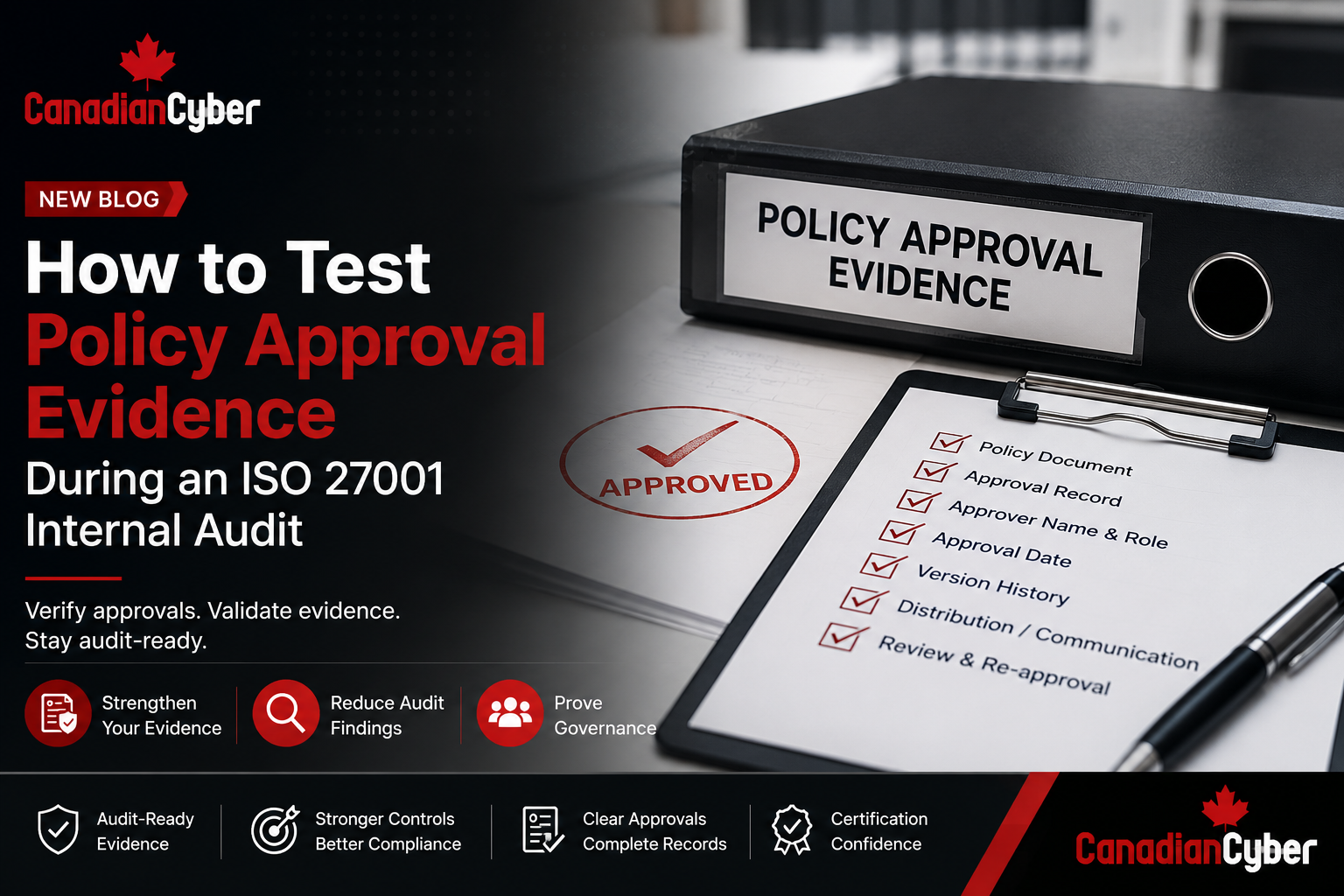
ISO 27001 Policy Approval Evidence: How to Test It During Internal Audit
Learn how to test ISO 27001 policy approval evidence before certification, including owners, approvers, versions, review dates, communication, acknowledgments, and SharePoint approval workflows.
Quick Answer
What is ISO 27001 policy approval evidence?
ISO 27001 policy approval evidence proves that a policy was reviewed and approved by the right person or group.
It should show the policy owner, approver, approval date, version, review date, published location, and communication record.
The key test is simple: can you prove who approved the policy, when it was approved, and which version is active?
Why Policy Approval Evidence Matters
Policies are usually the first documents prepared for ISO 27001.
But having a policy is not enough.
The organization must prove that the policy is controlled.
It must also prove that the policy was approved, published, reviewed, and communicated.
That is why ISO 27001 policy approval evidence is an important internal audit area.
Practical rule: a policy is audit-ready when ownership, approval, version, review date, publication, and communication can be proven.
The Main Internal Audit Question
The strongest audit question is not only, “Where is the policy?”
A better question is:
Can you show the approved version, who approved it, when it was approved, how it is controlled, and how employees know it applies?
Quick Policy Approval Evidence Snapshot
| Audit Area | What to Test |
|---|---|
| Policy Owner | Is a named owner responsible for keeping the policy current? |
| Approval Authority | Was the policy approved by the right person or group? |
| Approval Date | Is the approval date visible and linked to the policy version? |
| Current Version | Can the team prove which version is active? |
| Review Date | Is the next review date defined? |
| Communication | Were employees or relevant teams notified? |
What Counts as Strong Approval Evidence?
Policy approval evidence can come from several places.
The source depends on how your organization controls documents.
Practical rule: approval evidence should show the decision, not just the document.
Step 1: Confirm the Policy Inventory
Before testing approval, confirm which policies exist.
Do not audit random files. Start with the document register.
Ask These Questions
- Is there a complete policy inventory?
- Which policies are published?
- Which policies are still drafts?
- Which policies are overdue for review?
- Which policies support Annex A controls?
Step 2: Verify Policy Ownership
Every policy needs a clear owner.
The owner should be responsible for keeping the policy current and useful.
| Policy | Typical Owner |
|---|---|
| Information Security Policy | Executive Sponsor or ISMS Manager. |
| Access Control Policy | IT Manager or Security Manager. |
| Supplier Security Policy | Operations, Procurement, or Security. |
| AI Acceptable Use Policy | Security, Privacy, or IT. |
| Backup Policy | IT Operations. |
Practical rule: policy ownership should follow real accountability, not document storage responsibility.
Step 3: Test Approval Authority
Not every person should approve every policy.
The auditor should check whether the right authority approved the policy.
Ask These Questions
- Who approved the policy?
- Was the approver authorized?
- Was leadership approval required?
- Did Legal review privacy or contract-related policies?
- Did IT review technical policies?
Need to Test Policy Approval Evidence Before Audit?
Canadian Cyber helps organizations test ISO 27001 policy approval evidence, document control, ownership, SharePoint workflows, and corrective actions.
We help teams fix approval gaps before certification, surveillance audits, and client security reviews.
Step 4: Confirm Approval Date and Version
Approval should be linked to a specific version.
Otherwise, the auditor may not know which policy was approved.
Strong evidence example: Access Control Policy, version 2.1, approved by the IT Director and ISMS Manager on September 5, 2026, published on September 6, 2026, and scheduled for review on September 5, 2027.
Step 5: Check Review Dates
Policies should not remain unchanged forever.
Each policy should have a review frequency and a next review date.
Step 6: Test Document Control
Policy approval evidence is part of document control.
The audit should confirm that drafts, approved versions, published versions, and retired versions are separated.
Evidence to Request
- Document control procedure.
- Draft document library.
- Published document library.
- Archive library.
- SharePoint version history.
- Approval workflow configuration.
Step 7: Verify Policy Communication
Approval is not enough if employees do not know the policy exists.
Internal audit should test whether relevant users were notified.
Step 8: Test Policy Acknowledgment
Not every policy needs formal acknowledgment.
However, key policies often should be acknowledged by employees or contractors.
Policies That May Need Acknowledgment
- Information Security Policy.
- Acceptable Use Policy.
- Remote Work Policy.
- Data Classification Policy.
- Incident Reporting Policy.
- AI Acceptable Use Policy.
Step 9: Link Policies to ISO 27001 Controls
Policies should not sit alone.
They should connect to ISO 27001 clauses, Annex A controls, the Statement of Applicability, risks, and evidence.
| Policy | ISO 27001 Area | Evidence Example |
|---|---|---|
| Risk Management Policy | Clause 6. | Risk methodology and risk register. |
| Access Control Policy | Annex A access controls. | Access reviews and MFA reports. |
| Supplier Security Policy | Annex A supplier controls. | Vendor register and assessments. |
| AI Acceptable Use Policy | Risk, supplier, access, and data handling. | AI tool inventory and training. |
Common Internal Audit Findings
Policy approval findings are often simple, but they can create avoidable audit issues.
The policy exists, but no approval record is available.
The author approved the policy without the right authority.
Old and new versions are both visible.
No next review date is tracked.
The policy was approved but not communicated.
The policy is not linked to clauses, Annex A controls, or risks.
SharePoint Policy Approval Workflow for ISO 27001
Many organizations use SharePoint for ISO 27001 documents.
SharePoint can work well when the document structure is clear.
Store policies before approval.
Show documents waiting for review.
Store approved current policies.
Keep retired versions separate.
Track next review dates.
Map policies to clauses and controls.
Practical rule: SharePoint should show the full approval trail, not just store the final document.
How Canadian Cyber Helps
Canadian Cyber helps organizations test ISO 27001 policy approval evidence before internal audit, certification, or surveillance review.
We help teams move from scattered policy files to controlled, approved, and audit-ready document governance.
Frequently Asked Questions
What is policy approval evidence in ISO 27001?
Policy approval evidence proves that a policy was reviewed and approved by the right authority. It may include SharePoint approval history, signed records, meeting minutes, or document register entries.
Is a policy file enough evidence?
No. A policy file alone may not prove approval. Internal audit should confirm owner, approver, approval date, version, review date, and communication evidence.
Who should approve ISO 27001 policies?
Approval depends on the policy. Major ISMS policies should be approved by top management or an authorized executive sponsor. Technical and operational policies should be approved by the right control owners.
Can SharePoint support ISO 27001 policy approvals?
Yes. SharePoint can support draft libraries, approval workflows, version history, published policy libraries, review reminders, metadata, and document control dashboards.
What are common policy approval findings?
Common findings include missing approval evidence, wrong approver, unclear version control, overdue reviews, missing communication evidence, and incomplete acknowledgments.
Can Canadian Cyber review policy approval evidence?
Yes. Canadian Cyber helps organizations review policy approval evidence, document control, SharePoint workflows, policy mapping, acknowledgments, corrective actions, and certification readiness.
Takeaway
ISO 27001 policy approval evidence is easy to overlook.
It is also easy to fix before audit.
Each policy should show who owns it, who approved it, which version is current, when it must be reviewed, where it is published, and who was notified.
The goal is not only to have policies. The goal is to prove that policies are controlled, approved, communicated, reviewed, and connected to the ISMS.
Test Your ISO 27001 Policy Approval Evidence Before Audit
Canadian Cyber can help you review policy approvals, document control, SharePoint workflows, evidence mapping, and corrective actions.
We support ISO 27001 internal audits, SharePoint ISMS workspaces, vCISO services, SOC 2 readiness, ISO 42001, ISO 27017, ISO 27018, and cybersecurity assessments.
Stay Connected With Canadian Cyber
Follow Canadian Cyber for practical guidance on ISO 27001 internal audits, policy approval evidence, document control, certification readiness, SharePoint ISMS, SOC 2 readiness, AI governance, and vCISO services.