Clause 4
ISMS Scope
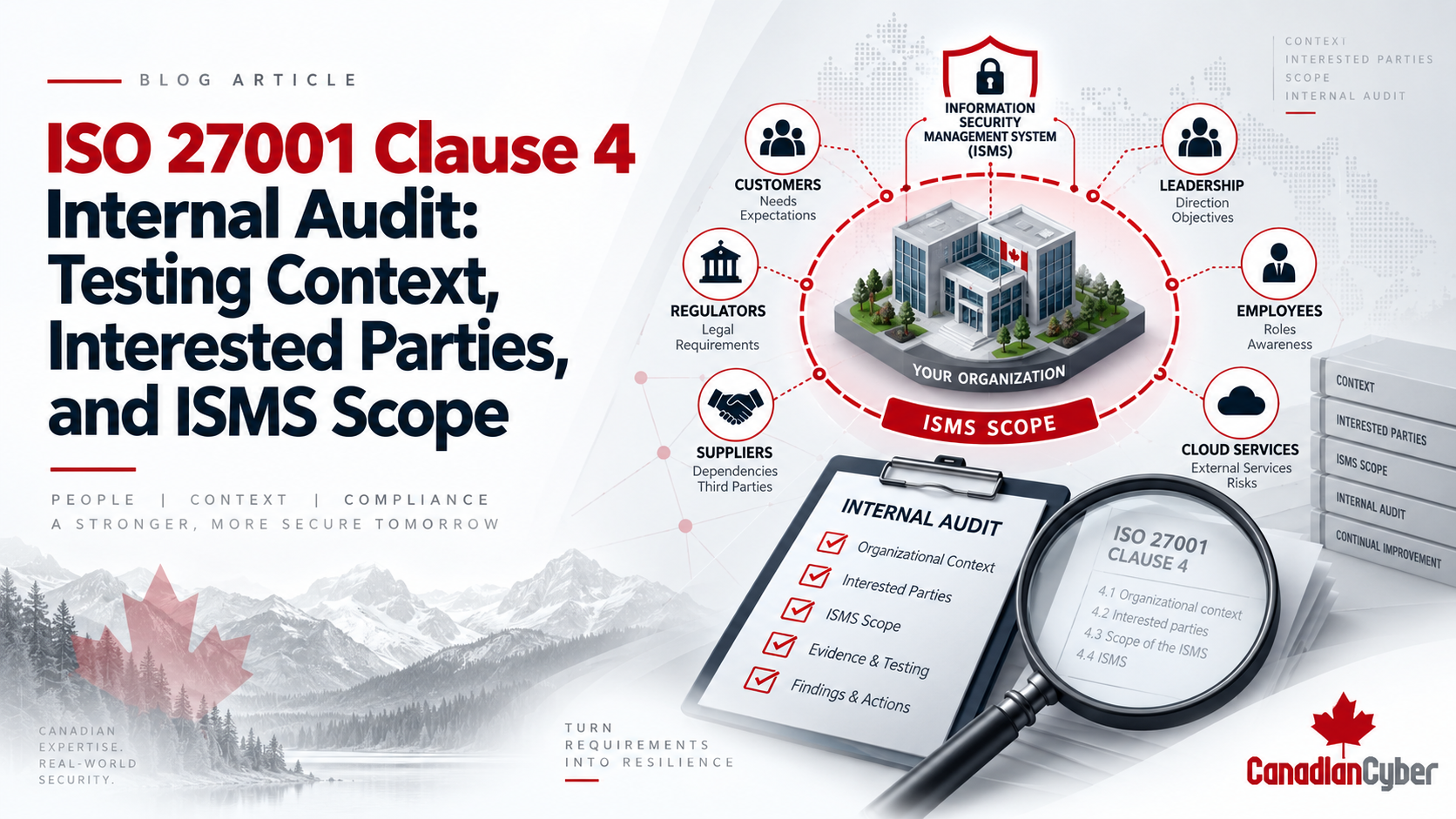
ISO 27001 Clause 4 Internal Audit: Testing Context, Interested Parties, and ISMS Scope
Learn how to audit ISO 27001 Clause 4 by testing organizational context, interested parties, ISMS scope, exclusions, cloud systems, vendors, AI tools, and certification readiness evidence.
Quick Answer
What should an ISO 27001 Clause 4 internal audit test?
An ISO 27001 Clause 4 internal audit should test whether the organization understands its context, interested parties, requirements, ISMS scope, exclusions, and scope-related dependencies.
Strong evidence includes an approved scope statement, interested parties register, context register, system inventory, cloud inventory, vendor register, AI tool inventory, data flow map, risk register, Statement of Applicability, and management review records.
The goal is simple: confirm that the ISMS scope reflects the real business, systems, vendors, risks, obligations, and security responsibilities.
Clause 4 Is Where the Audit Should Begin
Clause 4 is the foundation of the ISO 27001 internal audit.
Before testing access reviews, policies, vendors, backups, incidents, corrective actions, or leadership commitment, the auditor needs one clear answer.
What exactly does the ISMS cover?
That sounds simple.
However, many organizations struggle to keep scope, context, and interested parties current.
Practical rule: if Clause 4 is weak, the rest of the audit may test the wrong boundary.
Quick Clause 4 Audit Snapshot
| Clause 4 Area | What Internal Audit Should Test |
|---|---|
| 4.1 Organizational Context | Internal and external issues affecting information security. |
| 4.2 Interested Parties | Clients, regulators, vendors, employees, leadership, partners, and their requirements. |
| 4.3 ISMS Scope | Boundaries, locations, systems, teams, services, cloud tools, vendors, and exclusions. |
| 4.4 ISMS Establishment | Whether the ISMS is defined, implemented, maintained, and improved within scope. |
| Business Change | Whether new services, vendors, AI tools, cloud apps, or locations changed the scope. |
The Main Clause 4 Audit Question
The strongest Clause 4 audit question is not, “Do we have an ISMS scope document?”
A better question is:
Does the ISMS scope accurately reflect the organization’s real business, systems, interested parties, risks, obligations, vendors, cloud services, and security responsibilities?
Why Clause 4 Matters
Clause 4 answers the most important scoping questions in the ISMS.
If these answers are weak, every later audit area becomes harder to trust.
Practical rule: if Clause 4 is weak, the internal audit may produce false confidence.
What Clause 4 Should Prove
Clause 4 should prove that the organization understands the environment in which the ISMS operates.
It should also prove that the ISMS is designed around the organization’s actual business.
Clause 4.1: Testing Internal and External Context
Clause 4.1 focuses on understanding the organization and its context.
Internal audit should test whether internal and external issues are current, relevant, and linked to information security.
Internal Issues to Review
Business model.
Remote work model.
Technology stack.
Cloud dependency.
Data types handled.
AI tool usage.
External Issues to Review
Client expectations.
Regulatory requirements.
Contractual obligations.
Supplier dependencies.
Threat environment.
AI governance pressure.
Evidence to Request
- Internal and external issues register.
- Business context document.
- Risk assessment inputs.
- Management review minutes.
- Cloud system inventory.
- AI tool inventory.
Common finding: the organization has a context document, but it was not updated after new services, cloud systems, vendors, or AI tools were introduced.
Clause 4.2: Testing Interested Parties
Clause 4.2 is often treated too lightly.
Many organizations create a basic list of clients, employees, management, vendors, and regulators.
However, the audit should go deeper and test what those parties require from the ISMS.
| Interested Party | Possible Security Requirement |
|---|---|
| Clients and enterprise buyers. | Security controls, audit rights, data handling, and incident notification. |
| Regulators and privacy authorities. | Legal, privacy, retention, and breach notification expectations. |
| Vendors and cloud providers. | Supplier security, shared responsibility, and service availability requirements. |
| Employees and contractors. | Security responsibilities, acceptable use, training, and access requirements. |
| Insurance providers. | Cyber insurance controls, MFA, backup, incident response, and evidence requirements. |
Evidence to Request
- Interested parties register.
- Client security requirements register.
- Legal requirements register.
- Contractual obligations summary.
- Vendor obligation register.
- Risk register mapping.
Practical rule: an interested parties register should not only list names. It should identify requirements that affect the ISMS.
Need to Test Clause 4 Before Certification?
Canadian Cyber helps organizations audit ISO 27001 Clause 4 by reviewing context, interested parties, ISMS scope, exclusions, cloud systems, vendors, AI tools, evidence mapping, and certification readiness.
We help leadership understand what is included, what is excluded, what changed, and what must be updated before external audit.
Clause 4.3: Testing the ISMS Scope
The ISMS scope defines the boundary of the management system.
Internal audit should test whether that boundary is clear, accurate, justified, and current.
Evidence to Request
- ISMS scope statement.
- Scope approval record.
- Organizational chart.
- System inventory and cloud inventory.
- Vendor register and outsourced process register.
- Risk register and Statement of Applicability.
Weak ISMS Scope vs Strong ISMS Scope
Weak scope statements are usually too vague to guide audit testing.
Weak Scope Example
“The ISMS covers information security activities of the organization.”
This does not identify services, locations, systems, cloud tools, vendors, data types, teams, or exclusions.
Stronger Scope Example
“The ISMS covers the design, development, delivery, and support of the organization’s cloud-based SaaS platform, including production cloud infrastructure, Microsoft 365, customer support processes, engineering workflows, vendor management, risk management, incident response, and related corporate operations for employees and contractors working remotely and from the Toronto office.”
Practical rule: a scope statement should be specific enough to guide audit testing.
Testing Scope Exclusions
Exclusions can be allowed when they are justified.
However, vague exclusions create audit risk.
| Audit Question | Evidence to Review |
|---|---|
| What is excluded from the ISMS? | Scope exclusion list. |
| Why is it excluded? | Exclusion justification and risk review. |
| Who approved the exclusion? | Management approval record. |
| Does the exclusion affect client data or obligations? | Contract review, data flow map, and risk assessment. |
Testing Interfaces and Dependencies
The ISMS scope should consider interfaces and dependencies.
This is especially important for cloud services, vendors, MSPs, AI tools, and outsourced operations.
Practical rule: a system outside the product can still affect the ISMS if it supports the product, stores data, or enables access.
Clause 4.4: Testing Whether the ISMS Is Established and Maintained
Clause 4.4 focuses on establishing, implementing, maintaining, and improving the ISMS.
Internal audit should test whether the ISMS is more than a folder of documents.
Clause 4 Evidence Matrix
| Clause 4 Requirement | Evidence to Review | Typical Owner |
|---|---|---|
| Internal and external issues. | Context register, business issue list, risk inputs, management review. | ISMS Manager / Leadership. |
| Interested parties. | Interested parties register, requirements list, client obligation tracker. | ISMS Manager / Legal / Operations. |
| ISMS scope. | Scope statement, system inventory, data flow map, approval record. | ISMS Manager / Leadership. |
| Interfaces and dependencies. | Vendor register, cloud inventory, architecture map, SaaS list. | IT / Operations / Security. |
| ISMS maintenance. | ISMS calendar, internal audit, management review, corrective actions. | ISMS Manager. |
Interview Questions for Clause 4
Questions for Leadership
How does the ISMS scope support business goals?
What business changes could affect the ISMS?
How does leadership approve scope changes?
Questions for the ISMS Manager
How is organizational context reviewed?
How are interested parties maintained?
How is Clause 4 linked to the risk register and SoA?
Questions for IT and Operations
Which systems support in-scope services?
Which vendors support these processes?
Which tools store or process sensitive data?
Common Clause 4 Internal Audit Findings
Sample Clause 4 Finding Language
Weak Finding
ISMS scope is unclear.
Strong Finding
The ISMS scope statement does not identify the cloud hosting environment, customer support system, code repository, remote workforce, or critical vendors supporting the in-scope SaaS service. Because the ISMS scope defines the boundary for risk assessment, control selection, and audit testing, unclear scope may cause important systems or dependencies to be missed during certification readiness activities.
How Clause 4 Connects to the Rest of ISO 27001
Clause 4 does not stand alone.
What is missing from Clause 4 often becomes missing from the rest of the ISMS.
Clause 4 Internal Audit Checklist
Context
- Internal issues are documented.
- External issues are documented.
- Business changes trigger updates.
- Context connects to the risk register.
Interested Parties
- Interested parties are identified.
- Requirements are documented.
- Client obligations are included.
- Requirements connect to risks and controls.
ISMS Scope
- Scope statement exists and is approved.
- Scope includes systems and cloud platforms.
- Vendors and outsourced services are considered.
- Exclusions are justified.
How to Audit Clause 4 Without Turning It Into Paperwork
Do not only check documents.
Ask whether the documents match reality.
| Fieldwork Test | Purpose |
|---|---|
| Compare scope statement to system inventory. | Confirm in-scope systems are reflected. |
| Compare interested parties to client contracts. | Confirm client obligations are captured. |
| Compare vendor dependencies to vendor register. | Confirm critical suppliers are included. |
| Compare AI tool usage to context review. | Confirm AI risks and dependencies are considered. |
| Compare scope to SoA and risk register. | Confirm control selection matches the boundary. |
SharePoint Evidence for Clause 4
A SharePoint ISMS workspace can help organize Clause 4 evidence.
It should make context, scope, interested parties, owners, approvals, and review dates easy to find.
Track internal and external issues.
Track parties and requirements.
Track boundaries, approvals, and exclusions.
Track systems, cloud platforms, and scope status.
Track suppliers supporting in-scope services.
Track AI tools pending scope or risk review.
Practical rule: Clause 4 evidence should be easy to review because it shapes the entire ISMS.
Leadership Questions for Clause 4
Leadership should be involved in Clause 4 because scope is a management decision.
Management should approve the scope with a clear understanding of what is included and excluded.
- Does the ISMS scope reflect our current business?
- Are major clients and contractual obligations considered?
- Are key systems and vendors included?
- Are remote work arrangements included?
- Are AI tools included where relevant?
- Are exclusions justified?
- Are we comfortable with the certification boundary?
How Canadian Cyber Helps
Canadian Cyber helps organizations audit ISO 27001 Clause 4 and prepare clear, accurate, audit-ready ISMS scope evidence.
We help teams connect context, interested parties, scope, risks, controls, vendors, cloud systems, AI tools, and certification readiness.
Frequently Asked Questions
What is ISO 27001 Clause 4?
ISO 27001 Clause 4 focuses on the context of the organization. It includes internal and external issues, interested parties, ISMS scope, and establishment of the ISMS.
Why is Clause 4 important in an internal audit?
Clause 4 defines the foundation of the ISMS. If context, interested parties, or scope are unclear, the audit may miss important systems, vendors, risks, controls, or obligations.
What evidence should auditors review for Clause 4?
Auditors should review the ISMS scope statement, interested parties register, context register, legal and contractual requirements, system inventory, vendor register, cloud inventory, AI tool inventory, risk register, SoA, and management review records.
What is a common Clause 4 finding?
A common finding is that the ISMS scope is too generic or outdated and does not reflect current systems, vendors, cloud services, remote work, AI tools, or business processes.
Should interested parties include clients and vendors?
Yes. Interested parties usually include clients, vendors, employees, contractors, leadership, regulators, partners, cloud providers, and other groups that influence the ISMS or have information security requirements.
Should AI tools be included in Clause 4 review?
Yes. When AI tools affect company data, client data, source code, support workflows, business processes, or vendor risk, they should be considered in context, interested parties, risk assessment, and scope review.
Can SharePoint help manage Clause 4 evidence?
Yes. SharePoint can track scope documents, interested parties, client requirements, system inventory, vendor dependencies, AI tools, risk links, SoA links, review dates, approvals, and management decisions.
Can Canadian Cyber help review ISO 27001 Clause 4?
Yes. Canadian Cyber helps organizations review Clause 4 evidence, define ISMS scope, map interested parties, align risks and controls, build SharePoint dashboards, and prepare for ISO 27001 certification readiness.
Takeaway
Clause 4 is not just the starting point of ISO 27001.
It is the boundary of the entire ISMS.
A strong ISO 27001 Clause 4 internal audit tests whether context, interested parties, systems, vendors, cloud services, AI tools, exclusions, and scope boundaries match reality.
When Clause 4 is clear, the rest of the audit becomes clearer.
When Clause 4 is weak, the audit may test the wrong areas, miss important risks, and create certification readiness problems.
Test ISO 27001 Clause 4 Before External Audit
Canadian Cyber can help your organization review Clause 4 evidence, define ISMS scope, map interested parties, align risks and controls, and prepare for certification readiness.
We support ISO 27001 Clause 4 reviews, internal audits, SharePoint ISMS dashboards, corrective action tracking, vCISO support, SOC 2 readiness, ISO 42001, ISO 27017, ISO 27018, and cybersecurity assessments.
Stay Connected With Canadian Cyber
Follow Canadian Cyber for practical guidance on ISO 27001 internal audits, Clause 4, ISMS scope, interested parties, certification readiness, SharePoint ISMS, corrective actions, SOC 2 readiness, AI governance, and vCISO services.