Get in touch
info@canadiancyber.ca


Rafia Rizwan

April 6, 2026
A realistic guide to implementing ISO 27001 for startups without a compliance team. Build scope, controls, and audit-ready evidence step by step.
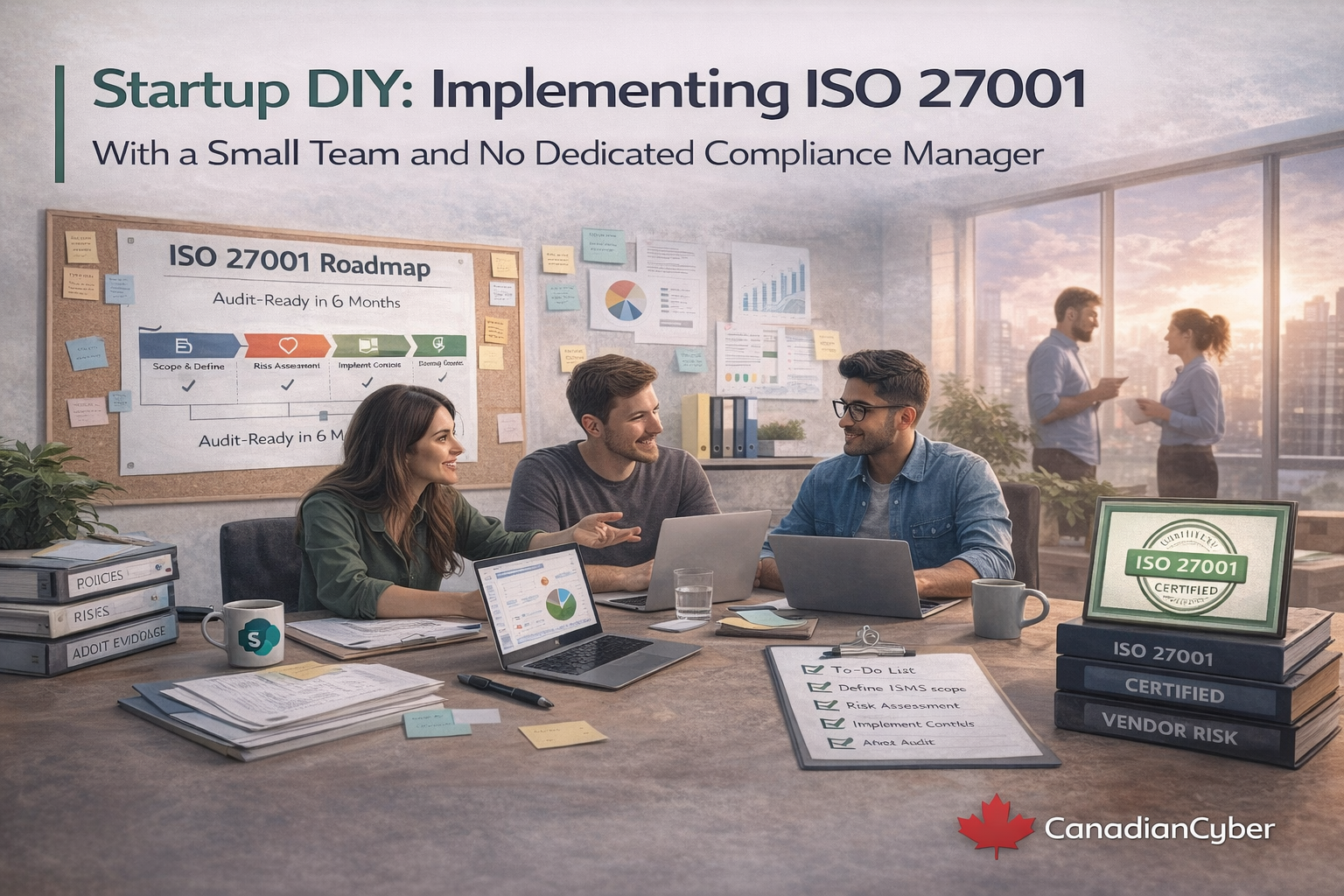
Most startups fail ISO 27001 because they try to document everything instead of building a system that produces proof every month. The winning move is not more paperwork. It is repeatability.
If access reviews happen on time, logs are reviewed and signed off, backups are tested and recorded, vendors are tracked, risks are owned, and management review decisions are documented, the ISMS starts looking real very quickly.
Once you strip away the fear, ISO 27001 becomes manageable. For a startup, it is mostly about making a small number of recurring actions happen on time and preserving proof that they happened.
That is what creates credibility with auditors and buyers. The rest is supporting structure.
This is where startups win or lose. If you scope the entire company on day one, certification slows down. A practical startup scope is usually the production SaaS platform and the systems that directly deliver it.
ISO 27001 does not require a dedicated compliance manager. It requires ownership. On a 10 to 50 person team, part-time ownership is often enough if responsibilities are clear.
| Role | Typical startup owner | What they do |
|---|---|---|
| ISMS Owner | COO or Head of Ops | Keeps the cadence moving |
| Security Owner | CTO or senior engineer | Owns technical controls and evidence |
| Risk Owner | Ops lead or ISMS owner | Tracks risks and exceptions |
| Internal Audit Lead | Ops, security, or outsourced support | Runs internal audit sampling and findings |
| Management Review Chair | CEO or COO | Documents leadership decisions |
Keep it lean. You do not need a giant documentation project. You need a small set of documents and registers that your team will actually maintain.
If these are current, audits go much smoother because the system is visible instead of implied.
If you already use SharePoint, make it work for you. Store evidence as quarterly packs instead of loose screenshots spread across folders.
You do not need perfect maturity across every control on day one. You need consistent operation of the controls that buyers and auditors push on first.
This is what replaces the full-time compliance manager. A small, repeatable cadence creates evidence automatically.
| Frequency | Activity | Typical effort |
|---|---|---|
| Monthly | Log review sign-off | 30 minutes |
| Monthly | Vulnerability and patch exception review | 15 minutes |
| Monthly | Evidence due-list check and risk update | 30 minutes total |
| Quarterly | Privileged access review, vendor review, tabletop, management review | 2 to 3 hours |
Once this cadence is running, ISO stops feeling like a side project and starts feeling like normal operations.
Internal audits overwhelm startups when they are saved for the end. A better approach is to audit a small batch of controls every month, sample the evidence, and log findings with owners and due dates.
A startup management review can be 45 minutes. What matters is that leadership sees the top risks, incidents, corrective actions, vendor issues, KPIs, and decisions required, and that those decisions are documented.
ISO 27001 becomes realistic for startups when it runs like a monthly operating system instead of a once-a-year documentation exercise. Keep the scope tight, assign owners, focus on the few controls that matter most, and create evidence as you go.
That is how a small team becomes audit-ready without a dedicated compliance manager.