Security Awareness
Internal Audit
How to Audit ISO 27001 Security Awareness Evidence Beyond Attendance Sheets
Learn how to audit ISO 27001 security awareness evidence beyond attendance sheets, including policy understanding, role-based training, phishing response, incident reporting, AI acceptable use, and proof of real behavior.
Quick Answer
How do you audit ISO 27001 security awareness evidence?
To audit ISO 27001 security awareness evidence, do not stop at attendance sheets.
Review training records, policy acknowledgments, quizzes, employee interviews, phishing evidence, incident reporting awareness, role-based training, AI acceptable use communication, and follow-up actions.
Strong evidence should prove that people understand and apply security responsibilities in daily work.
Attendance Is Only the Starting Point
Security awareness is not proven by an attendance sheet.
An employee can attend training and still not know how to report an incident.
A contractor can complete a course and still upload client data into an unapproved AI tool.
A privileged user can sign a policy and still miss access review duties.
Therefore, ISO 27001 internal auditors should test awareness in a practical way.
Practical rule: attendance proves exposure. Awareness testing should prove understanding and action.
The Main Internal Audit Question
The best question is not, “Did employees attend security awareness training?”
A stronger question is:
Can employees, contractors, and control owners show that they understand and apply security responsibilities relevant to their role?
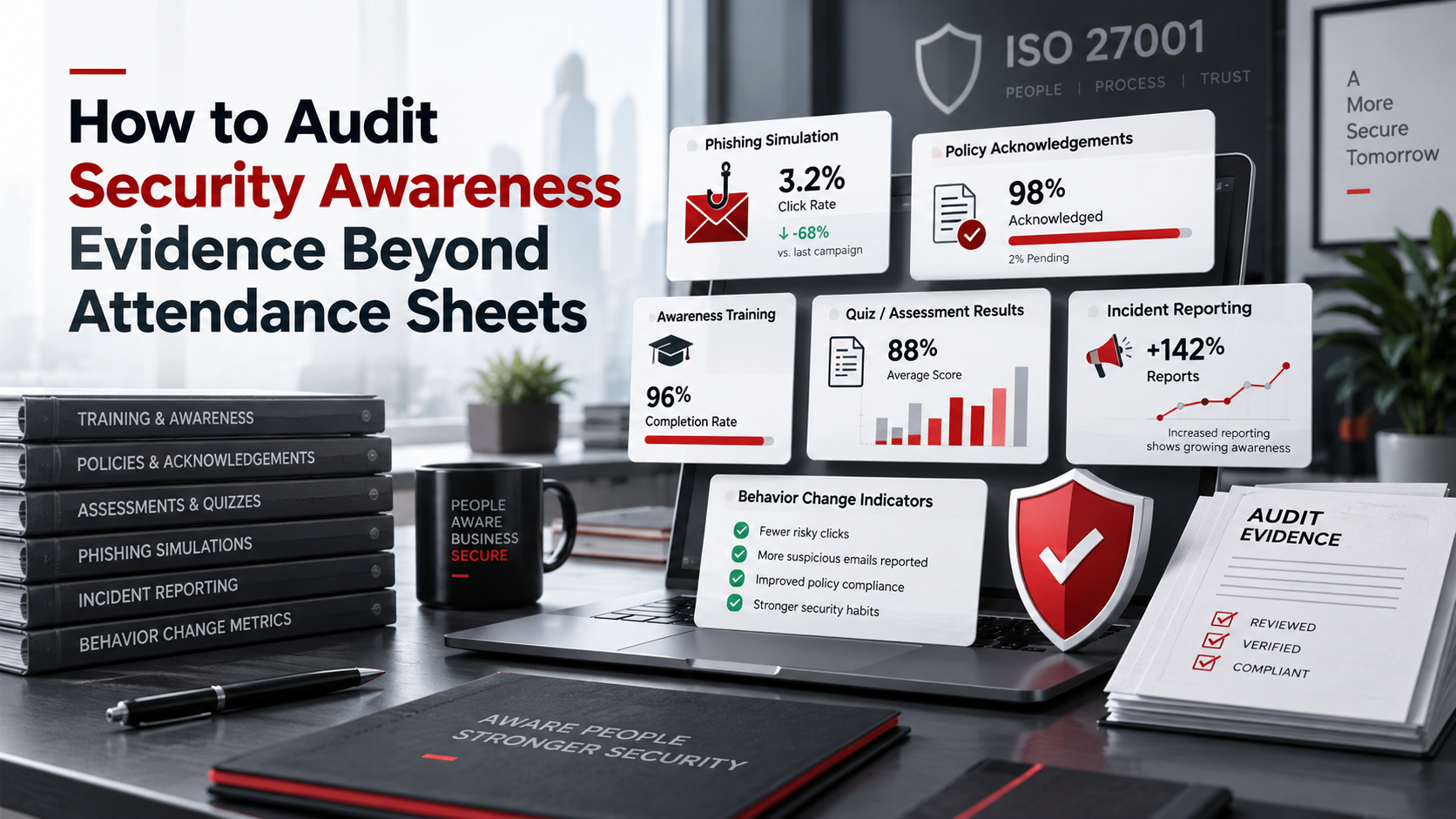
Security Awareness Evidence Snapshot
| Evidence Area | What Internal Audit Should Test |
|---|---|
| Training Completion | Who completed training, who missed it, and how overdue users were followed up. |
| Policy Acknowledgment | Whether employees acknowledged current policy versions. |
| Understanding | Whether employees can explain basic security responsibilities. |
| Role-Based Awareness | Whether higher-risk roles receive targeted awareness. |
| Incident Reporting | Whether people know how and where to report incidents. |
| AI Tool Use | Whether approved and prohibited AI use is clearly communicated. |
Why Attendance Sheets Are Not Enough
Attendance sheets can show who was present.
They can also show when training happened and which group was included.
However, they do not prove that people understood the content.
What Strong Security Awareness Evidence Looks Like
Strong evidence uses more than one proof point.
It should show completion, understanding, coverage, follow-up, and improvement.
1. Test Training Completion Carefully
Training completion is still useful.
However, audit should test whether the right people were included.
Audit Questions
- Who was required to complete training?
- Were employees, contractors, and new hires included?
- Were privileged users included?
- Was training completed by the due date?
- Were overdue users followed up?
Common finding: training was completed by most employees, but contractors or privileged users were missing from the training population.
2. Review Training Content
A completion report means less if the content is outdated.
Therefore, internal audit should review what was actually taught.
Content to Check
- Incident reporting.
- Phishing awareness.
- Acceptable use.
- Data handling rules.
- Remote work expectations.
- AI tool rules where relevant.
Practical rule: awareness content should change when the organization’s risk environment changes.
Need to Audit Awareness Evidence Beyond Attendance?
Canadian Cyber helps organizations review ISO 27001 security awareness evidence, training records, policy acknowledgments, employee understanding, phishing evidence, AI acceptable use communication, and SharePoint evidence libraries.
We help move your evidence from “training completed” to “awareness proven.”
3. Test Policy Acknowledgment Evidence
Security awareness is closely linked to policy communication.
Employees should know which policies apply to them.
Policies to Review
- Information Security Policy.
- Acceptable Use Policy.
- Incident Reporting Procedure.
- Data Classification Policy.
- Remote Work Policy.
- AI Acceptable Use Policy.
Common finding: employees acknowledged an older policy version, but no acknowledgment exists for the current approved version.
4. Interview Employees to Confirm Understanding
Interviews are one of the best ways to test awareness.
The goal is not to embarrass employees. The goal is to test whether awareness messages are working.
Good Interview Questions
- Where can you find the current security policy?
- How do you report a suspected incident?
- What would you do after clicking a phishing link?
- Can you upload client data into public AI tools?
Strong Answers Sound Like
- “I would report it through the security channel.”
- “The current policies are in SharePoint.”
- “We cannot upload client data into unapproved AI tools.”
- “I would report phishing using the approved process.”
Practical rule: awareness is proven when people can explain what they should do in realistic situations.
5. Test Role-Based Awareness
Not every employee needs the same awareness.
Some roles need more targeted training because they create higher risk.
| Role | Awareness Topic |
|---|---|
| IT Admins | Privileged access, MFA, logging, and incident reporting. |
| Developers | Secure coding, secrets handling, and AI coding tool risk. |
| Support Agents | Ticket data handling, identity checks, and AI response review. |
| Executives | Risk acceptance, incident escalation, and management review. |
Common finding: the organization provides general training but no role-based awareness for privileged users, developers, support teams, or AI tool users.
6. Review Phishing Awareness Evidence
Phishing is a common awareness topic.
However, auditors should test more than whether phishing was mentioned in training.
Evidence to Review
- Phishing training material.
- Simulation reports.
- Click and reporting rates.
- Repeat user reports.
- Follow-up training records.
Practical rule: phishing awareness should measure risky behavior and good reporting behavior.
7. Test Incident Reporting Awareness
Incident reporting is one of the most important awareness outcomes.
Employees should know how to report suspicious activity quickly.
Audit Questions
- Do employees know how to report an incident?
- Are reporting channels clear?
- Are instructions included in onboarding?
- Are reminders sent?
- Are managers trained to escalate reports?
Common finding: employees completed training, but interview samples show they do not know the correct incident reporting channel.
8. Review Data Handling Awareness
Employees should understand how to handle sensitive information.
This is especially important for SaaS, HealthTech, FinTech, MSPs, professional services, and AI-enabled businesses.
9. Test AI Acceptable Use Awareness
AI tools have created new awareness gaps.
Employees may use AI for writing, coding, support drafting, research, or document review.
Audit Questions
- Are approved AI tools defined?
- Are prohibited uses defined?
- Do employees know what data cannot be entered into AI tools?
- Are AI outputs reviewed by humans?
- Are AI tool rules included in onboarding?
Common finding: employees use AI tools, but there is no evidence that approved use cases or prohibited data types were communicated.
10. Review Awareness Effectiveness
Awareness should be measured.
Attendance alone does not show whether the program works.
| Effectiveness Measure | Why It Matters |
|---|---|
| Quiz scores | Shows weak areas in understanding. |
| Phishing reporting rate | Shows whether employees report suspicious emails. |
| Interview results | Shows whether people understand what to do. |
| Corrective actions | Shows whether gaps lead to improvement. |
Sample Internal Audit Finding
Weak Finding
Security awareness evidence is weak.
Stronger Finding
The organization retains annual security awareness attendance records. However, the evidence does not show whether employees understood key responsibilities. In a sample of five interviews, two employees could not identify the incident reporting channel. Also, three employees were unsure whether client data could be entered into public AI tools. The training content does not include AI acceptable use or role-specific data handling examples. This may reduce awareness effectiveness and weaken Clause 7 evidence.
How SharePoint Can Help Manage Awareness Evidence
A SharePoint ISMS workspace can organize awareness evidence beyond attendance sheets.
It can connect training, policies, acknowledgments, interview notes, phishing evidence, AI communications, corrective actions, and management review.
Track assignments, completion, and overdue users.
Track current policy acknowledgments.
Record awareness interview results.
Track simulations, reports, and follow-up.
Track approved AI use communication.
Report awareness metrics and gaps.
How Canadian Cyber Helps
Canadian Cyber helps organizations audit ISO 27001 security awareness evidence beyond attendance sheets.
We review training coverage, policy acknowledgment, role-based awareness, employee understanding, phishing evidence, incident reporting readiness, AI acceptable use communication, and awareness effectiveness.
We also help organize awareness evidence inside a SharePoint ISMS dashboard for easier internal audit and certification readiness.
Frequently Asked Questions
Is an attendance sheet enough for ISO 27001 security awareness evidence?
No. Attendance sheets can support evidence, but auditors should also review training content, policy acknowledgments, employee understanding, role-based awareness, incident reporting awareness, and effectiveness metrics.
What evidence proves security awareness?
Strong evidence includes training completion reports, policy acknowledgments, quizzes, phishing simulation results, employee interview notes, awareness communications, incident reporting reminders, role-based training, and management review of awareness metrics.
Should contractors be included in awareness training?
Yes, when contractors have access to company systems, data, client information, or in-scope processes, they should be included in relevant awareness and policy acknowledgment requirements.
Should AI tool usage be included in awareness training?
Yes. When employees use AI tools for work, training should explain approved tools, prohibited data, acceptable use, human review expectations, and incident reporting.
Can SharePoint help manage security awareness evidence?
Yes. SharePoint can track training records, policy acknowledgments, communications, role-based training, phishing reports, AI awareness evidence, corrective actions, and management review dashboards.
Can Canadian Cyber help audit security awareness evidence?
Yes. Canadian Cyber helps organizations audit awareness evidence, review Clause 7 readiness, test policy acknowledgment, interview employees, build SharePoint dashboards, and prepare for ISO 27001 certification readiness.
Takeaway
Security awareness is not proven by attendance alone.
Attendance shows that people were present.
A strong internal audit should test whether people understood and can apply what they learned.
For ISO 27001 certification readiness, organizations need awareness evidence that shows real understanding, not just names on a sheet.
Audit Security Awareness Evidence Before Certification
Canadian Cyber can help your organization review security awareness evidence beyond attendance sheets.
We support ISO 27001 awareness evidence reviews, Clause 7 internal audits, policy acknowledgment testing, employee interviews, phishing evidence review, AI acceptable use awareness review, SharePoint ISMS dashboards, corrective action tracking, management review preparation, vCISO support, SOC 2 readiness alignment, ISO 42001, ISO 27017, ISO 27018, and cybersecurity assessments.
Stay Connected With Canadian Cyber
Follow Canadian Cyber for practical guidance on ISO 27001 internal audits, Clause 7, security awareness, policy acknowledgment, training evidence, certification readiness, SharePoint ISMS, corrective actions, SOC 2 readiness, AI governance, vCISO services, ISO 42001, ISO 27017, ISO 27018, and cybersecurity maturity.