Get in touch
info@canadiancyber.ca


Rafia Rizwan

April 6, 2026
A real fintech case study showing how to build a risk treatment plan that auditors can follow measurable actions, evidence, and faster audit outcomes.
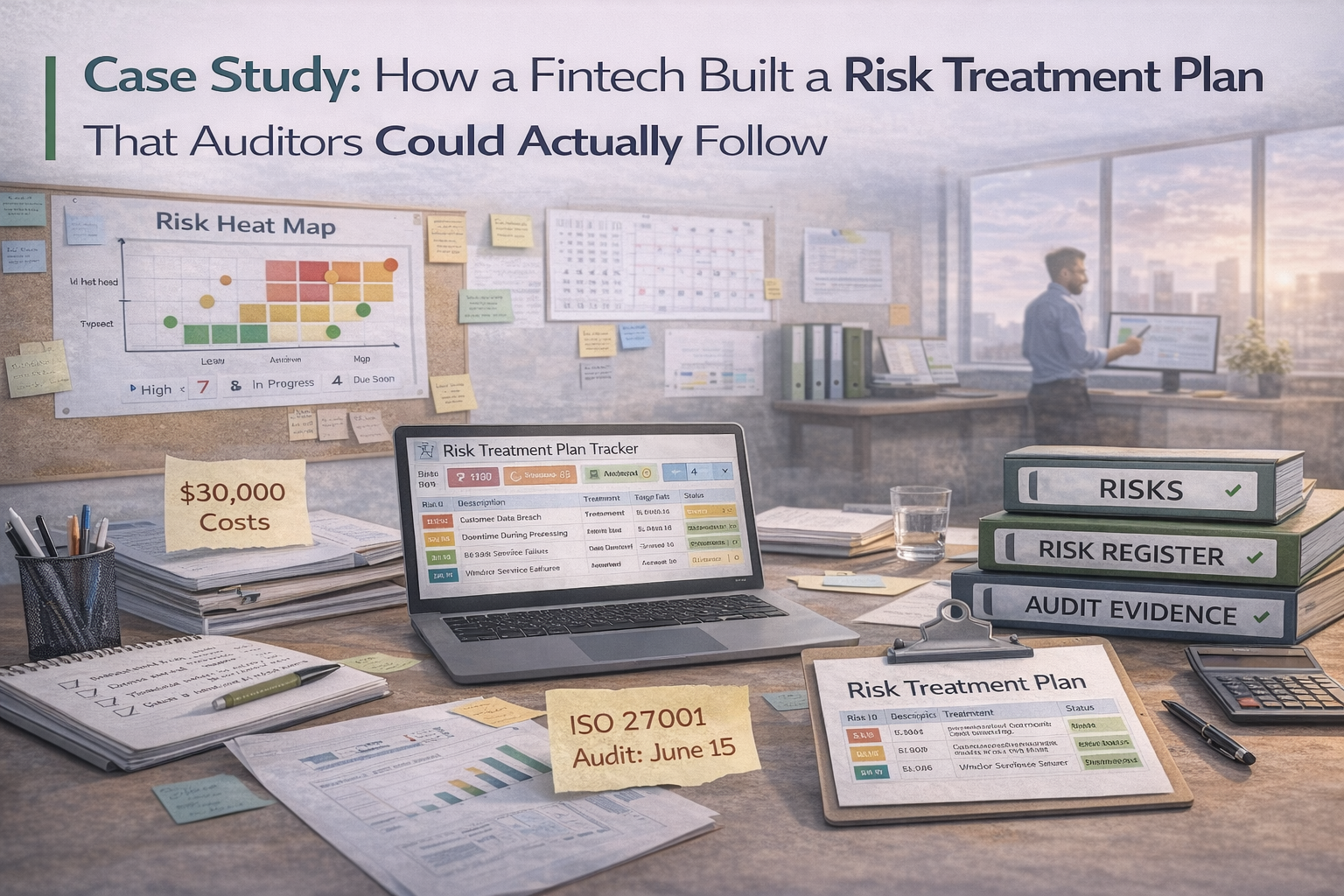
The chain they want is simple: risk, decision, treatment plan, owner, due date, evidence, and verification. Most fintechs break that chain in predictable ways. Treatments are vague, owners are unclear, evidence is not linked, exceptions never expire, and auditors cannot tell what changed since the last review.
This case study shows how one growing fintech fixed that by building a risk treatment plan that was clear, board-readable, and audit-friendly. The story is a realistic composite based on common fintech audit patterns, with details generalized to protect confidentiality while preserving the approach and outcomes.
Auditors kept asking the same questions. Show me how you treat risks, not just how you list them. What changed since the last review. Where is the proof that treatment happened. Those are not hard questions, but they become painful when the treatment plan is vague.
So auditors could not tell whether the plan was executed, whether residual risk had actually gone down, or whether done meant implemented, evidenced, and verified. That created audit drag, repeat questions, and unnecessary debate.
The fix was not more paperwork. It was a followable structure. The vCISO introduced one simple rule: every risk treatment must be a task an auditor can verify in two minutes.
The fintech had more than 40 risks on paper, but only a handful actually drove business decisions. So the team agreed to treat the top 10 risks like board-level work and handle everything else as operational hygiene.
That one decision changed the risk program from a spreadsheet into a leadership tool.
A common audit failure is vague risk language. So they shifted every top risk to a consistent statement format that made treatment decisions obvious.
Once risks were written this way, treatments became much easier to define and verify.
For each top risk, the team created a one-page Risk Treatment Plan. This became the auditor’s map.
| RTP field | Why it mattered |
|---|---|
| Risk ID and title | Created one authoritative reference point |
| Risk owner | Made accountability visible |
| Inherent risk score | Showed the baseline before treatment |
| Treatment decision | Clarified whether the path was mitigate, avoid, transfer, or accept |
| Treatment actions | Turned intent into measurable work |
| Target residual risk | Defined what better looked like |
| Due dates per action | Made progress trackable instead of vague |
| Evidence required | Removed guesswork about proof |
| Verification method | Tested whether the treatment actually worked |
| Residual re-score date | Forced the program to measure outcome, not just activity |
Instead of broad phrases like improve access control, the fintech broke treatments into small, measurable actions with clear owners, due dates, evidence, and verification.
That was the difference between saying we intend to improve this and being able to prove we already did.
The team adopted a hard rule: a treatment action is not complete until evidence is attached and reviewed.
Auditors responded well to this because sampling became simple and fast.
Fintechs depend heavily on payment processors, KYC and AML platforms, fraud tooling, cloud providers, and customer support systems. So vendor risk had to become part of the treatment model, not an afterthought.
The fintech already had SharePoint for its ISMS, so there was no big rebuild. The win came from better structure.
| SharePoint component | Purpose |
|---|---|
| Risk Register list | Authoritative risk records |
| Risk Treatment Plan list | Actions, due dates, and evidence links |
| Exception register | Tracked temporary gaps with expiry |
| Evidence Packs library by quarter | Made sampling and retrieval easy |
| Dashboard views | Showed treatments due, overdue, expiring exceptions, and top residual risks |
That turned risk treatment from a PDF into an operating system.
During the assessment, the auditor sampled five risks. For each one, the fintech could show the risk statement and score, the treatment decision, the specific actions and owners, evidence links per action, the residual re-score after completion, and any exceptions with expiry and compensating controls.
Most importantly, auditors could follow the plan without needing translation from the team.
That is the playbook. It is simple, practical, and audit-friendly.
A strong risk treatment plan does not need to be complicated. It needs to be traceable. When risk statements are clear, actions are measurable, evidence is linked, and exceptions expire, audits move faster because there is less ambiguity to debate.
That is what made this fintech’s treatment plan followable, and that is what made the audit easier to pass.