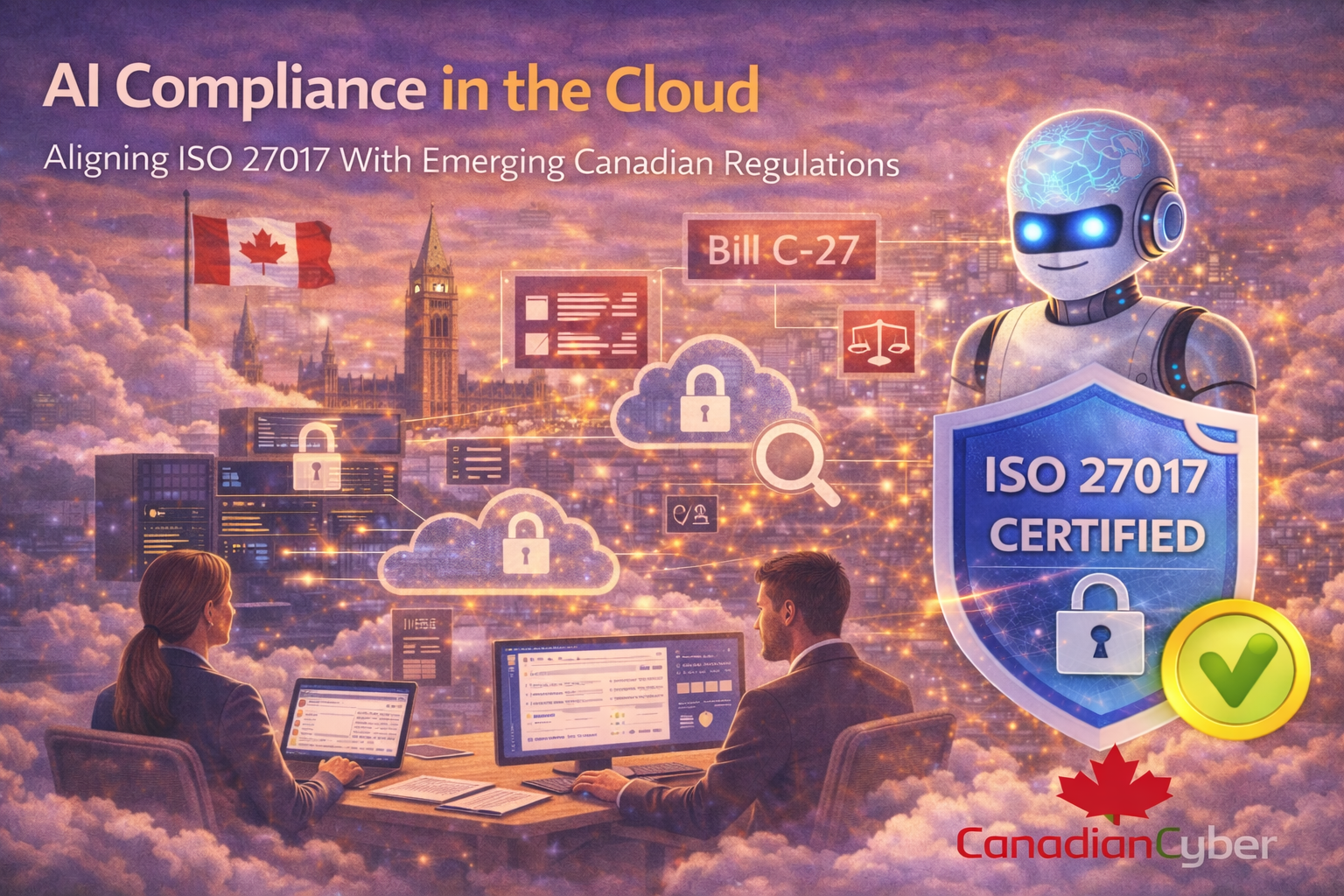
AI Compliance in the Cloud: Aligning ISO 27017 with emerging Canadian regulations
AI adoption is accelerating.
Models are trained in the cloud.
Decisions are automated.
Data moves fast.
Regulation, however, is still catching up.
For many organizations, this creates uncertainty.
“Are we compliant today?”
“What happens when new AI laws arrive?”
ISO 27017 offers a practical way to prepare—now.
It strengthens the cloud layer where AI actually runs.
The Growing Compliance Gap in Cloud AI
AI systems do not operate in isolation.
They rely on:
- Cloud infrastructure
- Shared platforms
- Third-party services
- Large datasets
This makes governance harder.
Regulators are noticing.
Expectations are rising before laws are finalized.
In Canada and the U.S., the signals are clear:
AI must be secure, accountable, and transparent.
Why Cloud Security Standards Matter for AI Compliance
AI regulation is not just about ethics.
It is about controls.
Controls answer practical questions:
- Who can access systems?
- How is data protected?
- How is activity monitored?
ISO 27017 provides a structured, auditable baseline
for cloud environments running AI workloads.
What Is ISO 27017 (In the Context of AI)
ISO 27017 is the cloud security extension of ISO 27001.
It clarifies:
- Security responsibilities between cloud providers and customers
- Required controls for cloud usage
- How to secure shared environments
For AI systems, ISO 27017 helps answer:
- Who is accountable for AI infrastructure security?
- How is data protected in multi-tenant clouds?
- What evidence proves controls are operating?
Compliance needs proof.
ISO 27017 helps you produce that proof through cloud governance.
Quick Snapshot: ISO 27017 and AI Compliance
| Category | Details |
|---|---|
| Primary focus | Secure use of cloud services |
| Why it matters for AI | AI runs on shared cloud infrastructure |
| Key controls | Access management, monitoring, encryption |
| Regulatory value | Supports accountability and data protection |
| Outcome | AI-ready cloud governance |
Emerging Canadian Expectations Around AI
Canada has made its direction clear.
Under Bill C-27, the proposed Artificial Intelligence and Data Act (AIDA) aimed to regulate high-impact AI systems.
Even when laws are not finalized, expectations still rise through procurement, audits, and privacy oversight.
While AIDA is not yet law, regulators are already signaling expectations:
- Strong data safeguards
- Accountability for system behavior
- Risk management and oversight
The Office of the Privacy Commissioner (OPC) has also emphasized responsible AI practices.
Waiting for legislation is risky.
Preparation is smarter.
How ISO 27017 Aligns With AI Regulatory Principles
AI rules tend to come back to a few core principles.
ISO 27017 supports them at the cloud-infrastructure level.
Accountability
ISO 27017 clarifies roles between cloud providers, cloud customers, and system owners.
This maps to expectations for responsibility in AI systems.
Transparency
Logging and monitoring enable auditability, incident investigation, and regulator inquiries.
Oversight requires visibility.
Data Safeguarding
Encryption, secure configuration, and access restrictions reduce exposure in AI workloads.
Data protection becomes provable.
Unsure whether your cloud AI setup would stand up to future regulation?
Prepare before rules are enforced.
Learning From U.S. and Global AI Guidance
Canada is not alone.
Regulators globally are moving in the same direction.
Examples include:
- NIST AI Risk Management Framework (U.S.)
- Increased scrutiny of cloud-hosted AI services
- Emphasis on security-by-design
ISO 27017 complements these approaches by addressing the
infrastructure layer where AI actually runs.
Making AI Work For You, Not Against You
Poorly governed AI creates risk.
Security incidents.
Compliance gaps.
Loss of trust.
ISO 27017 helps organizations:
- Reduce uncertainty
- Demonstrate due diligence
- Build defensible AI systems
When regulation arrives, you are not scrambling.
You are ready.
Proactive Steps CISOs Can Take Today
You do not need to wait for new laws.
Practical actions include:
- Define cloud responsibility boundaries (provider vs customer vs AI owners).
- Secure AI infrastructure using ISO 27017 controls.
- Log and monitor AI system activity and cloud access.
- Document governance decisions and risk acceptance.
These steps pay off regardless of regulation timelines.
They also strengthen customer trust today.
Looking to future-proof your AI strategy?
Align cloud security with ISO 27017 now.
How Canadian Cyber Supports AI Compliance in the Cloud
We help organizations bridge today’s standards with tomorrow’s regulations.
Our services include:
- ISO 27017 implementation for cloud environments
- AI and cloud risk assessments
- Alignment with ISO 27001, ISO 27018, and SOC 2
- Advisory support for emerging AI compliance
Governance before enforcement is an advantage.
It reduces risk and speeds up future audits.
Build AI Governance Before It’s Mandatory
AI regulation is coming.
The only unknown is timing.
ISO 27017 gives you a way to act now.
Strengthen cloud controls, document accountability, and reduce future compliance shock.
Stay Connected With Canadian Cyber
Follow us for practical insights on compliance, risk, and cybersecurity: