Cloud Security
Internal Audit
Cloud Evidence
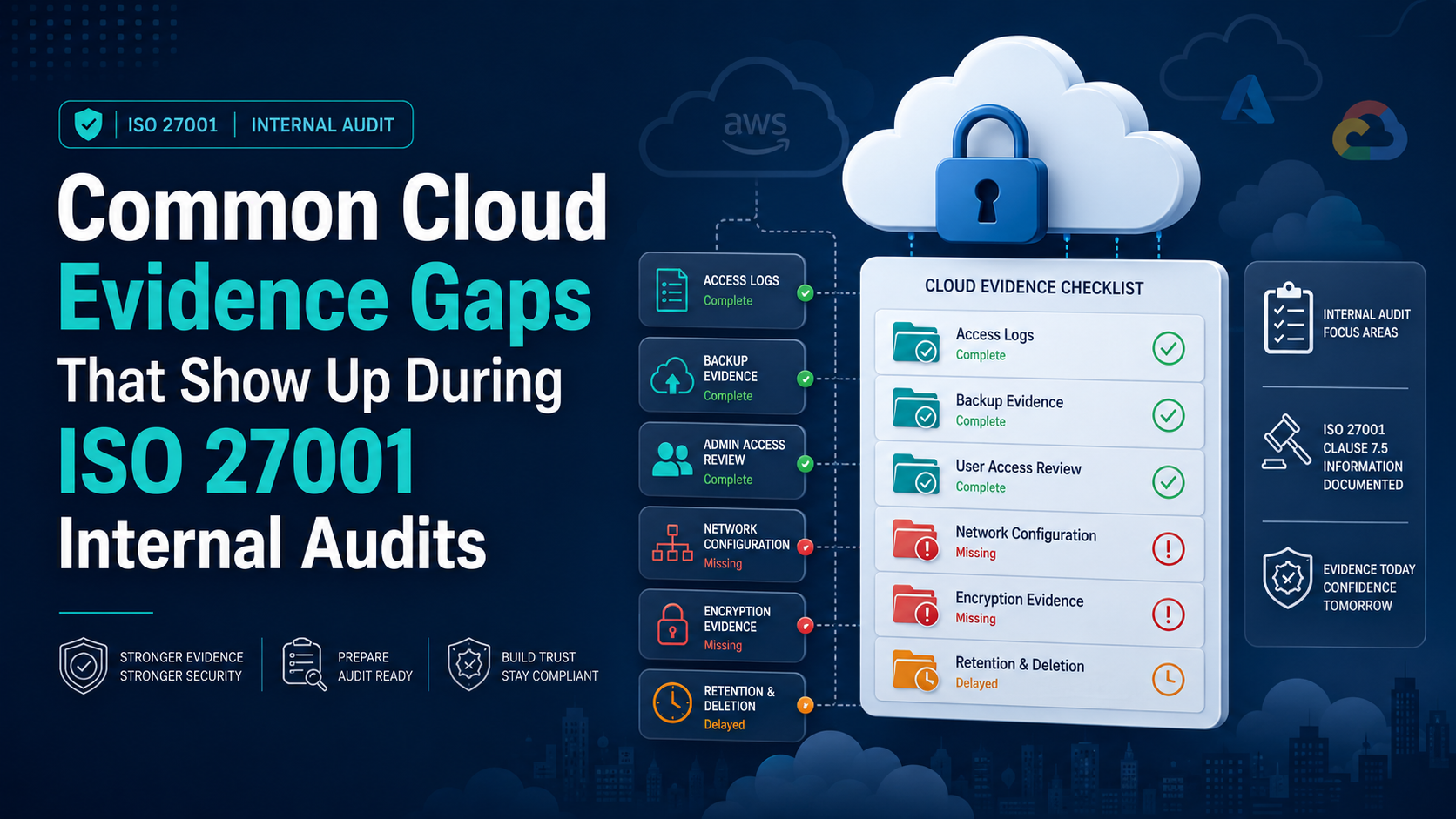
Common Cloud Evidence Gaps That Show Up During ISO 27001 Internal Audits
Cloud security often looks mature until the auditor asks for proof. This guide explains the cloud evidence gaps that create findings, delays, customer concerns, and last-minute audit stress.
Quick Answer
What cloud evidence gaps appear most often in ISO 27001 internal audits?
The most common gaps include missing cloud inventories, unclear shared responsibility records, incomplete access reviews, weak privileged admin evidence, undocumented MFA exceptions, poor offboarding proof, missing restore tests, logs that are collected but not reviewed, untracked vendor access, weak configuration evidence, missing risk register links, outdated SoA mappings, and corrective actions closed without verification.
These gaps can delay certification readiness.
They can also weaken customer trust.
Bottom line: cloud controls are hard to defend when the evidence is missing, scattered, outdated, or not reviewed.
Canadian Cyber Cloud Evidence Support
Find Cloud Evidence Gaps Before the Auditor Finds Them
Canadian Cyber helps organizations review cloud evidence before ISO 27001 internal audits, certification audits, SOC 2 readiness reviews, enterprise security reviews, and cyber insurance renewals.
We help review access evidence, admin roles, backups, restore testing, logs, vendor access, configuration reviews, risk register links, SoA mapping, corrective actions, and SharePoint evidence workspaces.
Quick Snapshot
| Cloud Evidence Gap | Why It Matters |
|---|---|
| Missing Cloud Inventory | The organization cannot prove which cloud systems are in scope. |
| No Shared Responsibility Matrix | Security ownership is unclear between provider, customer, MSP, and vendor. |
| Incomplete Access Reviews | Users may retain unnecessary access. |
| Weak Admin Role Evidence | Privileged access may be excessive or unapproved. |
| Undocumented MFA Exceptions | Authentication risk is accepted without approval. |
| No Restore Testing | Backups exist, but recovery is not proven. |
| Logs Not Reviewed | Security events may be missed. |
| Weak Corrective Action Evidence | Findings are closed without proof. |
Why Cloud Evidence Gaps Hurt ISO 27001 Readiness
Cloud security looks strong until the auditor asks for evidence.
MFA may be enabled. Backups may be running. Logs may be available. Admins may be trusted.
But ISO 27001 internal audit does not stop at “we have it.”
The auditor asks who reviewed it, when it was checked, who owns it, where the evidence is stored, and whether management saw the risk.
Cloud controls without evidence are difficult to defend during ISO 27001 internal audit.
Who This Blog Is For
- Canadian businesses preparing for ISO 27001.
- SaaS companies preparing for enterprise security reviews.
- MSPs managing client cloud environments.
- FinTech, HealthTech, AI, and professional services firms.
- IT managers, security managers, ISMS managers, and vCISO teams.
- Organizations using Microsoft 365, Azure, AWS, Google Cloud, or multiple SaaS tools.
The Real Problem: Cloud Work Moves Faster Than Evidence Collection
Cloud environments change every day.
New users are added. Admin roles are assigned. SaaS tools are adopted. Vendors connect integrations. Employees leave the company.
But evidence is often collected only when an audit is coming.
That creates the gap.
Practical rule: audit readiness should be built into cloud operations, not assembled at the last minute.
Common Cloud Evidence Gaps
Gap 1: Missing Cloud Asset Inventory
The organization may use many cloud systems, but only a few are listed in the ISMS.
Auditor focus: cloud platforms, SaaS tools, production systems, customer-facing systems, data stores, and business applications.
Fix: create an inventory with owner, purpose, data type, confidentiality level, vendor, risk level, and review date.
Gap 2: No Shared Responsibility Matrix
Teams often assume someone else owns access, backups, logs, incidents, or configuration.
Auditor focus: provider, customer, MSP, vendor, IT, security, and business ownership.
Fix: create a responsibility matrix for each critical cloud service and review it during internal audit.
Gap 3: Incomplete Access Reviews
Most organizations can export a user list. Fewer can prove review, sign-off, decisions, and removals.
Auditor focus: guest users, contractors, inactive users, privileged users, exceptions, and review period.
Fix: create a quarterly access review process with scope, reviewer, date, decisions, exceptions, and removal evidence.
Gap 4: Admin Roles Are Not Reviewed Separately
Cloud admins can change permissions, logs, backups, security settings, and data exposure.
Auditor focus: global admins, service accounts, break-glass accounts, emergency access, and former employee admin access.
Fix: create a separate privileged access workflow with stronger justification for admin roles.
Gap 5: MFA Exceptions Are Not Documented
MFA may be enabled, but exceptions can create audit risk.
Auditor focus: service accounts, legacy apps, break-glass accounts, third-party integrations, and temporary bypasses.
Fix: build an MFA exception register with owner, reason, risk, approval, expiry date, and review frequency.
Gap 6: Offboarding Does Not Cover All Cloud Systems
Offboarding may disable Microsoft 365 but miss other SaaS, vendor, backup, code, CRM, or admin platforms.
Auditor focus: termination records, SaaS removal, admin role removal, vendor portal removal, and verification sign-off.
Fix: expand offboarding to include cloud, SaaS, admin, vendor, developer, backup, and remote access tools.
An access export is not an access review. A backup report is not a restore test. A closed finding is not verified closure.
More Cloud Evidence Gaps Internal Auditors Find
Gap 7: Restore Testing Is Missing
Backup reports are useful, but they do not prove recoverability.
Auditor focus: backup scope, backup failure tickets, restore test reports, recovery evidence, and backup vendor reviews.
Fix: create a backup and restore evidence calendar and store test results in a controlled library.
Gap 8: Logs Are Collected But Not Reviewed
Logs are not useful if no one reviews alerts, escalates issues, or links events to incidents.
Auditor focus: retention settings, admin activity logs, alert review tickets, SIEM records, escalation records, and incident links.
Fix: define which logs matter, who reviews them, how often, and which alerts create tickets.
Gap 9: Vendor and MSP Access Is Not Tracked
External access often receives less review than employee access.
Auditor focus: vendor admin accounts, MSP access, support accounts, contractor access, MFA evidence, and access removal.
Fix: create a vendor and third-party access register and include it in quarterly access reviews.
Gap 10: Configuration Reviews Are Missing
Cloud configuration can drift over time.
Auditor focus: secure baselines, public exposure settings, storage permissions, encryption evidence, network rules, and exception expiry dates.
Fix: create a quarterly cloud configuration review process and link high-risk issues to corrective actions.
Gap 11: Cloud Risks Are Missing From the Risk Register
Many risk registers are too generic.
Auditor focus: admin access, cloud misconfiguration, backup failure, vendor outage, API exposure, Shadow IT, AI tool exposure, and weak monitoring.
Fix: update the risk register with real cloud operating risks, owners, and treatment actions.
Gap 12: The SoA Does Not Reflect Cloud Reality
The Statement of Applicability should show selected controls, implementation status, and evidence links.
Auditor focus: cloud-specific implementation notes, control owners, ISO 27017 mapping, evidence links, and risk treatment links.
Fix: review the SoA against actual cloud services, risks, and evidence.
Gap 13: Corrective Actions Close Without Verification
Cloud findings are often marked closed too quickly.
Auditor focus: root cause, owner, due date, closure evidence, verification notes, recurrence check, and management visibility.
Fix: use a “Pending Verification” status and require evidence links before closure.
Gap 14: Management Review Does Not Include Cloud Security
Leadership should see cloud risks, audit findings, backup failures, access issues, vendor risks, and corrective action status.
Auditor focus: management review agenda, cloud risk summary, access review summary, vendor risk summary, decision log, and action tracker.
Fix: add cloud security as a standing management review agenda item.
Cloud Evidence Gap Checklist
| Checklist Item | Ready? |
|---|---|
| Cloud asset inventory is current. | |
| SaaS application inventory is current. | |
| AI tools and cloud integrations are inventoried. | |
| Shared responsibility matrix is documented. | |
| Cloud access reviews are completed and signed off. | |
| Guest and contractor access is reviewed. | |
| Privileged admin roles are reviewed separately. | |
| Break-glass accounts are documented and monitored. | |
| MFA exceptions are approved and tracked. | |
| Offboarding covers cloud, SaaS, admin, and vendor tools. | |
| Backup scope is documented. | |
| Backup reports are retained. | |
| Backup failures are tracked. | |
| Restore testing is performed and documented. | |
| Logs are collected and retained. | |
| Alerts are reviewed and ticketed. | |
| Vendor and MSP access is tracked. | |
| Cloud configuration reviews are performed. | |
| Cloud risks are included in the risk register. | |
| SoA reflects cloud control implementation. | |
| Corrective actions include evidence and verification. | |
| Management review includes cloud risks and findings. |
Recommended Cloud Evidence Pack Before ISO 27001 Internal Audit
A cloud evidence pack helps the internal audit run faster.
It also reduces last-minute evidence chasing.
Why This Matters for Enterprise Sales and Customer Trust
Cloud evidence gaps do not only affect ISO 27001 certification.
They also affect revenue.
Enterprise buyers often ask whether you review access, enforce MFA, test backups, review logs, control admin roles, assess cloud vendors, manage incidents, and maintain ISO 27001 evidence.
If evidence is ready, the sales cycle moves faster. If evidence is scattered, the deal slows down.
Strong cloud evidence is not just audit support. It is customer trust support.
How SharePoint Can Help Close Cloud Evidence Gaps
A structured SharePoint ISMS can help manage cloud evidence in one controlled workspace.
Cloud evidence gaps are easier to fix when evidence, owners, due dates, and dashboards live together.
Canadian Cyber’s ISMS SharePoint Solution Can Organize
How Canadian Cyber Helps
Canadian Cyber helps organizations identify and close cloud evidence gaps before internal audits, certification audits, SOC 2 readiness reviews, enterprise security reviews, and cyber insurance renewals.
We help teams move from scattered screenshots and informal explanations to structured, audit-ready cloud evidence.
Canadian Cyber’s Cloud Evidence Gap Review
Canadian Cyber’s Cloud Evidence Gap Review helps organizations answer the hard audit questions before they become findings.
We help identify:
- What cloud evidence is missing.
- Which access reviews are incomplete.
- Which admin roles are excessive.
- Which MFA exceptions are undocumented.
- Which backups are untested.
- Which logs are not reviewed.
- Which vendors have unmanaged access.
- Which cloud risks are missing.
- Which SoA controls need better evidence.
- Which corrective actions need verification.
Frequently Asked Questions
What are cloud evidence gaps?
Cloud evidence gaps are missing, incomplete, outdated, or weak records that fail to prove cloud security controls are operating. Examples include missing access review sign-offs, no restore tests, undocumented MFA exceptions, and logs without review evidence.
Why do cloud evidence gaps matter for ISO 27001?
They matter because ISO 27001 internal audit requires evidence that controls are implemented and operating. Weak cloud evidence may create findings that require corrective action.
What is the most common cloud evidence gap?
Access review evidence is one of the most common gaps. Many organizations can export user lists but cannot prove that access was reviewed, corrected, signed off, and followed by removal where needed.
Are backup reports enough for ISO 27001?
Backup reports are helpful, but they are not enough by themselves. Organizations should also show backup failure handling and restore testing evidence.
Do logs need to be reviewed for ISO 27001?
Yes. Logs should not only be collected. The organization should define which logs are reviewed, who reviews them, how alerts are handled, and how incidents are escalated.
Should cloud risks be in the risk register?
Yes. Cloud risks such as excessive admin access, misconfiguration, vendor outage, backup failure, API exposure, and weak monitoring should be included in the ISMS risk register where relevant.
Can SharePoint help manage cloud audit evidence?
Yes. SharePoint can organize access reviews, backup reports, restore tests, logs, vendor reviews, risk records, corrective actions, management dashboards, and auditor-ready evidence views.
Can Canadian Cyber help fix cloud evidence gaps?
Yes. Canadian Cyber helps organizations identify, prioritize, and close cloud evidence gaps through ISO 27001 internal audits, cloud evidence reviews, SharePoint ISMS workspaces, corrective action tracking, and vCISO support.
Takeaway
Cloud security evidence is one of the most important parts of ISO 27001 internal audit.
The most common gaps are not always technical failures.
They are proof failures.
The access review happened, but there is no sign-off. The backup ran, but no restore was tested. Logs exist, but no one can prove review. Admins are trusted, but their roles are not justified.
The best approach is simple: inventory the cloud, assign owners, review access, control admin roles, test restores, review logs, track vendors, update risks, map evidence to the SoA, verify corrective actions, and report high-risk issues to management.
Ready to Close Cloud Evidence Gaps Before Your Audit?
Canadian Cyber can help your organization prepare for ISO 27001 internal audit with stronger cloud evidence and fewer last-minute surprises.
We provide cloud evidence gap reviews, ISO 27001 internal audits, Microsoft 365 and Azure evidence reviews, backup and restore evidence testing, cloud admin role reviews, logging and monitoring reviews, SharePoint ISMS implementation, corrective action tracking, vCISO services, SOC 2 readiness alignment, ISO 27017, ISO 27018, ISO 42001 AI governance readiness, and cybersecurity assessments.
Stay Connected With Canadian Cyber
Follow Canadian Cyber for practical guidance on ISO 27001 internal audits, cloud evidence, access reviews, admin roles, backups, logs, SharePoint ISMS, SOC 2, ISO 27017, ISO 27018, ISO 42001, vCISO services, and cybersecurity readiness.