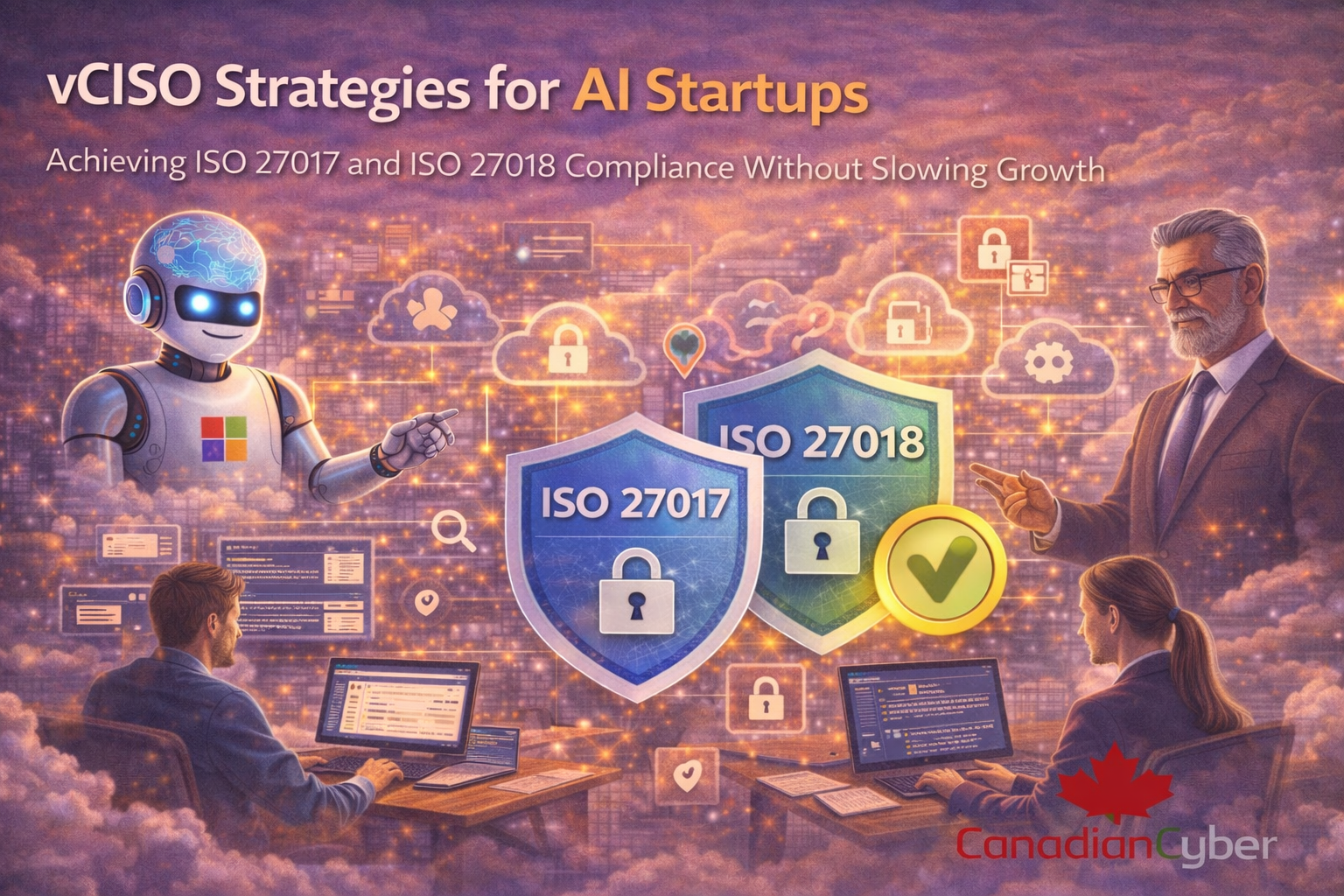
vCISO Strategies for AI Startups
Achieving ISO 27017 and ISO 27018 compliance without slowing growth
AI startups move fast.
Products ship quickly.
Cloud infrastructure scales overnight.
Customers come from everywhere.
Security leadership often comes last.
Not because founders do not care.
But because hiring a full-time CISO feels premature.
Subtle highlight: This is where a vCISO changes the equation.
You get senior leadership without the full-time overhead.
The Security Reality for AI Startups
AI startups operate in high-risk environments.
They rely on:
- Cloud infrastructure
- Large datasets
- Third-party services
- Rapid DevOps and MLOps cycles
At the same time, many lack:
- Formal security governance
- Privacy expertise
- Cloud compliance experience
Yet customers and regulators still expect proof.
ISO 27017 and ISO 27018 make those expectations explicit.
Why AI Startups Struggle With Cloud Compliance
Cloud compliance is not intuitive.
Especially for AI-focused teams.
Common challenges include:
- Unclear shared responsibility in the cloud
- Weak access and configuration controls
- No structured privacy risk assessments
- Limited documentation and evidence
Subtle highlight: ISO 27017 and ISO 27018 demand structure.
Startups need guidance, not overhead.
What a vCISO Brings to AI Startups
A virtual CISO provides senior leadership without full-time cost.
For AI startups, a vCISO acts as:
- Strategic advisor
- Security architect
- Compliance guide
- Board-level communicator
The goal is simple.
Build trust early.
Scale securely.
Quick Snapshot: vCISO for AI Cloud Compliance
| Category | Details |
|---|---|
| Best for | AI startups and SaaS companies |
| Primary goal | Secure cloud and privacy without heavy overhead |
| Key standards | ISO 27017 (cloud security), ISO 27018 (cloud privacy) |
| Big win | Enterprise trust and audit readiness |
| Audience | CTOs, founders, CFOs, boards |
Five vCISO Strategies That Keep Startups Fast
Strategy 1: Perform targeted gap assessments
A vCISO starts with clarity, not assumptions.
This sets direction fast.
- Assess cloud environments against ISO 27017
- Review PII handling against ISO 27018
- Identify quick wins and high-risk gaps
Strategy 2: Define cloud responsibility clearly
AI startups often assume the cloud provider “handles security.”
That is only partially true.
- Clarify what the cloud provider secures
- Define what the startup owns
- Identify where AI workloads introduce extra risk
Subtle highlight: ISO 27017 requires this clarity.
Auditors expect it.
Customers ask for it.
Strategy 3: Introduce cloud and privacy risk assessments
Privacy risk is new territory for many AI teams.
A vCISO introduces structured assessments aligned with ISO expectations.
- Cloud risk assessments for AI workloads
- Privacy risk assessments for training data and models
- Documentation that creates audit-ready evidence
This helps prevent accidental PII exposure, improper data reuse, and regulatory surprises.
Mid-Section CTA
Scaling fast but unsure where your cloud risks really are?
Get clarity without slowing delivery.
Strategy 4: Build ISO 27017 and 27018 controls into DevOps
Security cannot block innovation.
A vCISO works with engineering teams to embed controls into how work is delivered.
- Embed access controls into pipelines
- Enforce secure cloud configurations
- Monitor environments continuously
Controls become part of how teams work.
Not an afterthought.
Strategy 5: Guide the startup toward certification readiness
Certification readiness is about proof, not promises.
- Structure documentation and evidence
- Define control ownership and accountability
- Support audit readiness and customer due diligence
This positions startups to meet enterprise requirements, partner reviews, and regulatory expectations.
Why This Matters to Boards and CFOs
Security failures are expensive.
Especially for AI companies.
A vCISO helps startups:
- Reduce risk early
- Avoid costly rework later
- Demonstrate responsible AI governance
This resonates with leadership.
Trust becomes a business enabler.
Managing AI Risk Before It Becomes a Crisis
Generative AI introduces new risks.
A vCISO helps startups:
- Identify AI-specific risks
- Secure cloud-based models
- Protect training and inference data
Subtle highlight: Proactive management beats reactive response.
Mid-Guide CTA
Need senior security leadership without hiring full-time?
Engage a vCISO and accelerate compliance with confidence.
How Canadian Cyber Supports AI Startups With vCISO Services
We work with innovation-driven companies.
We understand startup pressure.
We respect speed.
Our vCISO services include:
- ISO 27017 and ISO 27018 strategy
- Cloud and privacy risk assessments
- Certification readiness support
- Ongoing security leadership
Security that scales with you.
Not against you.
Build Trust Early. Scale Securely.
AI startups do not fail because of innovation.
They fail because trust breaks.
A vCISO helps you build trust before customers demand it.
Stay Connected With Canadian Cyber
Follow us for practical insights on compliance, risk, and cybersecurity: