Get in touch
info@canadiancyber.ca


Rafia Rizwan

April 20, 2026
A practical guide to the ISO 27001 timeline for growing software companies, showing what actually drives delays and how to plan realistically.
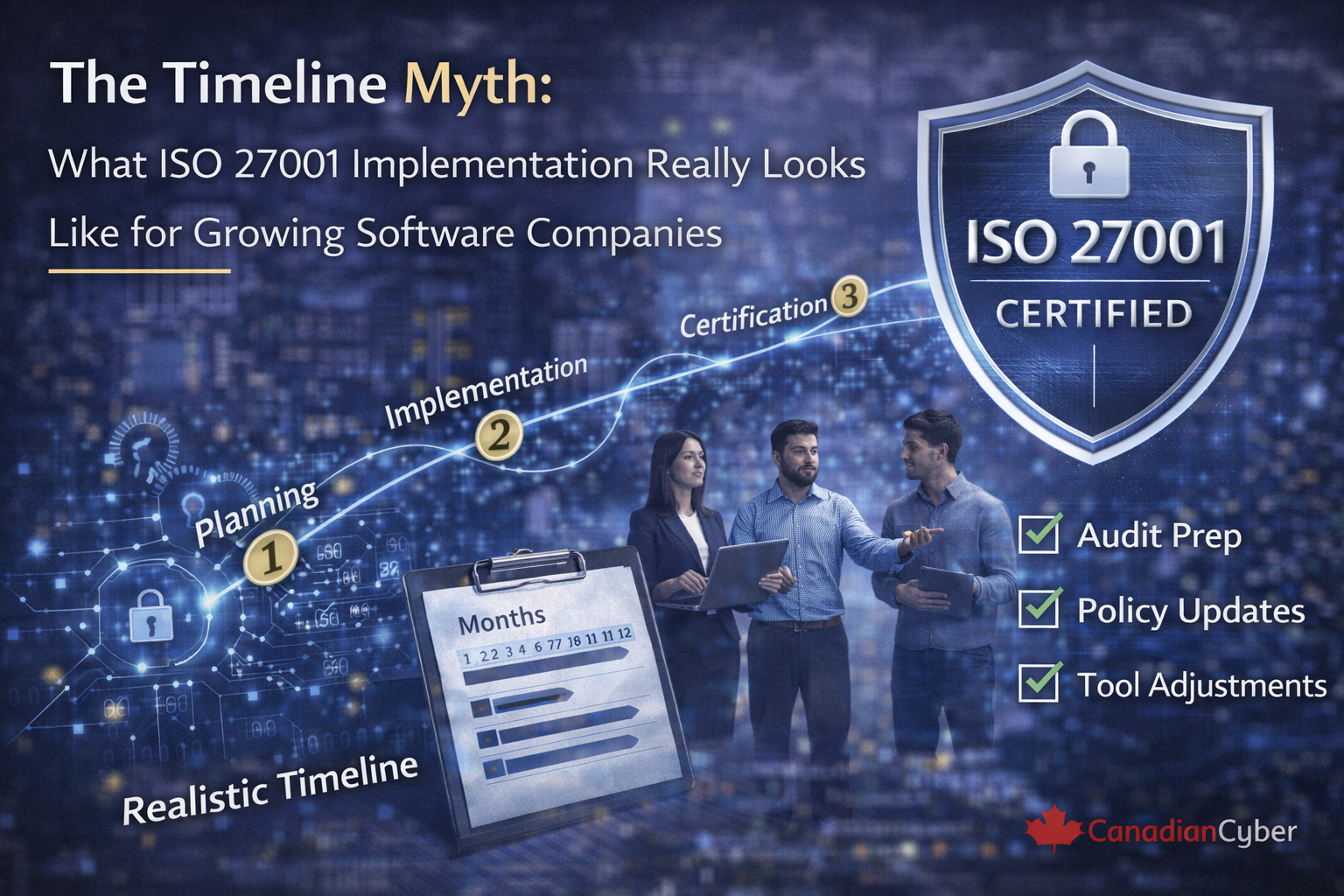
It sounds like a normal planning question. But it usually hides a bigger assumption: that ISO 27001 implementation follows a clean, predictable timeline if the company just works hard enough.
In reality, that is rarely how it goes. For growing software companies, implementation is not delayed because teams are lazy or uncommitted. It gets harder because the business keeps moving while the work is underway.
Products change. Infrastructure evolves. Vendors are added. Teams grow. Customer pressure increases. Internal processes are still maturing while the implementation is trying to formalize them.
That is why the biggest ISO 27001 timeline problem is not usually lack of effort. It is the myth that implementation is a straight line.
Companies ask the timeline question for good reasons. They are trying to plan around customer deadlines, enterprise deals, board expectations, procurement reviews, budget cycles, team capacity, and audit scheduling.
The problem is that many people still imagine ISO 27001 as a neat sequence:
That sequence is technically true. But it leaves out the part that creates most of the delay: the organization has to make the controls real while the business keeps changing around them.
A mature enterprise with stable systems can often move through implementation in a more controlled way. A growing software company usually cannot.
During implementation, the company may also be doing many other things at the same time.
Every one of those changes can affect scope, risk, controls, evidence, or ownership. So the real timeline challenge is not only “how much work is there?” It is also “how much of the environment is still changing while we are trying to formalize it?”
Picture a SaaS company that wants ISO 27001 because larger customers keep asking for stronger security assurance. Leadership sets an ambitious target: certification within a few months.
At the beginning, the plan looks straightforward. The team starts drafting policies, creating a risk register, reviewing access controls, documenting vendors, preparing the Statement of Applicability, and identifying gaps in logging, onboarding, and asset tracking.
Then real life happens.
Now the ISO plan has not exactly failed. But the original timeline assumption no longer matches reality. This is where many companies get discouraged. They think the delay means they are doing something wrong. Often, it means they are experiencing normal implementation reality for a growing software business.
The timeline myth causes problems because it pushes companies toward the wrong definition of progress. Teams start focusing on document count, policy completion, checklist closure, and ambitious audit dates instead of whether the ISMS is actually becoming operational.
That leads to familiar mistakes.
This is how timeline pressure creates weak implementation quality. And weak implementation quality usually causes more delay later.
For growing software companies, implementation usually looks less like a straight line and more like overlapping waves of work.
These phases still matter. But they rarely happen one at a time in perfect order.
Many software companies think scope will be easy. They assume they can simply say “our SaaS platform and internal operations.” But once implementation begins, scope gets more complicated.
Questions appear quickly. Which entities or regions are included? Are contractors in scope? Which cloud environments matter? Are support operations included? What about development and staging systems? Which vendors materially affect the service? Which teams own which controls?
Ownership confusion is one of the biggest hidden timeline drivers. A control may exist technically, but implementation slows down when nobody is clearly responsible for review, evidence, exceptions, maintenance, or improvement.
Once the company starts mapping risks properly, the implementation usually gets more real. Teams discover that asset inventories are incomplete, access reviews are informal, vendor records are inconsistent, backup testing is not documented well, onboarding and offboarding vary by manager, or production and non-production separation is weaker than assumed.
None of this means the company is insecure by default. But it does mean the organization is not as implementation-ready as it first believed. This phase often expands the project because it replaces optimism with visibility.
Software companies often move quickly through policy drafting. That can create false confidence. Policies can be written in days or weeks. Operational discipline takes longer.
A company may write an access control policy, incident response policy, vendor management policy, secure development policy, backup policy, and risk management method. But then the real questions begin.
This is where implementation becomes real. ISO 27001 is not delayed because policy writing is hard. It is delayed because turning policy into repeatable practice takes coordination.
For many growing software companies, this is the phase that reshapes the timeline most. Control cleanup means fixing the operational gaps that the implementation uncovered.
This work is rarely owned by one person. It depends on engineering, IT, HR, operations, security, leadership, procurement, finance, and support teams. That is why the timeline often stretches here. Real control implementation is cross-functional work.
A common timeline myth is that once a control is “implemented,” it is ready for audit. Not necessarily. A control may exist, but evidence may still be weak.
| Control area | Why evidence may still be weak |
|---|---|
| MFA | Enabled, but privileged access review records are missing |
| Vendor management | Reviews happen, but records are incomplete |
| Incident handling | Incidents are handled, but not documented consistently |
| Backups | Configured, but restore testing evidence is missing |
| Training | Delivered, but acknowledgments are scattered |
| Policies | Approved, but review history is inconsistent |
Certification readiness depends not only on control existence, but on control traceability. And traceability takes time to build.
Some teams treat internal audit and management review as late-stage checklist items. That is risky. These steps matter because they test whether the ISMS is functioning as a management system, not just as a project.
A useful internal audit often reveals weak evidence trails, inconsistent ownership, overdue reviews, corrective actions not really closed, policies misaligned with practice, risks not updated after environment changes, and vendor oversight not applied consistently.
Management review matters too because leadership has to engage with risk posture, control health, corrective action trends, resource needs, and improvement priorities. If these steps happen too early, they become superficial. If they happen at the right time, they strengthen audit readiness.
Instead of asking only “How many months does ISO 27001 take?”, software companies get better answers by asking what the timeline depends on.
Those questions produce much better planning decisions than simply asking for a faster date.
For growing software companies, a better mental model is this: ISO 27001 implementation is usually a maturity-building process with milestones, not a one-time sprint to documentation.
That means progress usually looks like this:
This is a healthier way to judge progress because it focuses on whether the ISMS is becoming usable, not just whether the project is moving.
A smarter implementation approach usually breaks the program into three realistic goals.
| Goal | What it focuses on |
|---|---|
| Goal 1: Build the management foundation | scope, risk method, policy framework, ownership, control mapping, basic evidence structure |
| Goal 2: Stabilize key operational controls | access, vendors, incidents, backups, secure development, onboarding and offboarding, logging, corrective actions |
| Goal 3: Prove the system is operating | evidence cadence, internal audit, management review, remediation, certification readiness |
This model helps teams see that certification is the result of operating discipline, not just project closure.
Across growing software companies, the same issues tend to slow ISO 27001 work the most: unclear control ownership, too much change happening in parallel, overestimating how ready the environment already is, rushing policies ahead of process maturity, weak evidence organization, inconsistent support from busy functional teams, underestimating vendor and access cleanup, and treating internal audit as late-stage admin work instead of a readiness test.
These are normal issues. But they need to be planned for honestly.
The biggest ISO 27001 timeline myth is that implementation should move in a straight, predictable line if the team is organized enough. For growing software companies, that is rarely true.
Implementation usually unfolds while the business is still evolving. That means scope shifts, control gaps appear, ownership gets tested, and evidence takes time to mature.
A more realistic view is that ISO 27001 implementation involves clarifying scope and ownership, gaining visibility into real risks and systems, translating policies into working processes, cleaning up controls across teams, building evidence discipline, testing the ISMS through internal review, and only then moving confidently toward certification.
Because in the end, the real goal is not just to hit a date. It is to build a security management system that actually works for a growing software business.