Get in touch
info@canadiancyber.ca


Rafia Rizwan

April 17, 2026
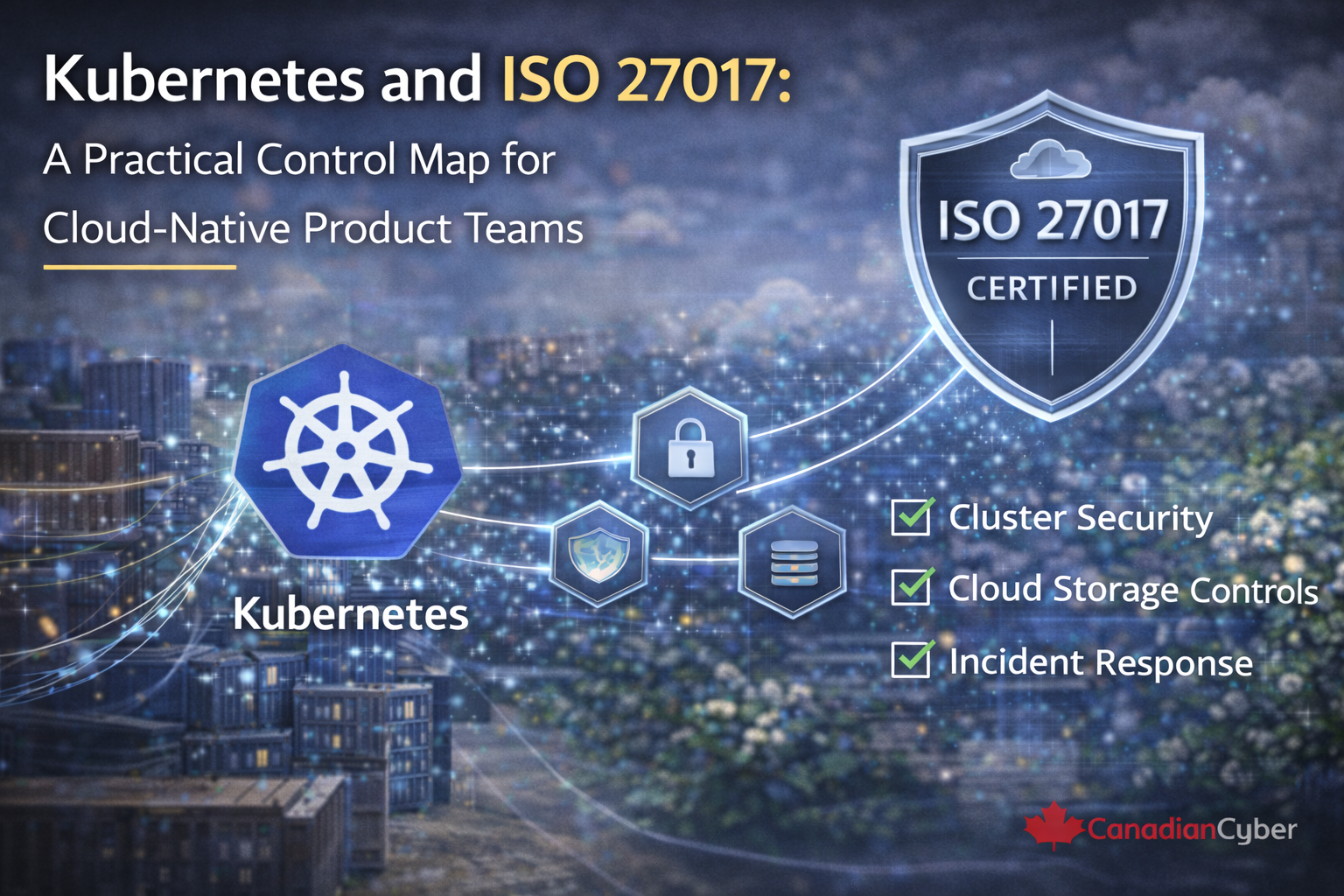
A practical guide to Kubernetes security controls using ISO 27017, helping cloud-native teams build audit-ready access, monitoring, and governance.
Suddenly, your environment includes clusters, namespaces, nodes, workloads, secrets, service accounts, ingress rules, Helm charts, CI/CD pipelines, container registries, cloud IAM roles, and monitoring layers.
That creates a new challenge for cloud-native teams: how do you map all of that to clear, auditable security controls?
This is where ISO 27017 becomes useful. It helps cloud-native teams turn Kubernetes security from a collection of technical settings into a structured control environment.
Traditional infrastructure is easier to picture. There are servers, firewalls, admins, change tickets, backups, and access lists. Kubernetes spreads responsibility across many layers.
Now responsibility may sit with the cloud provider, the managed Kubernetes service, the platform team, app teams, CI/CD owners, security teams, and third-party tool providers.
Without a clean control map, Kubernetes security becomes fragmented. Teams may be doing the right technical work, but still struggle to explain ownership, prove consistency, and show how controls support broader compliance goals.
ISO 27017 is not a Kubernetes standard. It is a cloud security guidance standard. That is exactly what makes it helpful.
Kubernetes does not run in isolation. It sits inside a cloud service model with shared responsibility, infrastructure dependencies, identity layers, managed services, and customer-controlled configurations.
Imagine a SaaS company that has moved most production workloads into Kubernetes. The engineering team has done a lot of smart work. RBAC is enabled. Images live in a private registry. Infrastructure is deployed through IaC. Secrets are managed through cloud tooling. Logs are collected centrally. Ingress is controlled. Namespaces are used to separate workloads.
From a technical point of view, the environment feels mature. Then an internal audit or enterprise review begins, and the questions become more structured.
Now the problem is no longer just “is Kubernetes secure?” The real problem is whether the team can explain and prove its cloud-native controls in a structured way.
A lot of Kubernetes security discussions get stuck at the tooling layer. Teams say they use OPA, network policies, a secrets manager, image scanning, GitOps, or SIEM logging. That is useful, but it is not a control map.
A control map answers better questions: what risk is being addressed, which control exists, who owns it, how it operates, what evidence proves it works, and which layer of the environment it applies to.
For cloud-native teams, a practical ISO 27017 control map usually centers on six areas.
Kubernetes environments get risky very quickly when access is too broad. This often happens through cluster-admin overuse, stale access paths, weak service account design, broad CI/CD permissions, unmanaged kubectl access, or excessive cloud IAM integration.
| Evidence type | What it helps prove |
|---|---|
| RBAC role definitions | Access is intentionally scoped |
| IAM and SSO settings | Strong authentication protects admin paths |
| Access review records | Privileged roles are checked regularly |
| Break-glass procedure | Emergency access is controlled |
Kubernetes makes it easy to run many workloads together. That is one of its strengths. It is also one of its risks. Without clear separation, teams can end up with over-shared namespaces, weak environment boundaries, excessive east-west communication, and too much workload visibility.
Strong separation usually includes clear dev, staging, and prod boundaries, namespace design aligned to teams or trust levels, network policies controlling traffic paths, separate credentials by environment, and tighter production controls for sensitive workloads.
Kubernetes changes constantly. That is normal. But fast-moving changes without control create some of the biggest cloud-native risks: insecure manifests, accidental public exposure, broken ingress rules, image drift, unreviewed Helm values, and inconsistent policy enforcement.
Secrets management is one of the most important practical security topics in Kubernetes, and one of the easiest to get wrong. Sensitive data may show up in Kubernetes secrets, environment variables, Helm values, CI/CD pipelines, config files, service account tokens, logs, and backup snapshots.
A mature secrets model usually uses a centralized secrets manager, avoids plaintext values in repositories, restricts access to secret material, separates secrets by workload and environment, and rotates high-risk credentials on a defined basis.
Kubernetes environments generate a huge amount of activity. That activity is useful only if the right events are visible and reviewed. Teams often collect logs but still struggle with weak audit logging, noisy alerting, unclear ownership of review, and limited visibility into privileged changes.
A strong monitoring model usually includes centralized logging, audit logs for administrative actions, alerts on high-risk configuration or access changes, retention policies for investigation-relevant logs, and defined escalation paths when something important happens.
Kubernetes teams often focus heavily on deployment speed and uptime, but resilience controls need just as much structure. This includes workload recovery, persistent volume backup, restoration testing, rollback capability, multi-zone design, and dependency recovery planning.
A mature resilience model usually includes documented backup strategy, restore testing, highly available architecture where appropriate, rebuild capability through code, and a clear understanding of provider-managed versus customer-managed recovery responsibilities.
| Kubernetes area | Practical control focus | ISO 27017-aligned theme |
|---|---|---|
| RBAC and IAM | Restrict admin and deployment access | Cloud access control |
| Namespaces and network policies | Limit lateral movement and environment overlap | Segregation in shared cloud environments |
| GitOps, IaC, and CI/CD | Review and govern changes | Secure cloud change management |
| Secrets handling | Protect credentials and sensitive values | Sensitive data handling in cloud services |
| Audit logs and alerts | Detect risky admin or workload activity | Monitoring and traceability |
| Backups and recovery | Maintain service resilience | Cloud continuity and recovery governance |
Even strong engineering teams make a few repeat mistakes. Common issues include relying on defaults too long, granting broad admin access for convenience, treating namespaces as if they are full security boundaries, allowing direct production changes outside controlled pipelines, storing secrets in technically workable but weakly governed ways, and assuming the cloud provider covers more than it really does.
These are usually not knowledge failures. They are governance failures. The platform evolves quickly, but the control model does not keep up.
Most internal reviewers, enterprise customers, and auditors are not asking for a deep Kubernetes lecture. They want clear answers to a few important questions.
A practical control map helps answer these questions without forcing product teams to flatten everything into vague policy language.
Many cloud-native teams are already doing a lot of strong Kubernetes security work. The issue is usually not the absence of technical controls. The issue is that those controls are spread across cloud IAM, cluster settings, CI/CD workflows, network design, logging systems, and engineering habits.
Without a control map, the environment can feel secure to operators but still look fragmented to reviewers. ISO 27017 helps connect Kubernetes decisions to broader cloud-security expectations in a way that is practical and explainable.
Kubernetes security is not only about turning on features. It is about building a cloud-native control environment that is access-controlled, segmented, reviewed, monitored, resilient, and clearly owned.
ISO 27017 helps product teams organize that work in a more practical way by connecting Kubernetes operations to real cloud-security governance.
For most teams, the most useful starting points are administrative access, workload separation, change control, secrets handling, monitoring, logging, resilience, and recovery. Because in the end, the goal is not just to make the cluster work. It is to make the platform trustworthy, explainable, and defensible as it scales.